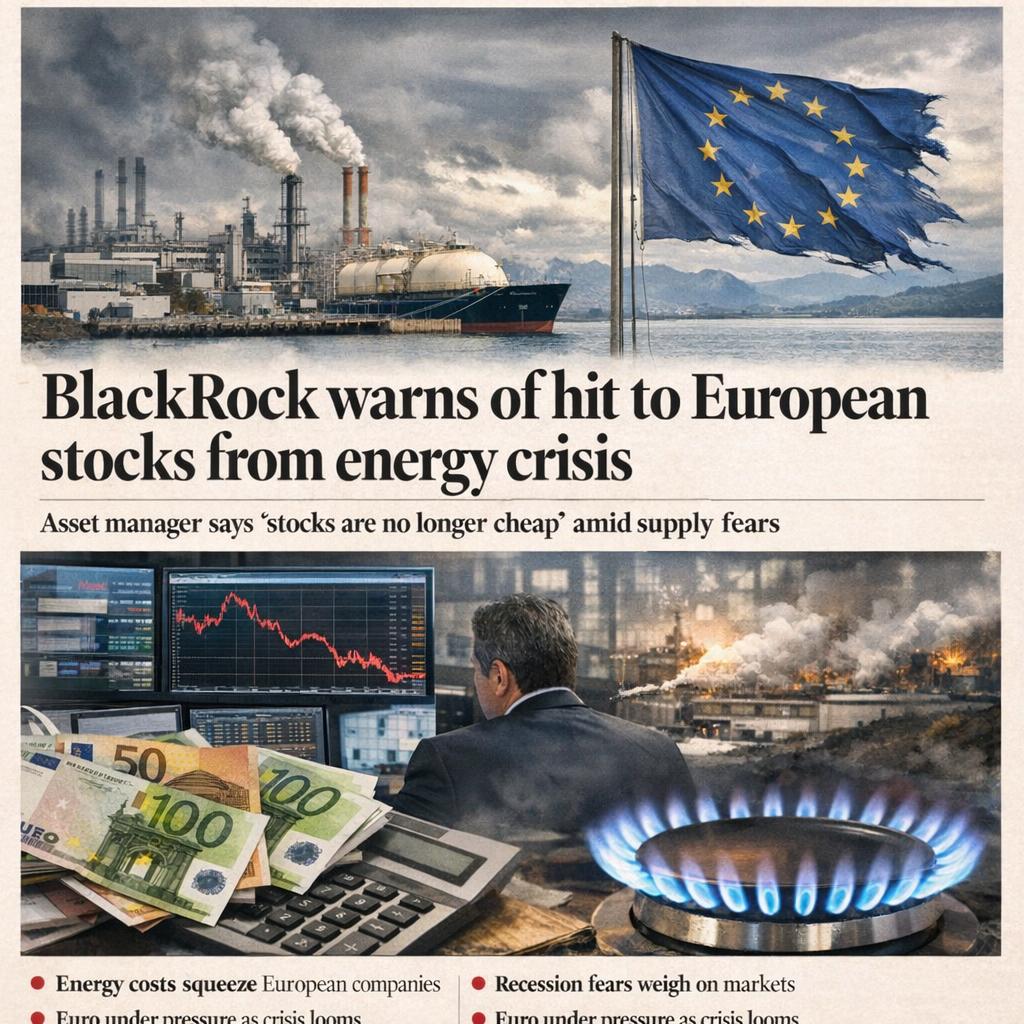
BlackRock’s Warning on Europe Isn’t Just About Stocks — It’s About the Next Phase of the Energy Trade
One of the more telling market signals this week didn’t come from a central bank or a government press conference. It came from the world’s biggest asset manager warning that Europe’s energy situation could start to bite harder — and that European equities are “no longer cheap” after a strong run earlier in the year.
That single shift in tone matters, because it highlights something investors often underestimate: Europe’s equity story can turn quickly when energy stops being a background variable and starts behaving like a constraint.
Why this warning lands differently now
European markets have spent long stretches being valued as a “discount” region: solid multinationals, decent dividends, and cyclical leverage when global growth is stable. When energy is calm, that playbook works. But when energy gets tight or unpredictable, Europe’s advantage can flip into a vulnerability.
An energy-driven hit to European stocks doesn’t always show up as a neat, immediate sell-off. More often, it appears as a slow grind lower in earnings expectations, widening dispersion between winners and losers, and investors demanding a higher risk premium for businesses that can’t pass costs through.
In other words: the market stops paying for hope and starts paying for resilience.
The mechanism: energy risk becomes an earnings risk
When energy prices rise or supplies look fragile, investors don’t just model “higher costs.” They start to reprice four things:
1) Margins
Energy-heavy sectors (chemicals, industrials, materials, utilities depending on regulation) face direct cost pressure. But even asset-light businesses can get squeezed through logistics, suppliers, and consumer demand.
2) Demand
Households under energy stress don’t behave the same way. Discretionary spending softens, and the mix shifts toward staples and value. That hits certain retailers, travel, and consumer cyclicals.
3) Policy and intervention risk
Europe has a habit of responding to energy stress with policy measures that can change the profit pool quickly: subsidies, taxes, price caps, market reforms. Sometimes it helps consumers while compressing corporate returns. That uncertainty alone can drag valuations.
4) Currency and rates spillovers
Energy dependence has implications for trade balances. If the energy import bill rises, it can feed into currency moves and rate expectations, which then loops back into equity multiples.
None of this is theoretical. The past few years trained markets to watch energy not as a “sector story,” but as a macro transmission channel.
“Stocks are no longer cheap” is a valuation message — and a positioning message
When a major allocator says European stocks aren’t cheap anymore, that typically implies two things:
First, the easy money from multiple expansion has likely been made. Going forward, returns need to be earned via real earnings delivery.
Second, the hurdle rate rises for owning broad Europe exposure. Investors become more selective, and the index can suffer even if a handful of high-quality names hold up.
This is where global investors should pay attention. European equities aren’t just held by Europeans. They sit in global funds, pensions, sovereign allocations, and “developed markets ex-US” baskets. So when big firms de-risk Europe, it can affect flows, currency hedging demand, and relative performance across regions.
How investors typically reposition when energy becomes the dominant variable
When the market starts treating energy as a constraint rather than a cost line, three types of trades tend to emerge:
1) Quality and pricing power over pure cyclicals
Companies that can raise prices without destroying demand become the market’s safe harbour.
2) Domestic defensives outperform global industrial sensitivity
Healthcare, staples, and selected telecoms can see a bid while energy-intensive manufacturers lag.
3) Dispersion inside “Europe” increases
Europe stops trading like one block. Countries, sectors, and even individual firms get judged on energy exposure, contract structure, and regulatory risk. Stock picking matters more than regional beta.
It’s also worth noting what doesn’t automatically work: assuming energy producers are a perfect hedge. Depending on policy responses, taxation, and input costs, that hedge can be messy.
The global takeaway: Europe’s energy story is everyone’s story
Even if your portfolio is mostly US equities, Asia, or emerging markets, Europe’s energy stress can transmit globally through:
– Multinational earnings (European demand and supply chains)
– FX volatility (euro moves affect global risk appetite)
– Rates and credit (spread widening can spill into global funding conditions)
– Sector rotations (global investors reweight defensives vs cyclicals)
And at a time when markets are already juggling geopolitical and policy uncertainty, energy becomes one more reason for investors to prefer simplicity, liquidity, and businesses with robust margins.
If you’re watching markets right now, don’t treat this as a niche Europe call. It’s a reminder that valuation is never “cheap” or “expensive” in isolation — it’s cheap or expensive relative to the risks the market hasn’t fully priced in yet.
If you’ve been allocating to Europe this year, I’d be interested to hear how you’re thinking about energy risk: hedge it, avoid it, or lean into the dispersion. Comments welcome.