Oil Just Got a New Risk Premium: What a “Lost Billion Barrels” Means for Global Investors
One of the most important market stories right now isn’t about earnings, AI, or central bank dot plots. It’s about supply—plain, physical supply—and how quickly it can vanish when geopolitics turns hot.
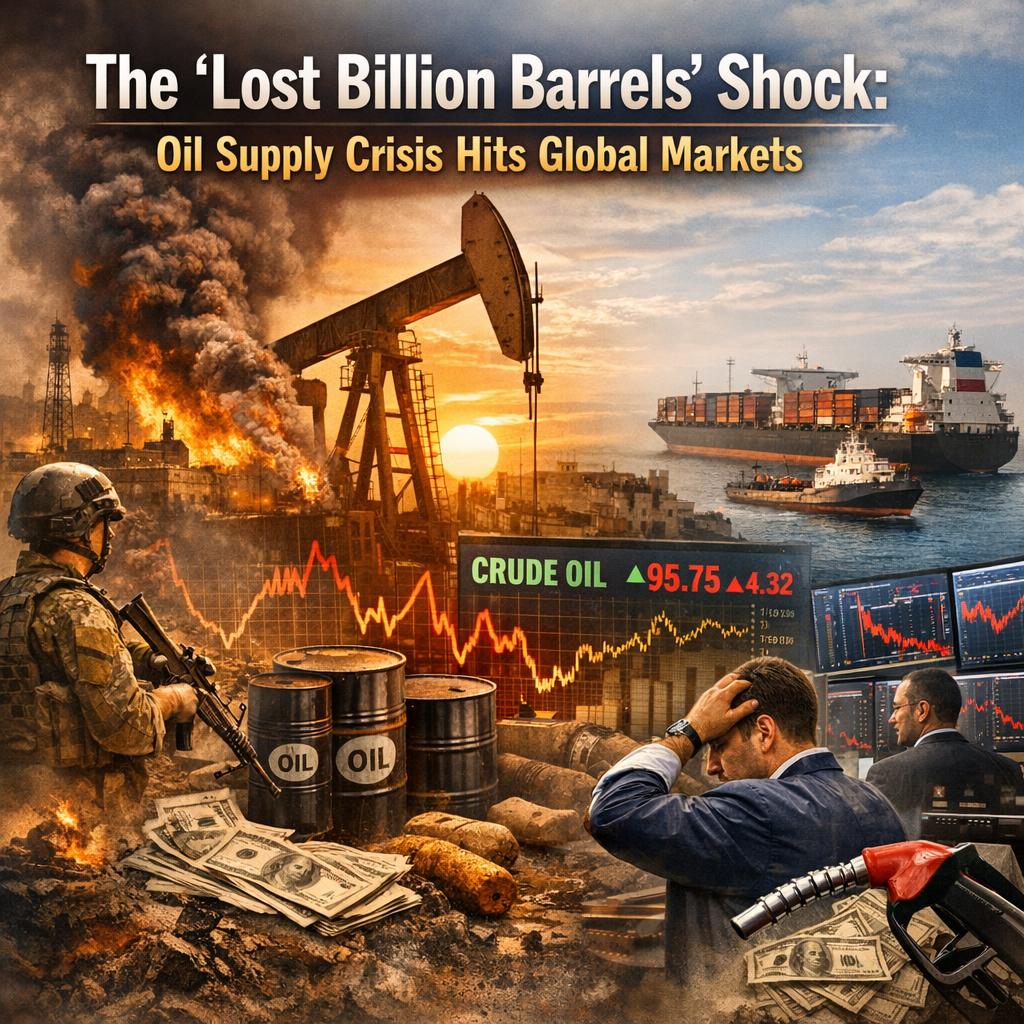
A major energy trader has warned that the oil market has effectively “lost” a billion barrels as a result of the Iran war, with traders describing an unprecedented hit to global energy supplies. That wording matters. Markets can deal with bad news. What they struggle with is a shrinking margin for error.
When spare capacity meets geopolitics
Oil prices are never just a spreadsheet exercise of supply and demand. They’re a confidence trade. When participants believe barrels can move freely, the market tends to price oil with a relatively small “fear component.” But when shipping lanes, infrastructure, insurance costs, and political escalation all start pulling in the same direction, a new premium appears—often suddenly.
A “lost” billion barrels doesn’t necessarily mean production has permanently disappeared. It can mean:
– supply that can’t reach the market reliably
– inventory draws accelerating faster than expected
– higher operational and shipping risks (and costs) that reduce effective supply
– buyers and refiners stockpiling “just in case,” amplifying tightness
In other words: the market becomes more fragile. And fragile markets reprice violently.
Why this matters beyond oil traders
For global investors, energy shocks spill over into almost everything:
1) Inflation expectations can re-ignite
Even if core inflation is cooling, oil has a way of reintroducing itself through transport, plastics, chemicals, agriculture inputs, and logistics. The real danger isn’t just higher petrol prices—it’s the second-order effect on inflation expectations. Once that creeps up, rate-cut optimism can fade quickly.
2) Central bank paths can get messy
A fresh energy-driven inflation impulse complicates the “soft landing” narrative. Policymakers may hesitate to ease if headline inflation stays sticky, even if growth is slowing. That tension can raise volatility across bonds, FX, and equities.
3) Equity leadership can rotate fast
Energy producers and some commodity-linked names often benefit from higher prices, but the broader market impact is more nuanced:
– airlines, transport, and heavy logistics can get squeezed
– consumer-facing businesses can see demand soften if households feel the pinch
– industrials with energy-intensive inputs can face margin pressure
– parts of tech can be affected indirectly if discount rates move higher again
This is why oil spikes often create unusual market tapes: a handful of sectors rally while the index struggles, and correlations start behaving badly.
4) Credit spreads can widen in unexpected places
Energy price shocks can pressure highly leveraged companies that rely on cheap transport or thin margins. At the same time, they can improve cash flow for parts of the energy complex. The result is a more bifurcated credit market—winners and losers separating quickly.
5) Emerging markets feel it in the currency first
Oil importers can see trade balances worsen and currencies weaken, especially if global rates remain high. Oil exporters can benefit, but only if domestic politics and fiscal management are stable. In risk-off moments, investors often treat EM as one big bucket before they start differentiating—so even “beneficiaries” can get volatility.
What I’m watching next
If you’re managing a portfolio (or even just trying to understand the daily noise), the key is to watch for signals that this is becoming a sustained regime shift rather than a headline spike:
– inventory trends and the pace of draws
– freight and insurance costs for key routes (often an early warning indicator)
– implied volatility in oil options (fear gauge for energy)
– inflation breakevens and real yields (macro transmission mechanism)
– equity factor performance (value vs growth, defensives vs cyclicals)
– FX moves in oil-sensitive currencies (both importers and exporters)
If oil is repricing because the market believes supply disruption risk is structural—not temporary—then a lot of “comfortable” positioning across global portfolios may need to adjust.
The bottom line
When the oil market loses effective supply at scale, investors aren’t just pricing barrels—they’re pricing uncertainty. That uncertainty doesn’t stay neatly inside the energy sector. It bleeds into inflation, rates, growth expectations, and ultimately valuations across asset classes.
If you’re positioning for the next quarter, it’s worth treating oil not as a standalone commodity chart, but as a macro lever that can reshape the entire risk landscape.
If you’re watching this story too, share what you think the market is underpricing right now: inflation risk, recession risk, or geopolitical escalation risk.