The Strait of Hormuz Risk Is Back — and Investors Can’t Treat It Like a Headline
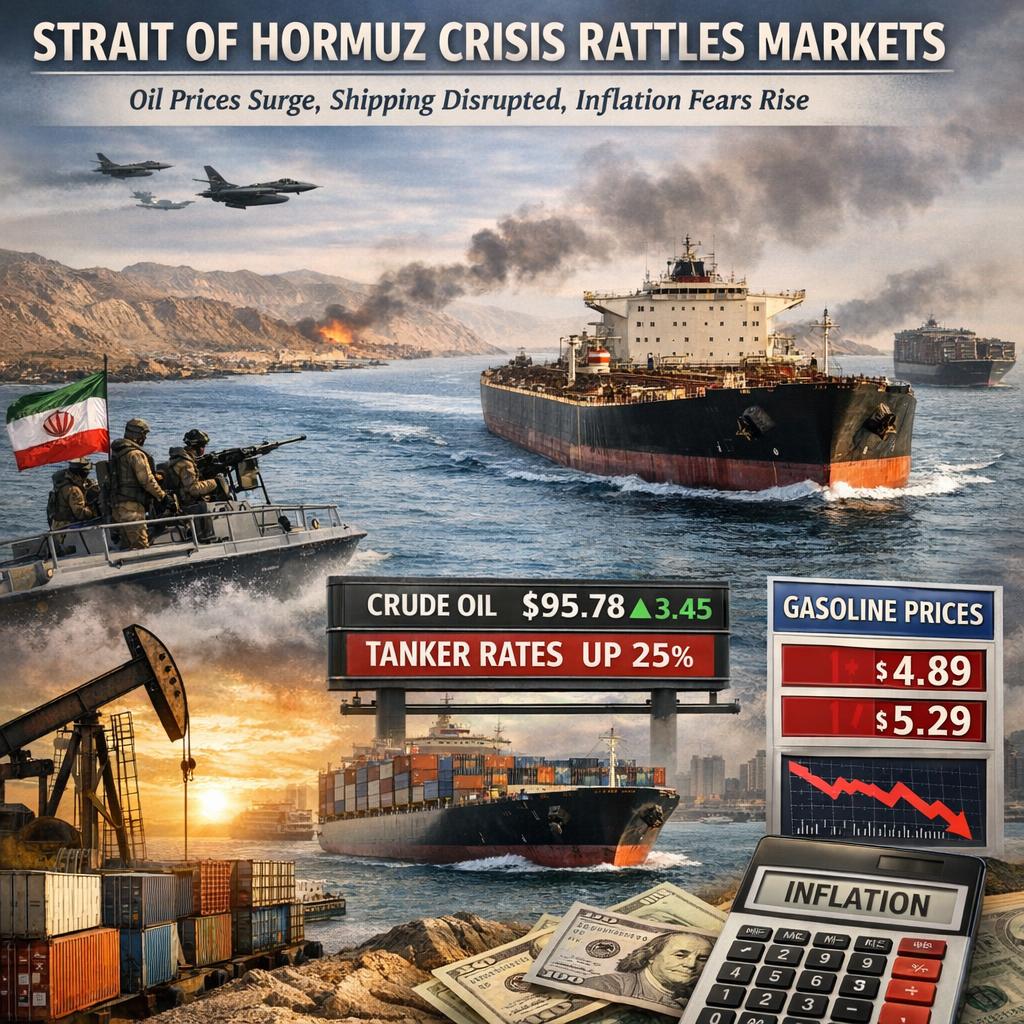
One story that’s quietly doing a lot of heavy lifting in markets right now is Iran’s claim that it has “strict control” of the Strait of Hormuz and that the route will not be fully reopened.
If you’re an investor, that sentence should immediately translate into two words: pricing power.
Not for companies, but for the energy complex, for shipping, and ultimately for inflation itself.
Why Hormuz matters more than almost any other chokepoint
The Strait of Hormuz isn’t just a geopolitical flashpoint; it’s an infrastructure asset the global economy relies on every single day. When the market starts to believe that transit could be restricted, delayed, rerouted, or intermittently disrupted, the reaction is rarely limited to oil futures.
It spills into:
1) Energy prices (crude, refined products, LNG linkages in some regions)
2) Freight and insurance (war-risk premiums, tanker rates, shipping availability)
3) Inflation expectations (especially in import-dependent economies)
4) Central bank reaction functions (rates staying higher for longer, or cuts being delayed)
5) Risk appetite (equities, high yield credit, EM assets, and FX all reprice)
This is why a “shipping lane” story can end up moving everything from airline stocks to bond yields.
The first-order market move: oil is the messenger
Energy markets are usually the fastest to react because they’re the most directly exposed. Even if physical supply isn’t immediately curtailed, the risk premium can widen fast. Traders don’t wait for the barrel not to arrive; they price the probability that it might not, or that it will arrive later and cost more.
That’s a big difference.
When the premium rises, it becomes a kind of tax on the global economy:
– Consumers feel it at the pump and in energy bills
– Businesses see it in transportation, packaging, inputs, and logistics
– Governments feel it in subsidies, fiscal strain, and higher funding costs
The second-order move: inflation gets “stickier” again
This is where the investment implications become more global.
If energy-driven inflation comes back while parts of the world are already navigating tariff effects, supply chain adjustments, and uneven growth, the risk is not just “higher prices.” It’s that inflation becomes more persistent.
And persistent inflation changes portfolios.
Because central banks don’t respond to oil prices in isolation; they respond to what oil does to expectations, wages, and broader pricing behaviour. If the market starts to believe this isn’t a one-week spike but a multi-month regime, you can see:
– Rate-cut timelines pushed out
– Front-end bond yields rising
– Curves behaving oddly (growth fear vs inflation fear wrestling)
– Equity multiples compressing, especially for long-duration growth names
In other words: it doesn’t need to become a full-blown energy crisis to tighten financial conditions.
Who’s most exposed (and it’s not just “oil importers”)
In a scenario where Hormuz remains constrained or intermittently disrupted, the obvious winners/losers show up quickly, but the second layer matters more.
Potential beneficiaries:
– Upstream energy producers with non-Hormuz exposure (or diversified export routes)
– Select oilfield services if higher prices translate into capex (not guaranteed)
– Defence and security-linked segments (often, but valuations can overshoot quickly)
– Some commodity-linked currencies in the short term
Potential pressure points:
– Airlines, shipping-dependent retailers, and logistics-heavy business models
– Chemical and industrial names sensitive to feedstock costs
– Countries with large current account deficits and heavy energy imports
– Emerging markets where food and fuel inflation can destabilise policy and politics
– Consumer discretionary, where households have less margin for higher essentials
The key is that this risk hits both the top line (demand) and the cost line (inputs). That’s when earnings forecasts start to wobble.
The portfolio takeaway: think in scenarios, not predictions
Investors don’t need to “predict” the Strait of Hormuz to manage the risk. They need to scenario-plan it.
A practical way to frame it:
Scenario A: Risk fades quickly
– Oil gives back the premium
– Rate cuts come back into focus
– Risk assets stabilise
Scenario B: On/off disruption (the most market-annoying scenario)
– Rolling volatility in energy
– Choppy equities
– Central banks stay cautious
– Quality balance sheets and pricing power matter more than thematic stories
Scenario C: Sustained disruption
– Inflation shock + growth drag (stagflation-lite)
– Higher-for-longer rates becomes entrenched
– Credit spreads can widen meaningfully
– EM stress increases, especially for importers
In Scenarios B and C, diversification stops being a slogan and starts being your only free lunch: real assets exposure, thoughtful duration management in bonds, and avoiding portfolios that are accidentally one-way bets on disinflation returning.
One more point investors sometimes miss: this is also a liquidity story
When geopolitical risk spikes, liquidity can disappear exactly where you’d like it most. Spreads widen, “safe” trades get crowded, and correlations jump. That’s why position sizing and time horizon matter as much as the thesis.
Even if you’re right on fundamentals, you can be wrong on the path.
Where I land on this
The Strait of Hormuz story is not just about barrels of oil. It’s about whether the world is re-entering a period where geopolitics sets the marginal price of inflation, and inflation sets the marginal price of capital.
If that’s the regime, investors globally need to recalibrate what “normal” looks like: not permanent crisis, but persistent risk premia.
If you’re positioning around this, share how you’re thinking about it—especially whether you’re treating it as a short-term volatility event or a longer inflation-and-rates problem.