Oil, shipping lanes, and the “second-order” risks investors keep underestimating
If you’ve been reading me for a while, you’ll know I’m not obsessed with predicting the next headline. I’m more interested in what the headline does to the plumbing underneath the market: pricing, credit, currencies, supply chains, and sentiment. That’s where portfolios quietly get reshaped.
Right now, the market’s attention is being pulled toward one central pressure point: energy security. Not as an abstract macro theme, but as a very real logistics question with an immediate price tag.
The Strait of Hormuz isn’t a “far away” story
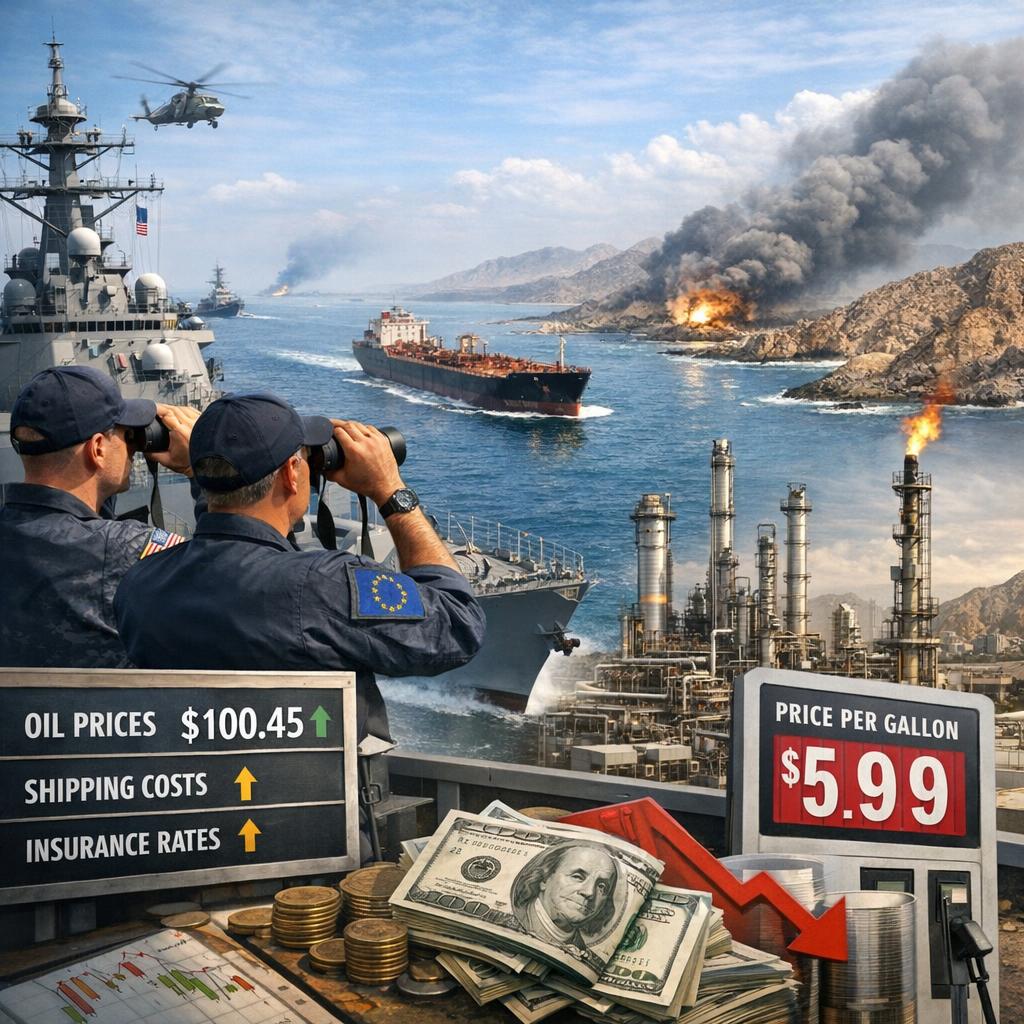
When you see reports about ministers discussing naval options for the Strait of Hormuz, or briefings on how mines could tighten a chokehold in the Gulf, it can read like geopolitical noise. But for investors, that narrow strip of water is one of the most important pieces of financial infrastructure on earth.
Why? Because it’s not just about oil prices moving up or down. It’s about whether energy flows can be relied upon, insured, shipped, and financed at normal terms.
The moment reliability becomes uncertain, the cost of moving energy rises even before a single barrel is lost. That cost shows up in:
1) Insurance and freight rates
2) Refining margins and regional fuel shortages
3) Corporate input costs (transport, plastics, chemicals, airlines, logistics)
4) Consumer inflation expectations
5) Central bank reaction functions
This is why a disruption can hurt even countries that produce plenty of their own energy. The price is set globally; the stress is transmitted locally.
The $100 oil scenario is less about “who wins” and more about who breaks
One of the more striking angles in the coverage is the idea of a potential windfall for US oil producers if crude averages around $100. That part is straightforward: higher realized prices can mean higher cash flows, stronger balance sheets, more buybacks, and better credit metrics for producers.
But zoom out: $100 oil is not just a gift to one sector. It’s a tax on everything else.
And markets don’t treat “higher oil” as a single trade. They treat it as a change in the whole economic mix:
– Growth tends to slow as consumers spend more on fuel and less on everything else.
– Inflation tends to re-accelerate in ways that are hard to dismiss as “transitory.”
– Rate cuts get delayed, or the path becomes less certain, even if growth weakens.
– Credit spreads can widen as profit margins compress for energy-intensive businesses.
So yes, some producers may benefit. But the broader question for global investors is whether higher energy becomes the catalyst that turns a fragile slowdown into something more persistent.
The risk people miss: volatility itself becomes a product
Another detail worth paying attention to: retail traders rushing into oil bets as price swings turn crude into a “meme moment.”
That’s not a moral judgment; it’s a market structure point.
When a highly consequential input (oil) becomes heavily traded through fast flows, leveraged products, and momentum-driven positioning, you don’t just get higher prices. You get sharper intraday moves, more gap risk, and more stop-driven behaviour. That feeds back into risk models, margin requirements, and forced de-risking in unrelated assets.
In plain terms: oil volatility can leak into equities, credit, and FX even if those assets have no direct link to the conflict. This is why correlations suddenly jump during stress. It’s not always fundamentals; it’s positioning and risk control.
Europe’s dilemma: energy, security, and policy credibility
Europe is in an awkward spot in moments like this. There are obvious security concerns, but there’s also a policy credibility question: how do you talk about inflation coming down and easing financial conditions while facing renewed energy shock risk? Add in the ongoing debates around Russian energy flows and the political messaging becomes even tighter.
For investors holding European assets, the key is not just “is Europe exposed?” but “how does Europe respond?”
– If energy costs rise and inflation expectations lift, bond markets can reprice quickly.
– If policymakers lean toward supporting growth at any cost, the currency can become the release valve.
– If policymakers lean toward inflation-fighting at any cost, the economy can take the hit.
That push-pull matters for everything from European banks to industrials to consumer names. It also shapes where global capital feels “comfortable” parking.
So what does a long-term investor actually do with this?
I’ll keep this practical and consistent with how I’ve always framed it: you don’t need to trade every event. You do need to ensure your portfolio can survive a regime where energy shocks are not rare.
A few questions I think are worth asking (not as advice, but as portfolio hygiene):
1) If oil stays elevated longer than expected, which holdings quietly suffer margin compression?
2) Where are you assuming rate cuts that may now be delayed or become more volatile?
3) Are you overexposed to one region’s policy response (either fiscal or monetary)?
4) Do you have genuine diversification, or just several versions of the same risk (growth + cheap money)?
5) Are you relying on liquidity that disappears in risk-off moments?
The uncomfortable truth is that markets can handle “bad news” better than they can handle “uncertain delivery systems.” When shipping lanes, insurance, and supply chains are the variables, forecasts become squishier and risk premia rise.
The takeaway I’m sitting with this week
This isn’t just another oil spike story. It’s a reminder that geopolitics doesn’t need to “go nuclear” to be market-moving. It just needs to make a critical corridor unreliable.
And once reliability is questioned, investors start demanding to be paid for risk again. That’s the real shift: not prices, but the price of risk.
If you want, reply and tell me what you’re most exposed to right now (energy-sensitive equities, EM FX, long duration tech, credit, etc.). I’ll share how I’d think about the main vulnerabilities and the simplest ways people typically reduce them without overtrading.