Foreign Central Banks Selling US Treasuries Isn’t Just a Headline — It’s a Stress Test for Global Portfolios
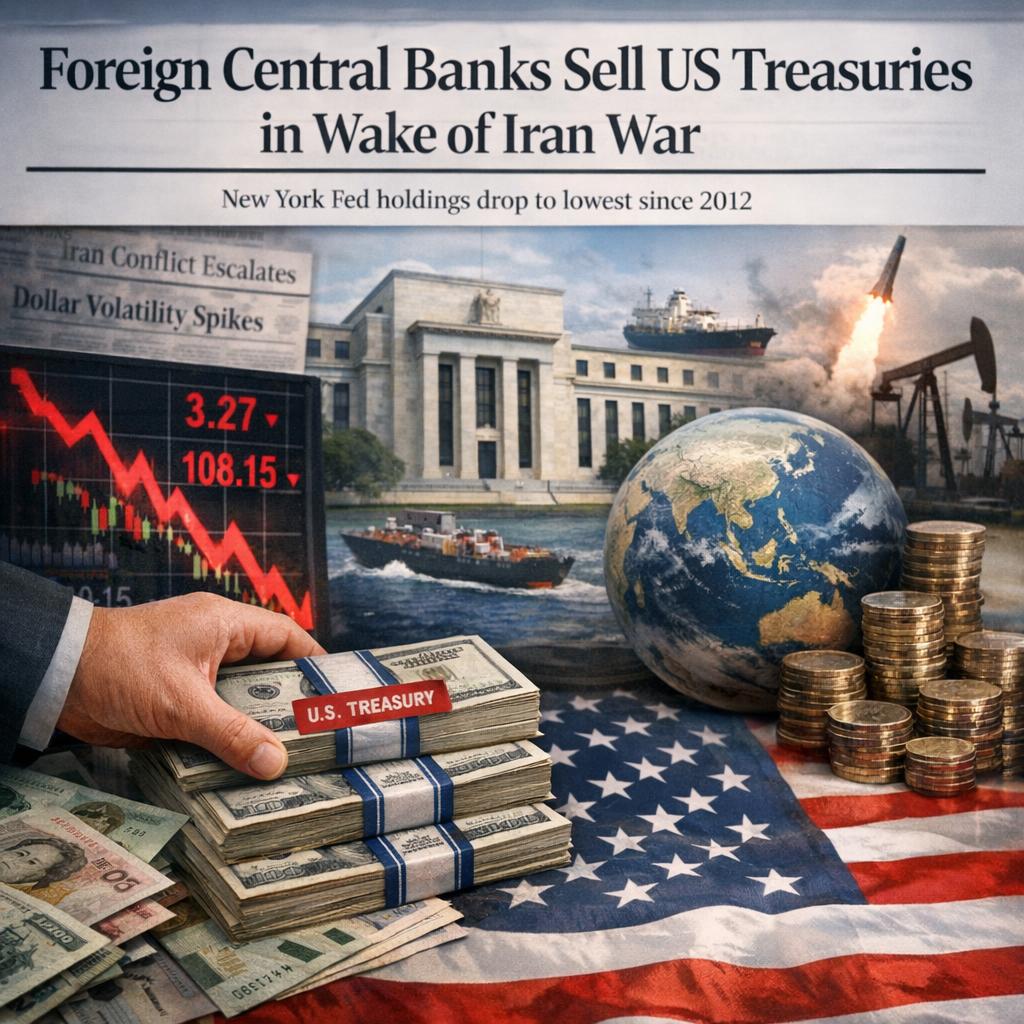
One of the more quietly consequential market stories right now is that foreign central banks have been reducing their US Treasury holdings in the wake of the Iran war, with official holdings at the New York Fed reportedly falling to their lowest level since 2012.
This matters because Treasuries aren’t just “another asset class”. They sit at the centre of global finance: the benchmark for risk-free pricing, the core collateral in funding markets, and the anchor reference for everything from mortgage rates to emerging market borrowing costs. When official institutions start stepping back, even modestly, investors should read it less like a single trade and more like a signal that the plumbing is under strain.
Why would central banks sell Treasuries?
There are a few non-dramatic reasons and a few more structural ones — and they can overlap.
1) Liquidity needs and defence
In periods of conflict-driven volatility, some central banks lean on reserves to stabilise their own currencies, fund essential imports (often energy), or cushion domestic financial systems. In that context, selling Treasuries is less a “vote against America” and more a practical decision: Treasuries are among the most liquid instruments on earth.
2) FX management in a choppy dollar environment
War risk, oil moves, and rate expectations can push the dollar around quickly. If a local currency comes under pressure, the central bank may intervene, and intervention typically means converting reserve assets into cash.
3) A slow diversification trend becoming more visible
Over the past decade, many reserve managers have been gradually diversifying across currencies, gold, shorter-duration instruments, and alternative liquidity buffers. A geopolitical shock can accelerate behaviour that was already underway.
Why investors globally should care
Because the marginal buyer of long-dated US government debt sets the tone for global rates.
If official foreign demand softens, the market needs someone else to step in at the same price. If that demand isn’t there, yields can rise until buyers emerge. And higher US yields don’t stay neatly contained inside the US.
Here’s how this can transmit across portfolios:
1) Higher “risk-free” yields can reprice everything
Equities, credit, real estate, and infrastructure all ultimately compete with the risk-free rate. A sustained rise in Treasury yields can compress valuations, tighten financial conditions, and change what “fair value” looks like across markets.
2) Stronger funding stress shows up in the dollar system
Treasuries function as top-tier collateral. When volatility rises and collateral dynamics shift, funding markets can tighten. That tends to reward liquidity and punish leverage — not just for banks, but also for hedge funds, private credit vehicles, and any strategy dependent on cheap financing.
3) Emerging markets feel it first, and sometimes hardest
For EM sovereigns and corporates, the combination of higher US yields and a firmer dollar can be toxic: refinancing costs rise, capital becomes more selective, and local currencies can weaken further. Even investors who don’t “own EM” can feel this through risk sentiment and credit spreads.
4) Duration stops being background risk and becomes front-page risk
Many portfolios have lived through years where duration risk was either a diversifier (when growth scares hit) or manageable. But when the marginal buyer of duration becomes less reliable, long-end volatility can rise. That has implications for pensions, insurers, and anyone using long bonds as a stabiliser.
What I’m watching next
– Are these sales temporary (liquidity-driven) or persistent (allocation-driven)?
– Is the selling concentrated in bills/notes, or is duration being cut at the long end?
– Do we see a knock-on effect in auction demand, bid-to-cover ratios, and term premia?
– Does this coincide with wider stress indicators: cross-currency basis swaps, repo specialness, and credit spread behaviour?
Portfolio implications (without pretending there’s a single “right trade”)
This is the kind of environment where investors tend to rediscover old virtues: liquidity, balance-sheet strength, and clarity on what risks they’re being paid to take.
It can also be a moment to be brutally honest about hidden duration exposure. It’s not just in government bonds; it’s in long-growth equities, in leveraged credit, in private assets marked with a lag, and in any business model that relies on refinancing staying easy.
If you’re tracking this story too, comment with what you think is driving the move most: war-driven liquidity needs, FX defence, or a more structural shift in reserve management.