Oil Back Above $100: The Strait of Hormuz Shock That Investors Can’t Ignore
When markets reprice energy in a hurry, it’s rarely just an “oil story”. It’s a liquidity story, an inflation story, a currency story, and—very quickly—a risk appetite story.
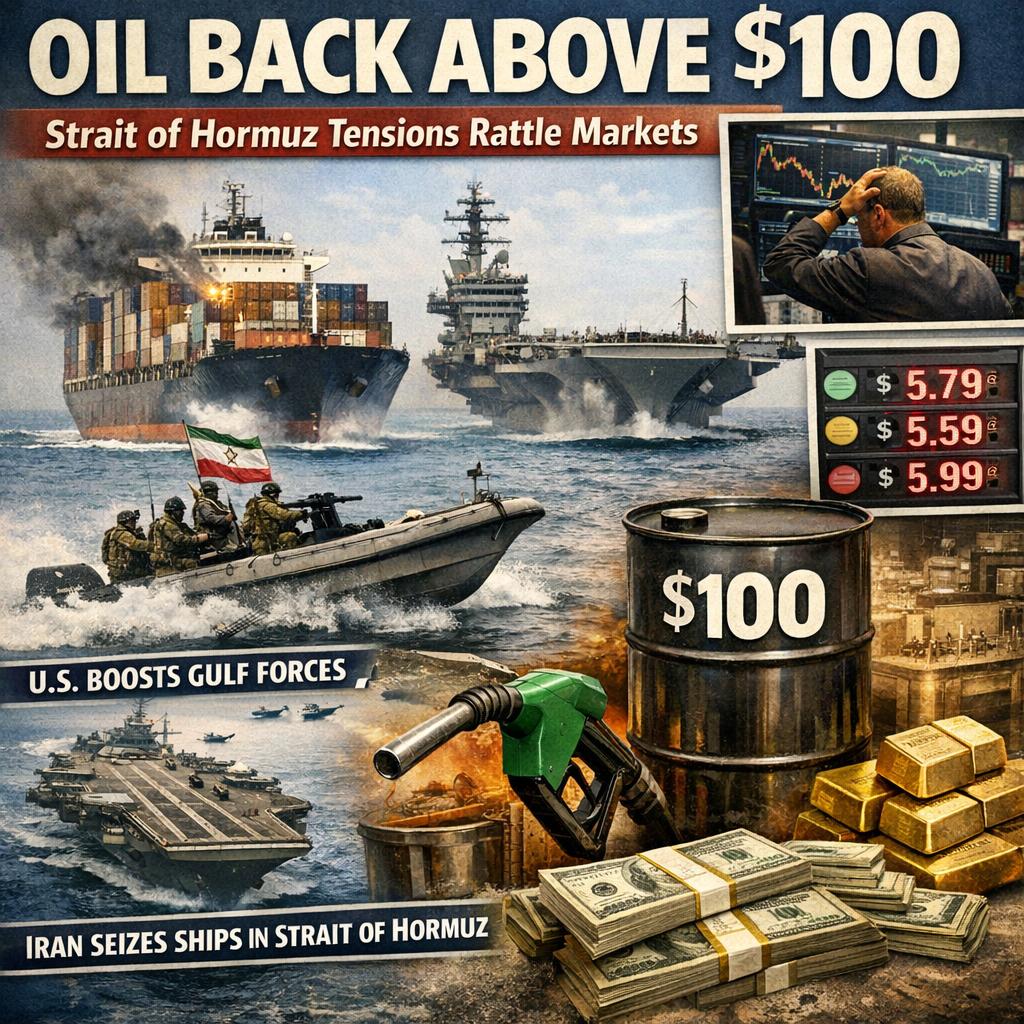
That’s why the reported seizure of two container ships in the Strait of Hormuz matters well beyond the shipping lanes. This is one of the world’s most strategically sensitive chokepoints, and even a limited incident can create a disproportionate reaction across portfolios because it attacks the market’s comfort zone: the assumption that energy flows will remain uninterrupted.
Why the move above $100 matters (even if it doesn’t last)
Oil at or above $100 is more than a headline number. It’s a psychological level that changes behaviour:
1) It raises the “risk premium” embedded in prices
Traders don’t just price today’s supply and demand—they price the probability of disruption tomorrow. When tensions rise near critical routes, the insurance cost on cargo, freight rates, and the value of optionality all increase. That premium can persist even if physical supply hasn’t yet been materially reduced.
2) It complicates the inflation narrative
Energy is one of the fastest channels from geopolitics to consumer prices. Even if core inflation is easing, oil spikes can feed through to transport, manufacturing inputs, and eventually food. For investors, the key isn’t only CPI prints—it’s what central banks will feel pressured to say and do.
3) It tightens financial conditions without a single rate hike
Higher oil acts like a tax on consumers and many businesses. In markets, that often shows up as weaker growth expectations, wider credit spreads, and a rotation toward defensives.
The global investor ripple effects
Equities: winners, losers, and the valuation reset
Energy producers and oil services names typically benefit first—cash flows get marked up immediately. But the broader equity market often struggles if investors begin to price slower growth and stickier inflation. Rate-sensitive sectors can take a double hit: higher input costs plus the possibility that yields stay higher for longer.
Credit: watch spreads, not just headlines
In risk-off moments, credit markets often provide a cleaner signal than equity indices. If oil strength is paired with widening spreads, that’s the market quietly saying, “This could spill into growth and defaults.” If spreads stay contained, investors may be treating it as a tradable shock rather than a regime shift.
FX: the dollar’s role can be counterintuitive
Geopolitical stress often pushes investors toward the US dollar, but the currency reaction depends on what’s dominant: safe-haven demand, interest-rate expectations, or the market’s view of conflict duration. Oil-importing economies can see their currencies come under pressure as their trade balance outlook worsens, while some commodity-linked currencies may find support—unless global risk aversion overwhelms everything.
Rates: inflation risk vs growth fear
A sharp oil move can pull yields in opposite directions. Inflation risk can push yields up; growth fear can pull them down via a bid for duration. The “winner” tends to be whichever narrative central banks are most likely to emphasise in the near term.
Commodities beyond oil: the second-order trade
If shipping risk rises, it can start to affect industrial metals, fertilisers, and agricultural supply chains through freight costs and delivery uncertainty. Investors focused only on crude may miss how quickly correlation can spread across real assets.
What to watch next (the signals that separate noise from a new regime)
1) Shipping and insurance pricing
Freight rates, war-risk insurance, and reported rerouting behaviour can tell you whether the market believes disruption risk is persistent.
2) The forward curve in oil
Spot spikes are emotional. The curve tells you whether the market is repricing the medium-term balance. Backwardation steepening can signal tighter perceived supply; a muted curve response can suggest “headline premium” more than true scarcity.
3) Energy-sensitive inflation expectations
Keep an eye on breakevens and survey-based inflation expectations. If they start to move alongside oil, central banks may have less room to pivot dovishly.
4) Credit spreads and funding markets
If the shock is turning systemic, it tends to show up here sooner than in confident equity narratives.
Portfolio implications without the drama
This kind of episode is a reminder that diversification isn’t just about owning many assets—it’s about owning exposures that behave differently when the world gets messy. Investors who are overly concentrated in one growth narrative often discover that geopolitics doesn’t care about their thesis.
It’s also a reminder that “risk management” can be as simple as knowing what you own and why: which holdings benefit from higher energy prices, which ones are vulnerable to margin pressure, and which ones are implicitly short volatility.
If you’re tracking markets this week, share what you’re watching most closely—oil’s next move, credit spreads, or the currency reactions.