Oil’s $126 Spike Wasn’t Just a Commodity Story — It Was a Stress Test for Every Portfolio
A lot of investors treat oil like a separate universe: a chart you watch if you trade commodities, or a headline you skim before you get back to equities, rates, and earnings.
That mindset is a mistake.
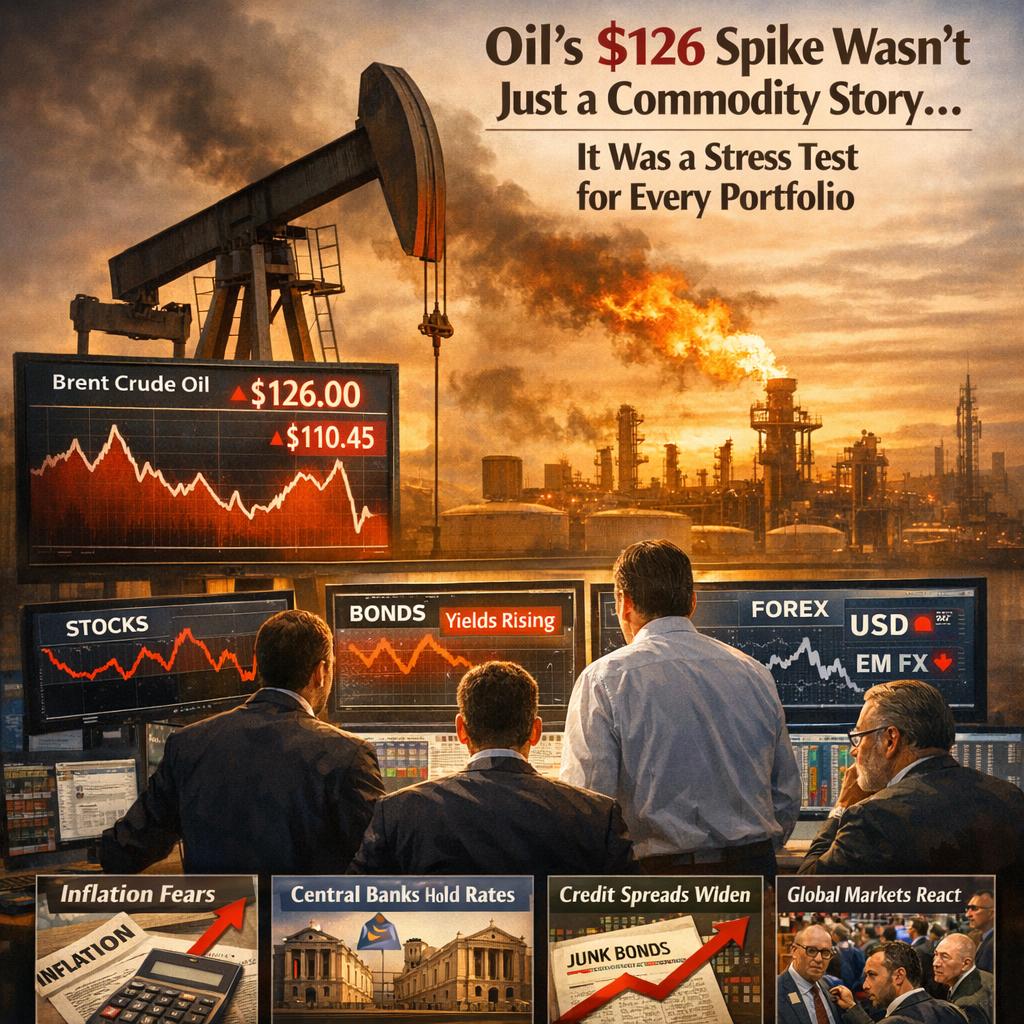
This week’s price action — with Brent surging to around $126 on supply fears linked to the Strait of Hormuz, then falling back in wildly volatile trading — is a reminder that oil isn’t a “sector.” It’s a transmission mechanism. When it moves violently, it pushes and pulls on inflation expectations, central bank reaction functions, currency markets, credit spreads, and equity leadership all at once.
And the bigger point is this: even when oil retraces, the shock doesn’t simply disappear. It often lingers in positioning, in risk premia, and in how policymakers interpret the next few data prints.
Why this kind of oil spike matters more than the level
Markets can handle “high oil” if it’s stable and gradual. What they struggle with is speed and uncertainty.
A sudden surge tied to geopolitical choke points changes how investors price the distribution of outcomes. It’s not just “oil up.” It’s:
1) The probability of supply disruption rises
2) The volatility of that probability rises
3) Hedging costs rise across multiple asset classes
4) Correlations tighten at the worst possible time
That’s when you start seeing awkward cross-asset moves: bonds selling off while equities wobble, energy stocks rallying while consumer names lag, and emerging market FX getting hit even if local fundamentals haven’t changed.
Inflation expectations: the first domino
Oil is one of the quickest ways to reprice inflation expectations because it touches transport, manufacturing inputs, and consumer sentiment in a very visible way.
Even if headline inflation doesn’t jump immediately, the market starts asking:
– Will companies push through cost increases?
– Will wage demands re-accelerate as households feel the pinch?
– Will central banks worry about “second-round effects”?
That’s where the real impact shows up for global investors: the entire path of interest rates can shift on the back of energy-driven inflation risk, especially when the shock is tied to geopolitics and therefore hard to forecast.
Central banks: “We’re data-dependent” meets “We can’t ignore oil”
When oil is calm, central banks can credibly focus on core inflation, labour markets, and growth. When oil is violent, they have to consider credibility and expectations management.
Even if policymakers don’t hike because of oil alone, they can become slower to cut, quicker to warn, and more sensitive to any upside surprise in prices. In practice, that can mean:
– Higher-for-longer pricing gets stickier in the front end of the curve
– Rate-cut optimism gets pushed out
– Bond term premia creep up because uncertainty is rising
For investors, that’s not a theory. It’s duration risk repricing in real time.
Equities: leadership shifts, not just index direction
A sharp oil move rarely hits “the market” evenly. It reshuffles winners and losers.
Typical pressure points:
– Consumer discretionary and travel tend to hate energy shocks
– Industrials can suffer if input costs squeeze margins
– High-multiple growth can struggle if rates reprice upward
– Energy and some defense-related names can attract flows, but with higher headline risk
The subtle point: even if the index looks resilient, the internal market can deteriorate. Breadth narrows. Volatility rises. Stock-picking gets harder because macro starts overpowering fundamentals.
Credit: the quiet casualty
Credit often reacts after equities, but it reacts meaningfully.
If oil volatility signals a broader geopolitical escalation risk, investors start demanding more compensation for holding corporate risk. That shows up as:
– Wider spreads, especially in lower-quality credit
– More expensive refinancing conditions
– Less appetite for cyclical issuers with thin margins
There’s also a second-order effect: if growth slows because consumers pull back, default risk rises at the margin. You don’t need a recession for credit to get uncomfortable — you just need uncertainty plus tighter financial conditions.
FX and emerging markets: where the oil shock gets amplified
Oil shocks are not neutral globally.
– Net importers (many parts of Europe and Asia) face a terms-of-trade hit: more money flowing out to pay for energy.
– Net exporters can benefit, but only if their domestic politics and fiscal frameworks don’t scare capital away.
– Many emerging markets get squeezed via stronger “safe haven” flows into USD, higher funding costs, and weaker local currencies.
That’s why these episodes often look like a “global liquidity” event, not just an energy story.
Positioning and volatility: the aftershock that sticks around
Even when oil falls back from the highs, markets don’t simply reset. Traders and asset allocators adjust risk:
– Hedging demand rises (options get bid)
– Value-at-Risk constraints tighten (risk budgets shrink)
– Leverage gets reduced (especially in fast-money strategies)
– Correlations change (diversification feels less reliable)
That’s how a commodity headline turns into a broader risk-off tone, even without a fresh escalation.
What I’m watching next
If you’re tracking how this filters into global portfolios, the key isn’t just the oil price. It’s the second-order indicators:
– Inflation breakevens and forward inflation expectations
– The front-end rate path (how quickly cuts get priced out)
– Credit spreads (especially high yield and cyclicals)
– Equity market breadth and defensives vs cyclicals
– USD strength and EM FX stress
Those will tell you whether this was a sharp scare that fades, or the beginning of a higher-volatility regime where energy becomes a recurring macro catalyst.
If you’re investing through this, I’d love to hear how you’re thinking about energy risk right now — as a temporary headline, or as something you’re explicitly building into your allocation and hedges. Comment with what you’re watching.