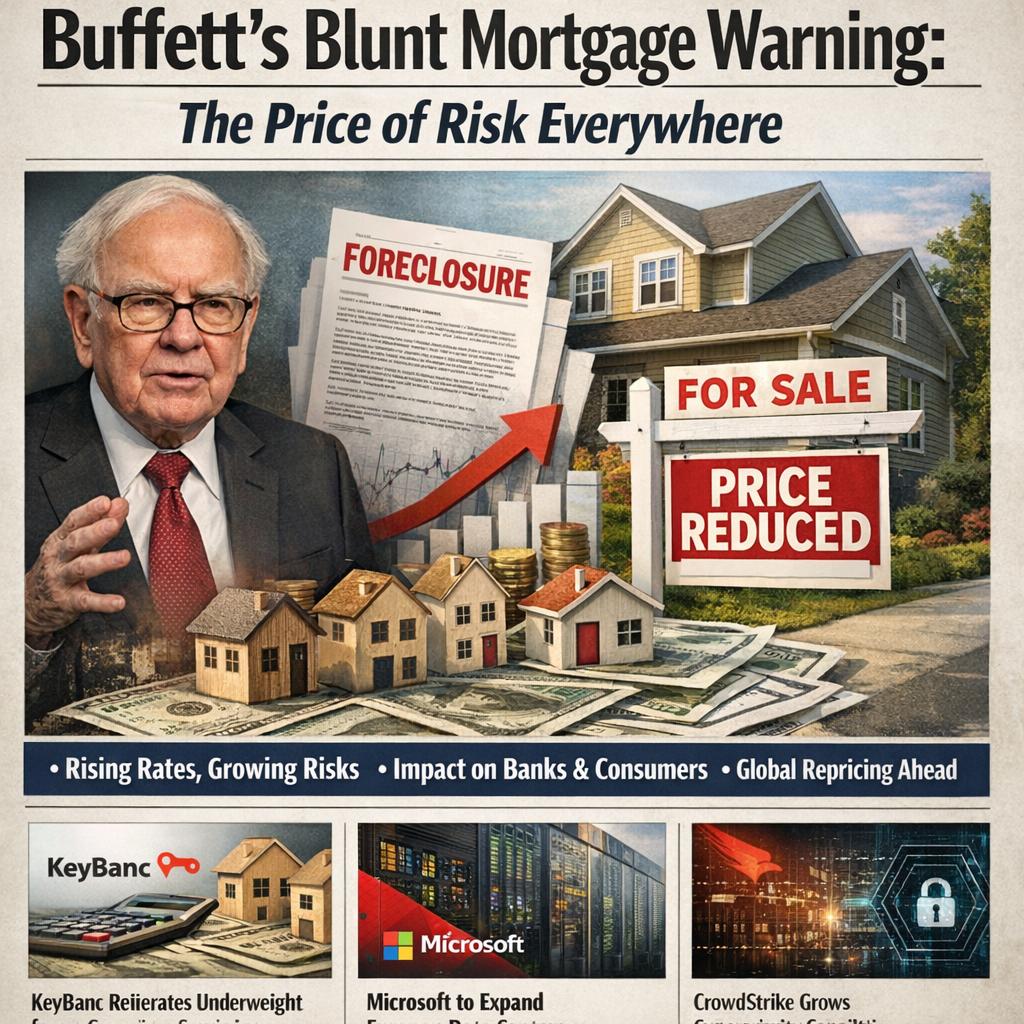
Buffett’s Blunt Mortgage Message Isn’t Just About Housing — It’s About Risk Pricing Everywhere
One of the most useful market signals this week didn’t come from a CPI print or a central bank speech. It came from Warren Buffett weighing in on mortgages and home financing.
When Buffett gets direct about debt, it’s rarely “just” personal finance advice. It’s usually a reminder of how quickly optimism can turn into fragility when people (and institutions) treat cheap or available credit as if it’s permanent.
And right now, that matters for investors globally.
The real takeaway: housing is where the cost of money becomes emotional
Housing is a financial asset class with a built-in psychological amplifier. People don’t just buy homes based on spreadsheets; they buy based on life plans, family needs, and fear of being priced out. That makes the mortgage market one of the clearest places to see how higher rates and tighter lending standards ripple through a real economy.
Buffett’s bluntness lands because it cuts through the narratives that often show up late in the cycle:
– “Rates will fall soon, so stretch now.”
– “You can always refinance later.”
– “Prices only go up in the long run.”
Those lines aren’t analysis; they’re coping mechanisms. When a legendary long-term investor stresses caution around financing, it’s a reminder that the margin for error is smaller than many people want to believe.
Why investors should care (even if they don’t own property)
Most global portfolios have more housing exposure than they realize, even without owning a single home.
1) Banks and lenders
Mortgages sit at the heart of consumer credit. If affordability deteriorates, loan growth slows, credit quality becomes a bigger conversation, and deposit/wholesale funding dynamics start to matter more. For equity investors, that’s not simply “are banks cheap?” It becomes “are banks being paid enough for the risks the market is about to reprice?”
2) Consumer spending and the “wealth effect”
When housing is strong, homeowners feel richer, borrow more confidently, and spend more freely. When housing is strained, consumers don’t just buy fewer houses — they buy fewer everything. That hits retailers, discretionary brands, travel, home improvement, furniture, and autos. Globally, the same pattern shows up with different accents depending on local mortgage structures (fixed vs variable rate, recourse vs non-recourse, refinancing culture, etc.).
3) Construction, materials, and employment
Housing is also jobs. When transaction volumes slow and new builds pause, that filters into employment and wage growth in ways that eventually show up in earnings expectations far outside “real estate” tickers.
4) The bond market’s quiet influence on equity valuations
Mortgage rates are downstream of sovereign yields and credit spreads. If the market decides the “right” price of risk is higher for longer, it’s not just homeowners who feel it. Equities feel it through discount rates, financing costs, and the viability of debt-funded growth strategies.
The global angle: different countries, same pressure point
The mortgage story travels because it sits on top of a universal equation: income vs shelter costs vs the price of credit.
In countries where variable rates dominate, households feel the squeeze faster. In markets with long fixed-rate terms, the pain can be delayed but becomes visible in frozen transaction volumes, locked-in homeowners, and weaker mobility. Either way, affordability acts like a governor on growth.
For investors allocating across regions, this is where macro stops being abstract:
– If housing and credit are tightening, you generally want higher quality balance sheets.
– You want cash flow that doesn’t rely on constant refinancing.
– You want businesses that can hold pricing power without leaning on consumers taking on more debt.
What I’m watching next
If Buffett’s message keeps echoing, the next market chapter isn’t necessarily a dramatic crash narrative. It’s more likely a slow repricing narrative:
– Lower transaction volumes becoming “the new normal” for a while
– Credit standards quietly doing more tightening than rate hikes
– Earnings expectations for consumer-linked sectors drifting down
– Investors rediscovering that leverage is only “efficient” when conditions stay friendly
In other words: less adrenaline, more gravity.
If you’re positioning a portfolio right now, it may be worth treating housing not as a separate corner of the market, but as a stress test for the entire risk ecosystem — from banks to consumer demand to the valuation multiples investors are willing to pay.
If you’ve been watching the housing/credit picture in your region, share what you’re seeing on the ground in the comments.