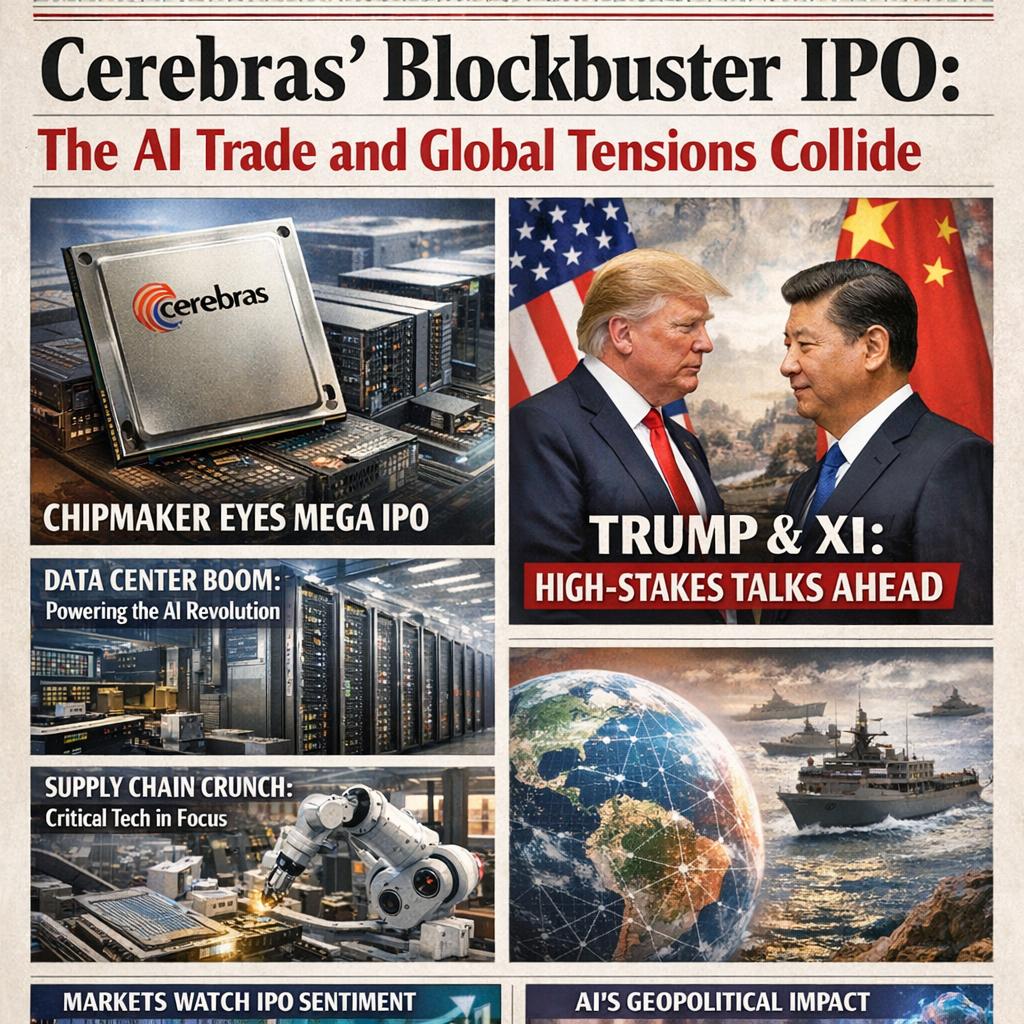
Cerebras’ IPO Buzz Is More Than a Tech Story — It’s a Macro Signal for Global Investors
One of the most telling stories in markets right now isn’t just “another AI company going public.” It’s the reported push toward a blockbuster IPO from Cerebras, a chipmaker built around training massive AI models, landing at the same moment AI is showing up in top-level geopolitics ahead of a Trump–Xi meeting.
That combination matters. Because it highlights two forces that global investors can’t ignore in 2026: the cost of AI is becoming a capital markets story, and the direction of AI is becoming a statecraft story.
1) The AI trade is shifting from “software dreams” to “infrastructure math”
For the past couple of years, AI excitement has often been priced like a concept: user growth, model capability, narrative momentum. But the real bottleneck has been physical.
AI at scale is constrained by:
– Compute (chips)
– Power (electricity, grid capacity)
– Data centers (land, cooling, networking)
– Supply chains (advanced packaging, memory, manufacturing capacity)
A chipmaker IPO is a reminder that AI isn’t just a feature in an app—it’s an industrial buildout. And when a market gets excited about an infrastructure supplier, it’s often a signal that investors believe the spending cycle has legs.
For investors globally, the implication is simple: AI returns won’t only accrue to the most visible consumer brands. They’ll be distributed across a stack of suppliers, enablers, and “picks-and-shovels” businesses—many of which sit outside the mega-cap names that dominate index performance.
2) IPO windows are a sentiment indicator (and they can change risk appetite fast)
IPO activity is one of the cleanest “risk-on vs risk-off” gauges. Companies don’t rush to list when buyers are cautious; banks don’t underwrite big offerings when the bid is thin.
If the market is truly preparing to absorb a large, high-profile AI hardware IPO, it suggests:
– Liquidity conditions are supportive (or at least improving)
– Institutional investors are willing to underwrite growth narratives again
– Public market buyers are open to longer-duration cash flow stories
That matters for portfolios far beyond US tech. When the IPO window opens for exciting growth stories, it often lifts correlated areas: semis, cloud infrastructure, data center REITs, power/utilities tied to demand growth, and even industrial automation. It can also pull capital away from defensives and “cash-flow now” trades, at least temporarily.
If you’re investing globally, keep an eye on how this affects factor leadership: growth vs value, quality vs momentum, large caps vs the rest. Big IPOs can become a gravity well for capital.
3) AI as a geopolitical agenda item changes the risk model
The second half of the story—AI in focus for a Trump–Xi meeting—is the part that’s easy to underestimate. When political leaders elevate a technology to the diplomatic agenda, markets should translate that as: “policy risk is now a core input to valuations.”
That can show up through:
– Export controls and licensing rules
– Restrictions on advanced chips and manufacturing equipment
– Retaliatory measures affecting supply chains
– Pressure on cross-border listings, capital flows, and corporate partnerships
This creates a strange dynamic for investors:
– On one hand, AI is a growth engine.
– On the other, it’s increasingly a strategic asset treated like energy, defense, or critical infrastructure.
So the valuation question becomes not just “how fast will AI grow?” but “how much of that growth is politically frictionless?”
For global investors, the practical takeaway is to widen the lens beyond the company:
– Where are its fabs, suppliers, and customers?
– How concentrated is it in one regulatory regime?
– How exposed is it to one cross-border chokepoint?
4) What I’m watching as an investor (without trying to overtrade it)
I’m less interested in the day-one IPO pop and more interested in what follows in the weeks after:
– Does the deal price with discipline, or with euphoria?
– Do other AI-adjacent names accelerate their listing plans?
– Do public comps re-rate higher, or does supply of new paper cap the upside?
– Do policy headlines start to widen dispersion inside tech (winners vs restricted names)?
In other words, the bigger signal isn’t the IPO itself—it’s whether it reopens a broader “funding flywheel” for AI infrastructure, and whether geopolitics starts to impose a clearer ceiling on certain parts of the stack.
Because if both are true at once, we get a market that’s simultaneously optimistic about AI growth and more selective about where that growth is investable.
If you’re tracking the AI trade, I’d be interested to hear where you think the best risk-adjusted exposure is right now: the chip layer, the compute/data center layer, or the application layer. Comment with your view.