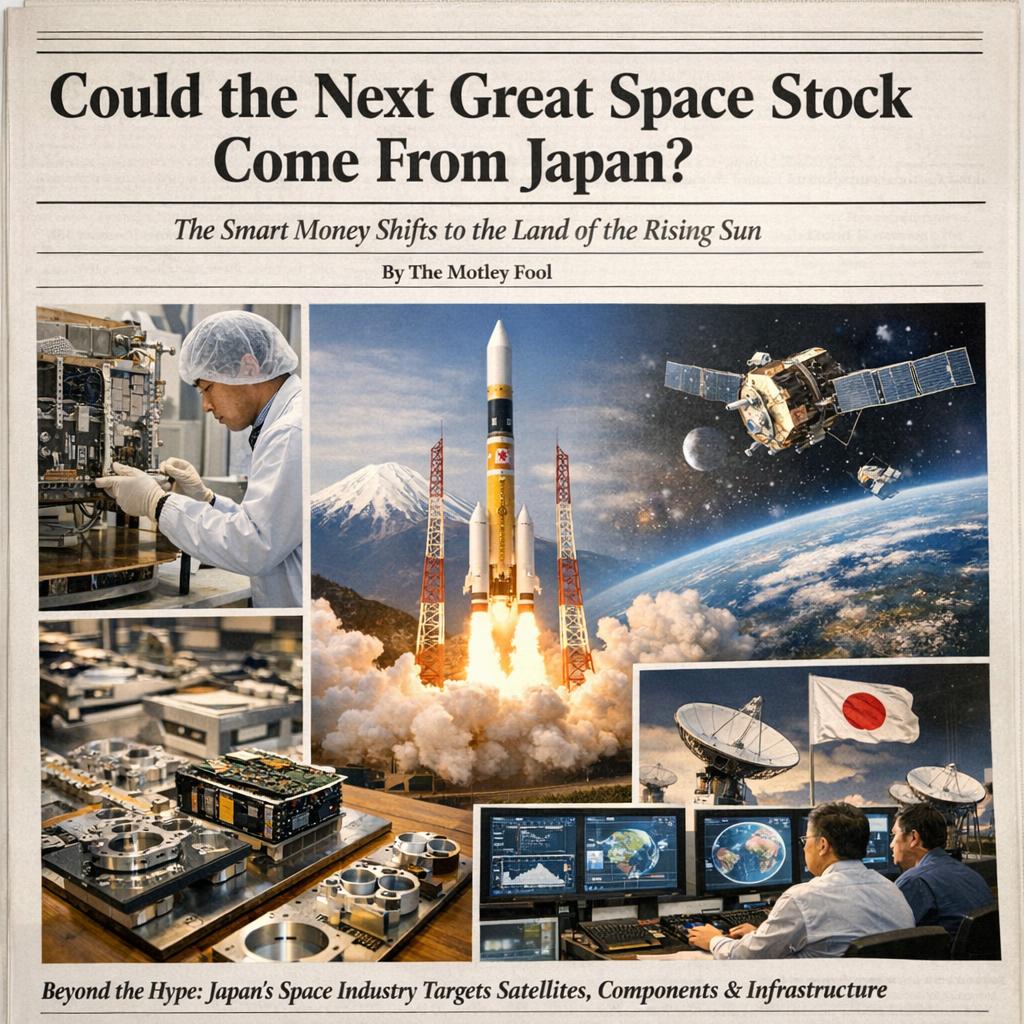
Could the Next Great Space Stock Come From Japan? The Quiet Shift Investors Shouldn’t Ignore
Every few years, “space” comes back into markets as a narrative. The first wave tends to be hype-driven: flashy rockets, bold timelines, big promises. The second wave is usually where the real money gets made—when the conversation shifts from spectacle to supply chains, contracts, launch cadence, satellite economics, and the less glamorous (but far more bankable) infrastructure that makes everything work.
That’s why the idea that the next standout space equity could come from Japan is more than a cute headline. It’s a sign that the space investment story is widening beyond the usual U.S.-centric shortlist—and that global investors may need to update their mental map of where aerospace innovation (and shareholder value) is most likely to show up next.
The “space trade” is maturing—and Japan fits the new phase
Early public-market space investing often revolved around a simple bet: “more launches = more growth.” But as the industry matures, the market increasingly rewards companies that can answer three questions clearly:
1) What part of the space economy do you own?
Launch is only one layer. The bigger opportunity set includes satellite manufacturing, components, Earth observation, communications, ground stations, space-grade semiconductors, navigation, and defense-linked applications. Many of the strongest businesses won’t look like “space companies” in the branding sense—they’ll look like industrials and advanced manufacturers with unusually high barriers to entry.
2) Who pays you, and how predictable is that cash flow?
Markets have learned (sometimes the hard way) that “total addressable market” is not a substitute for contracted revenue. The most investable businesses are tied to multi-year procurement cycles, recurring service agreements, or mission-critical components that customers can’t easily swap out.
3) Can you scale without constantly tapping capital markets?
Space is capital-intensive. Investors have become less patient with repeated dilution and optimistic forward guidance that depends on perfect execution. The companies that win investor trust tend to pair technical credibility with financial discipline.
Japan’s edge is that it already has a deep bench in the “mature phase” categories: precision manufacturing, materials science, sensors, optics, robotics, high-reliability components, and a culture of incremental engineering improvements that compound over time. Those traits aren’t always exciting on social media, but they’re exactly what long-term investors end up valuing once the sector stops being a novelty.
Why this matters for investors outside Japan
This isn’t just a “buy Japan” story. It’s a portfolio construction story.
For years, global exposure to space themes has been heavily concentrated in U.S. names—often clustered in a handful of high-beta, sentiment-driven stocks. That concentration creates two problems:
– Correlation risk: when U.S. growth sentiment turns, the whole basket can move together, regardless of individual fundamentals.
– Narrative risk: if one high-profile company disappoints, it can compress multiples across the sector.
A credible space contender emerging from Japan hints at something healthier: a broader, more diversified ecosystem where returns can come from multiple geographies and multiple business models. For global investors, that can mean better risk-adjusted exposure—especially if the company is positioned in “picks and shovels” segments rather than the most capital-hungry parts of the value chain.
The yen factor and valuation optics
There’s also a macro layer here that investors should not overlook: currency.
When you buy international equities, you’re not only underwriting the business—you’re taking a view (whether you mean to or not) on FX. A Japanese space-related stock that sells globally may benefit from currency dynamics in ways a domestic-only business doesn’t. Meanwhile, overseas investors might find the valuation framework in Japan—often more conservative in certain sectors—offers a different entry point than similarly positioned U.S. peers.
But the key is to be honest about what’s driving the return:
– Is it operational improvement and earnings growth?
– Is it multiple expansion as the market “discovers” the story?
– Or is it a currency tailwind?
If you can’t articulate that, you’re not investing—you’re sightseeing.
The geopolitical premium: space is no longer “optional”
Space has moved from a commercial novelty to a strategic domain. Communications resilience, Earth observation, navigation, and defense applications now sit uncomfortably close to national security priorities. That changes the demand profile.
In practical market terms, it means certain space capabilities are likely to attract longer-duration funding, deeper government-private partnerships, and procurement-backed revenue streams. It also means export controls, alliance politics, and security vetting increasingly matter to valuations.
Japan’s role in the broader geopolitical alignment of advanced economies may make select firms more relevant in allied supply chains—particularly in areas where redundancy and trusted manufacturing are prized. For investors, that can translate into a “geopolitical premium” attached to reliability and strategic importance, not just growth projections.
What to watch if you’re evaluating a potential Japanese space winner
If you’re looking at any space-related name—Japanese or otherwise—these are the fundamentals that tend to separate durable compounders from exciting stories:
– Contract quality: multi-year agreements, renewal rates, customer concentration.
– Unit economics: gross margins, throughput, and evidence that scaling improves profitability.
– Balance sheet resilience: cash runway, debt profile, and capex plans that don’t rely on constant fundraising.
– Competitive moat: certifications, IP, manufacturing tolerances, flight heritage, switching costs.
– Execution cadence: not announcements, but deliverables—on-time milestones, stable guidance, repeat customers.
– Where it sits in the value chain: components and services often have cleaner economics than moonshot business models.
And importantly: watch how management speaks. The best teams in technical industries tend to communicate in specifics—failure modes, production constraints, timelines with buffers—not in slogans.
The broader takeaway
The most interesting signal in this story is not “Japan might have a great space stock.” It’s that the global space economy is entering a phase where the winners may look less like science fiction and more like disciplined industrial champions—quietly embedded in the systems the modern world is starting to depend on.
If you’ve been watching space from the sidelines because the usual names feel overhyped, this could be the start of a more investable era: broader geography, more realistic business models, and a clearer path from innovation to cash flow.
If you’re building long-term exposure to the space theme, are you focusing more on launch and headline-grabbing platforms, or on the infrastructure layer (components, data, ground systems) that could quietly compound for years? Share your angle in the comments.