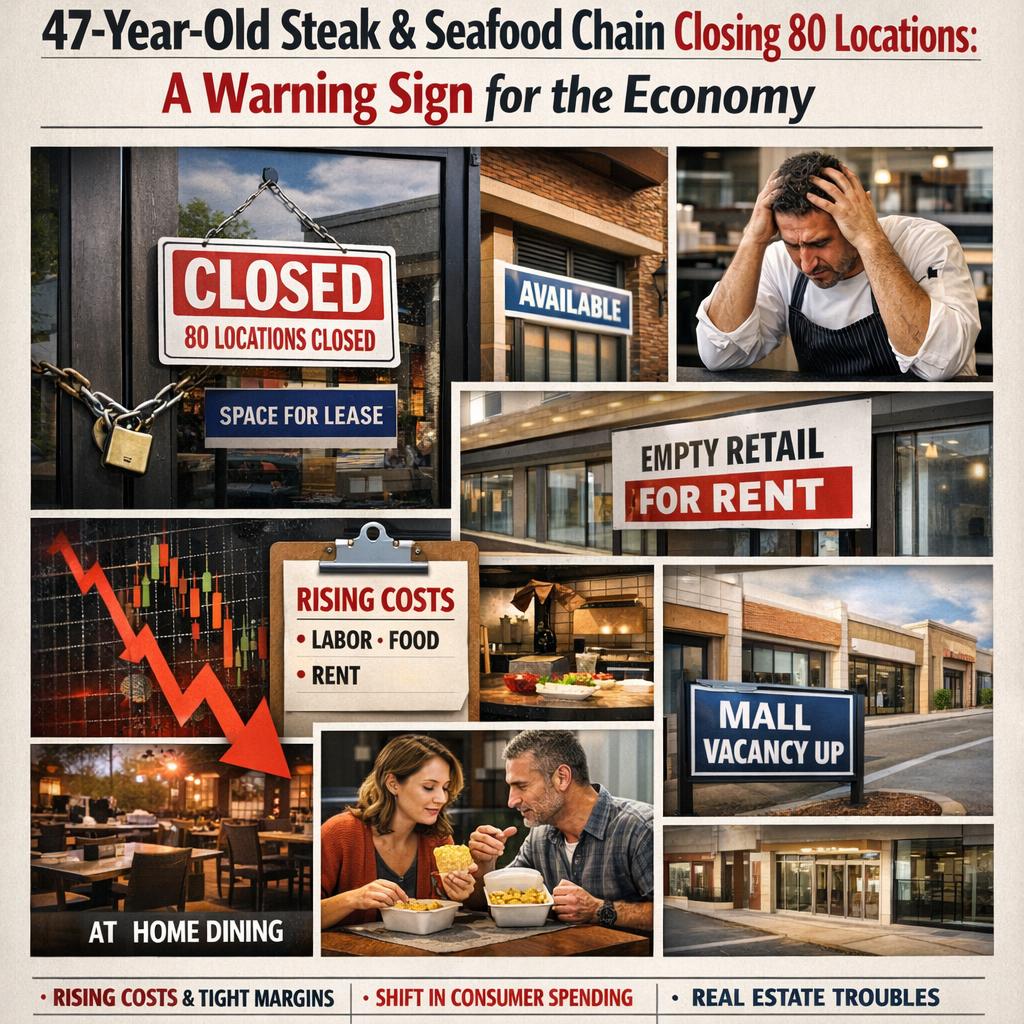
A 47-Year-Old Steak & Seafood Chain Closing 80 Locations Is a Bigger Market Signal Than It Looks
It’s easy to file a restaurant closure story under “sad but isolated.” A brand loses its edge, foot traffic shifts, management missteps happen, and the market moves on.
But when a high-end steak and seafood chain with decades of operating history shuts down 80 locations in one go, investors should treat it less like a one-off headline and more like a live read on the consumer, commercial real estate, and the cost structure of doing business in a post-inflation world.
This isn’t just about one company. It’s about what’s getting harder to make work across the entire discretionary economy.
1) The “affluent consumer” isn’t infinite
For the last couple of years, a common market narrative has been: “Yes, prices are up, but the higher-income consumer is still spending.” That’s been true enough to keep airlines, premium travel, and many branded experiences afloat.
The problem is that “still spending” doesn’t necessarily mean “spending the same way,” and it definitely doesn’t mean “spending with the same frequency.”
High-end dining sits in an uncomfortable middle ground:
– It’s not essential.
– It’s not cheap enough to be impulse.
– And it competes directly with newer, more flexible alternatives (fast-casual upgrades, local independents, delivery, at-home entertaining, and premium grocery).
So closures like this can be an early sign that even the better-off consumer is becoming more selective—trading down in subtle ways, or simply trading “out” less often. That matters for investors because consumer resilience has been one of the pillars supporting earnings expectations in a high-rate environment.
If that pillar softens, the knock-on effects can travel quickly.
2) Restaurants are a margin story, and margins have been under siege
Restaurants don’t just sell food; they sell a tightly managed operating system. When that system gets hit from multiple sides, closures become the rational option—even if demand is “okay.”
The margin pressures are well known, but still worth spelling out because they map directly to listed-market themes:
– Labour costs remain structurally higher than pre-2020 in many regions.
– Food inputs are volatile (beef and seafood especially), and customers resist endless price hikes.
– Rent escalations and occupancy costs are a silent killer, particularly for large-format venues.
– Financing is more expensive, so weak locations can’t be carried as long.
When a chain closes dozens of units, it’s often not a demand collapse. It’s unit economics failing the stress test.
For investors, that’s a reminder: in discretionary sectors, “revenue growth” headlines can distract from the real story, which is whether costs are stabilising faster than pricing power is fading.
3) Commercial real estate risk shows up in unexpected places
A restaurant closure wave isn’t just a consumer signal—it’s also a property market signal.
Large sit-down dining footprints are hard to backfill quickly, especially if:
– the site is purpose-built,
– the location depends on evening/weekend traffic,
– or the local economy is slowing.
That has consequences for landlords, mall operators, strip centers, and the lenders behind them. It can also ripple into municipal tax receipts and local employment, which then feeds back into the spending environment.
Investors watching REITs, regional banks, and credit conditions should pay attention to this kind of headline because it’s a real-world example of how vacancies can rise even without a dramatic macro shock.
4) The “experience economy” is being re-priced
One of the defining shifts since the pandemic has been the prioritisation of experiences. But experiences are not a single category; they are a spectrum.
Some experiences have become “non-negotiables” (a big annual trip, concerts, key family events). Others are becoming “nice-to-haves” that get trimmed quietly (midweek dinners out, add-on bottles of wine, premium appetisers, frequent visits).
High-end chains are exposed to that re-pricing because they rely on:
– repeat visits,
– high average ticket sizes,
– and a steady flow of business diners and celebratory occasions.
If those patterns change even slightly, the math can break quickly at the location level.
5) What this means for global investors
Even if you’re not invested in US casual dining or restaurant stocks, this story still carries global relevance because it points to three broader investment realities:
A) Discretionary earnings may be more fragile than index-level performance suggests
Broad indices can look fine while pockets of the economy quietly deteriorate. Closures are a physical, undeniable form of “earnings revision.”
B) Credit is the hidden variable in consumer-facing sectors
When rates are higher for longer, weaker operators don’t get the same runway. That can accelerate consolidation: fewer players, stronger survivors, and more pricing discipline—but also more job churn and community-level softness.
C) Defensive positioning isn’t just utilities and healthcare
In a world where the consumer is value-hunting, businesses with:
– recurring demand,
– better inventory turns,
– and less labour intensity
can look increasingly attractive relative to labour-heavy, footfall-dependent models.
6) A practical investor takeaway: watch the second-order signals
The market often reacts late to “slow” stories because they don’t feel dramatic. But closures are a hard data point. If you want to track whether this is isolated or part of a broader turn, watch:
– Other restaurant chains’ same-store sales and traffic (not just revenue).
– Comments on promotional activity (“discounting” is usually the tell).
– Retail and dining vacancy rates in key metro areas.
– Credit card delinquency trends and “trade-down” language in consumer company calls.
– Food commodity trends, especially beef, plus labour market cooling.
This is the kind of headline that can look small next to AI, rates, or geopolitics—but it’s actually a clean window into the everyday economy that supports a huge portion of earnings.
If you’re tracking consumer stocks or the health of the services sector more broadly, I’d be interested to hear what you think: is this mainly a company-specific failure, or another sign that discretionary spending is finally getting tired?