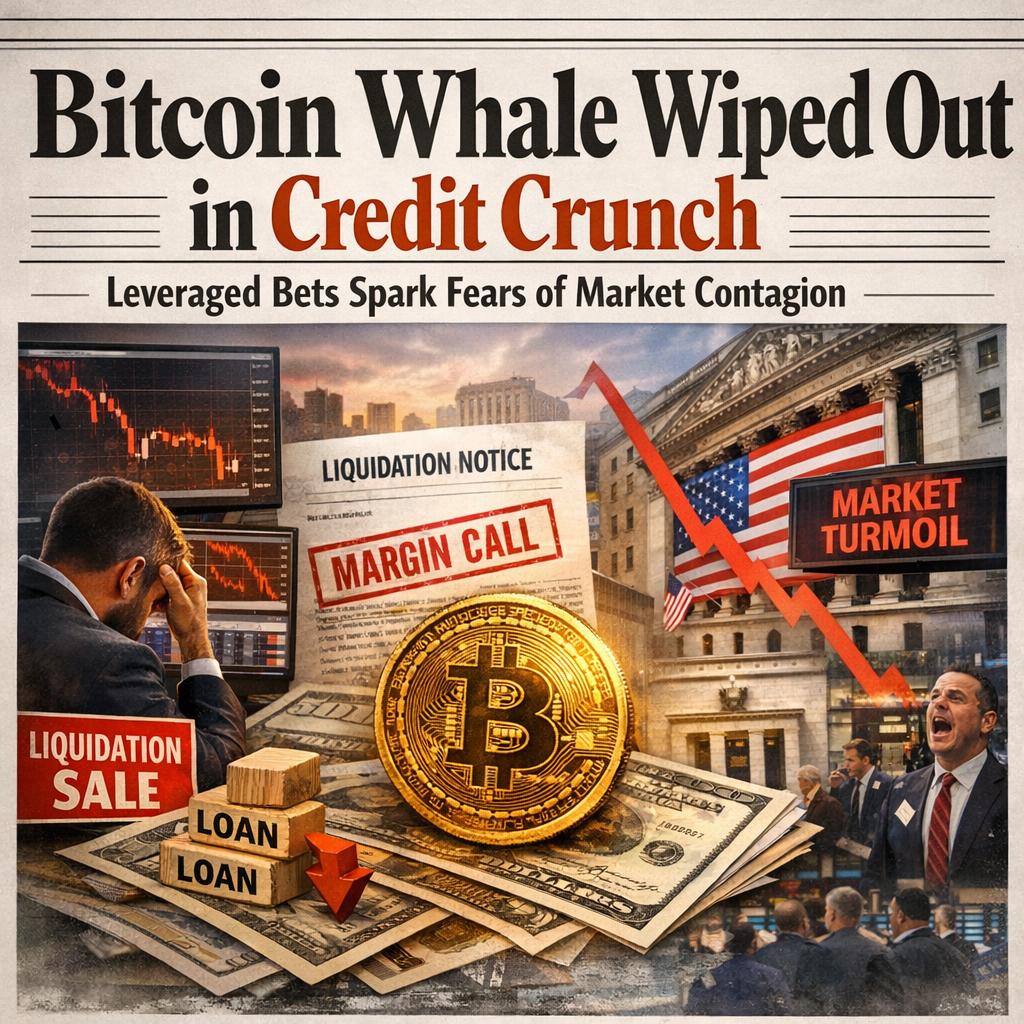
There’s a telling crypto subplot developing right now that a lot of traditional-market investors still underestimate: leverage is quietly becoming the real headline risk again.
One of the more interesting recent stories was about a large Bitcoin holder who effectively hit the wall after an aggressive borrowing spree. Strip away the crypto-native jargon and it’s a familiar lesson from every asset class: when price goes up, collateral looks “safer,” credit expands, and balance sheets get stretched. Then conditions tighten—sometimes because price dips, sometimes because lenders pull back, sometimes because volatility rises—and what looked like clever capital efficiency starts behaving like a forced seller in waiting.
Why this matters isn’t the drama of one whale. It’s what it reveals about market structure.
1) Leverage is the accelerant, not the fuel
Bitcoin’s long-term narrative—scarcity, adoption, monetary distrust, alternative store of value—gets the attention. But in the short run, leverage is what turns normal price discovery into sudden air pockets.
When big players borrow against crypto to buy more crypto, they’re not just “bullish.” They’re manufacturing demand today by promising future repayment under uncertain conditions. That’s fine in calm markets. In stress, it can create the same kind of reflexive feedback loop we’ve seen in equities during margin calls, in rates during liquidity scrambles, and in commodities when VAR models start flashing red.
If you’re an investor who doesn’t touch crypto, this still matters because liquidations rarely stay politely contained. They bleed into risk sentiment. They change how market makers price volatility. And they can hit at inconvenient times—like when macro is already fragile.
2) The hidden variable: crypto credit conditions
In equities, we watch earnings, guidance, and the Fed. In crypto, one of the most underappreciated “macro” indicators is the availability and cost of crypto-backed credit.
When lending terms loosen, borrowing spikes, and a lot of that borrowed purchasing power flows straight back into spot demand. Prices rise, confidence rises, more borrowing follows. The cycle looks healthy until it doesn’t.
When terms tighten—higher haircuts, stricter collateral requirements, reduced counterparty limits—that buying power fades. Not because people stop believing in the asset, but because the marginal buyer loses access to cheap leverage. That’s when the market learns, again, that liquidity is a fundamental.
For global investors, this is the key bridge: crypto isn’t just a “tech bet” or a “risk-on toy” anymore. It has a credit cycle, and credit cycles are global by nature.
3) Dilution and balance sheet engineering are creeping into crypto’s “equity-like” corner
Another layer here is that some of the biggest crypto exposures aren’t pure coins; they’re vehicles, firms, and balance-sheet strategies that behave like hybrid instruments—part operating company, part leveraged proxy.
When those players need to sustain buying, refinance, or roll obligations, they can end up using equity issuance or other funding tactics that look a lot like what we see in small-cap growth: dilution risk becomes the quiet tax paid by long-only holders chasing upside.
So even if Bitcoin itself is capped in supply, not every Bitcoin-adjacent exposure is. That distinction matters more as institutional money broadens beyond spot and into “crypto beta” products.
4) The spillover channel to traditional markets is getting cleaner
This is the part that deserves more attention. The plumbing between crypto and traditional finance has improved: more listed products, more institutional participation, more interconnected positioning.
That means crypto stress can show up as:
– A volatility bid across risk assets
– De-risking in high-beta tech names (where overlapping investor bases often sit)
– Tightening liquidity in corners of the market that rely on fast-moving speculative capital
No, Bitcoin liquidations don’t automatically crash the S&P 500. But they can worsen the mood at the margin, and markets are often decided at the margin.
How I’d translate this into investor takeaways (without pretending anyone can time it perfectly)
– Respect the difference between “adoption” and “positioning.” Adoption is slow. Positioning can flip in an afternoon.
– If you own crypto (or proxies), pay attention to signs of forced behavior: rising funding costs, lender caution, sudden drops that cascade rather than trend.
– If you don’t own crypto, still track it as a liquidity barometer. It’s one of the fastest places where risk appetite expresses itself—and one of the first places where it can break.
The broader point is simple: in 2026, crypto is less about ideology and more about market mechanics. And market mechanics—especially leverage—are universal.
If you’ve been watching this space, I’d be interested to hear in the comments: do you treat crypto leverage as a genuine systemic signal now, or still as noise that stays contained?