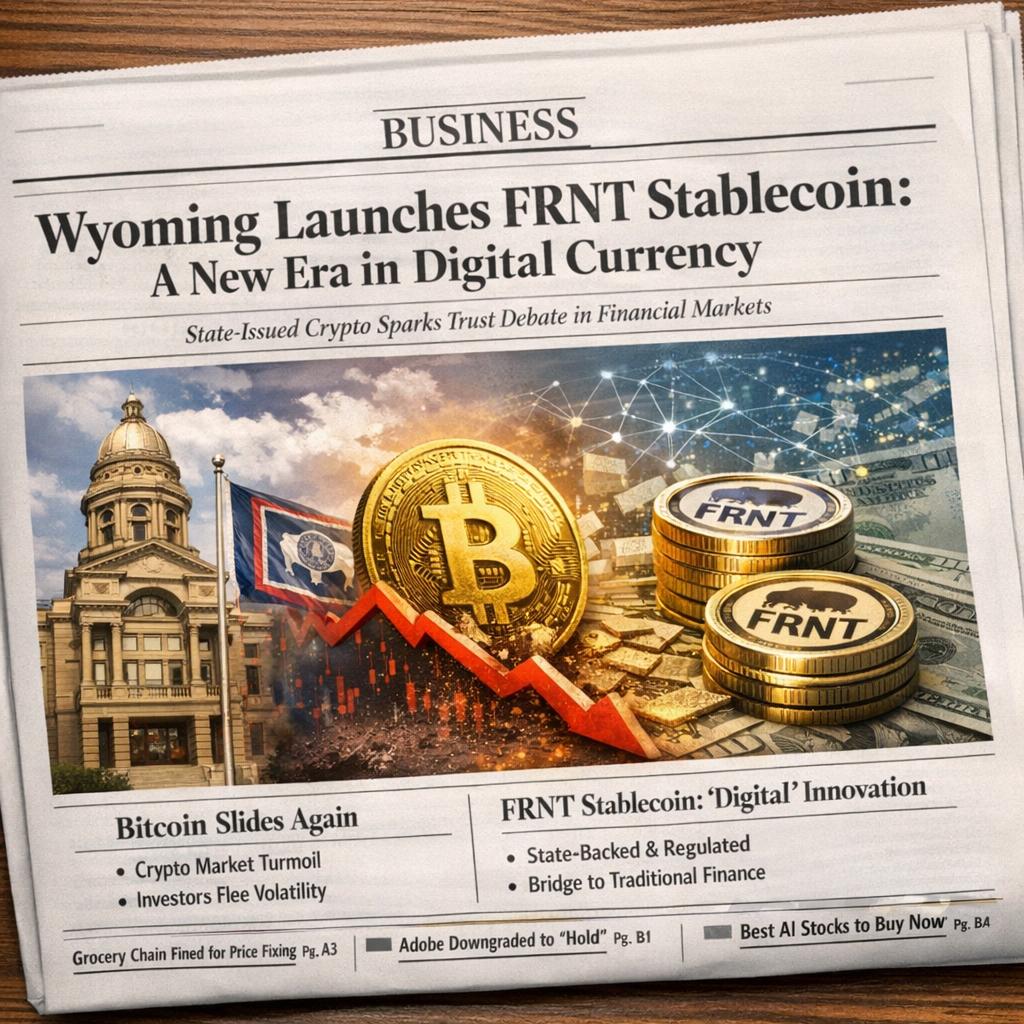
Wyoming’s FRNT Stablecoin Isn’t Just a Crypto Headline — It’s a Signal About Where Trust Is Going Next
While Bitcoin is sliding and the mood across crypto feels bruised (again), one story quietly carries bigger, longer-term implications for global investors: Wyoming becoming the first US state to issue a cryptocurrency, the FRNT stablecoin.
On the surface, it’s easy to file this under “local US innovation” or “political theatre.” But the deeper message is about the direction of travel for money itself: who gets to issue it, who gets to audit it, and how quickly it can move across the internet without relying on legacy rails.
And for investors, that’s not a niche debate anymore.
1) Stablecoins are becoming the real bridge between TradFi and crypto
Bitcoin tends to dominate headlines because it’s volatile and emotional. Stablecoins are different. They’re infrastructure.
Stablecoins are used for:
– Parking value when markets are swinging
– Moving funds across exchanges and wallets instantly
– Settling trades in crypto markets without touching banks every step
– Cross-border transfers and payments where the traditional system is slow or expensive
That means when a credible issuer enters the stablecoin arena, the significance isn’t whether it “pumps.” It’s whether it works, scales, and becomes trusted plumbing.
If Wyoming’s FRNT is designed and governed in a way that inspires confidence, it becomes a proof of concept: that regulated public entities can issue digital cash-like instruments that people may actually want to use.
2) “State-issued” changes the trust conversation
One of the stablecoin market’s core tensions is trust.
Even when stablecoins claim full backing, markets still ask:
– What are the reserves actually made of?
– Where are they held?
– How often are they audited?
– Who can freeze funds, and under what rules?
– What happens in a crisis?
A state-issued stablecoin introduces a different trust profile versus a private issuer. That doesn’t automatically make it “safer,” but it does change perceived credibility, oversight expectations, and political support.
This matters globally because trust is contagious in finance. If one jurisdiction shows a workable model, others copy it, compete with it, or regulate against it. Either way, capital markets react.
3) This is part of a bigger race: tokenised dollars, tokenised everything
The most important macro thread here is that the “digital dollar” ecosystem is expanding whether or not the US goes full central bank digital currency.
Stablecoins have already become a kind of shadow settlement layer for global markets, especially in regions where local currencies are unstable or capital controls are tight. In practice, tokenised dollars are already functioning like a parallel financial network.
Now bring in a US state stepping into issuance, and you get a new stage in that evolution:
– More legitimacy for on-chain settlement
– More pressure on banks and payment networks to modernise
– More urgency around regulation, standards, and interoperability
Investors should see this less as “Wyoming does crypto” and more as: the competitive landscape for payment rails and monetary instruments is widening.
4) Winners and losers won’t be limited to crypto
If stablecoins keep moving into the mainstream, the impact spreads outward:
Potential beneficiaries:
– Exchanges and trading venues (more stable, liquid rails)
– Payment processors and fintechs that integrate stablecoin settlement
– Infrastructure providers: custody, compliance tooling, on-chain analytics
– Some blockchain networks that become preferred settlement layers
Potentially pressured:
– Parts of the remittance market with high fees and slow settlement
– Smaller banks reliant on payments and deposits if stablecoins offer attractive alternatives
– Legacy rails that don’t adapt (or are boxed out by regulation)
None of this flips overnight. But investors don’t get paid for noticing the future only once it’s consensus. They get paid for tracking the direction early, then being selective about execution risk.
5) The uncomfortable bit: regulation risk cuts both ways
A state-issued stablecoin also raises questions regulators can’t avoid:
– How does it interact with federal oversight?
– Does it create a patchwork of rules across states?
– What happens if multiple states issue competing stablecoins?
– What standards will institutional investors demand before using them for settlement?
For markets, that means volatility in the policy narrative. But it also means clarity is being forced faster than it otherwise would be. And in finance, clarity tends to attract capital—especially institutional capital that has been waiting for the rules to solidify.
The investor takeaway
Bitcoin “tanking” makes for dramatic charts, but the structural story is the steady march of digital cash instruments into regulated space.
If FRNT succeeds even modestly, it won’t matter only to Wyoming. It will matter to anyone watching:
– the future of payments,
– the evolution of the dollar’s digital reach,
– and the competitive battle between banks, fintechs, and on-chain networks.
If you’re tracking this too, share your view in the comments: is state-level issuance a genuine step toward mainstream adoption, or a complication that will slow everything down?