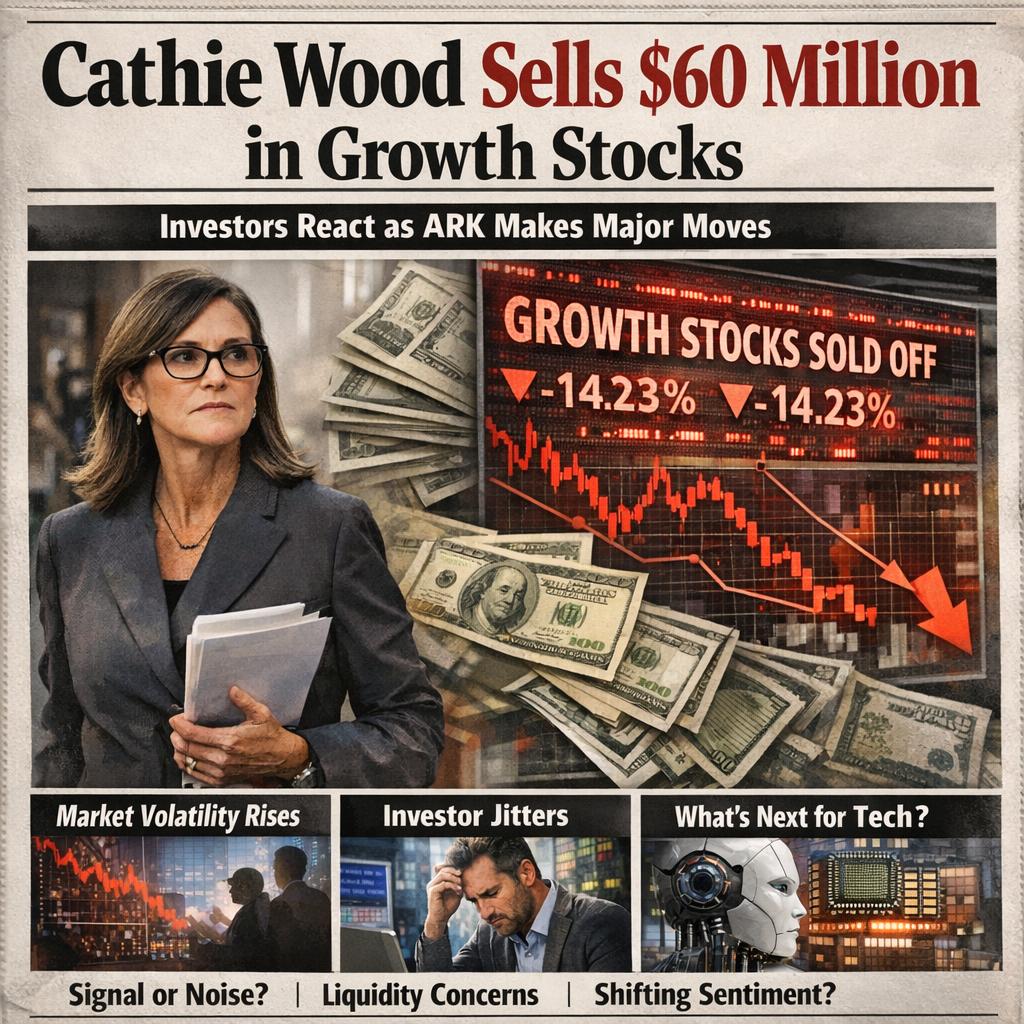
Cathie Wood Selling $60 Million in Growth Stocks: Signal, Noise, or a Useful Stress Test for Investors?
One of the more telling market stories this week wasn’t a macro print or a central bank headline. It was a portfolio decision.
Cathie Wood, through ARK, reportedly sold close to $60 million worth of popular growth names. Whether you love ARK’s high-conviction style or you’ve treated it as a contrarian indicator, these moves tend to travel fast across global investing circles for one reason: they sit right at the intersection of sentiment, liquidity, and narrative.
And right now, growth investing is back in a delicate phase—where positioning matters as much as fundamentals.
Why this matters beyond ARK
ARK has become a kind of public mood ring for “long-duration” equities: companies where a big chunk of the valuation is tied to expectations many years out. When those expectations are rising, the gains can look effortless. When the market decides to be less generous with future cash flows, the drawdowns can be savage.
So when a well-known growth manager trims sizable positions, global investors pay attention—not necessarily because it predicts what comes next, but because it highlights what risk looks like in this part of the market:
1) Liquidity is not a side note in growth
Large, crowded growth trades can behave beautifully on the way up, then suddenly feel one-way on the way down. If a major holder becomes a consistent seller, the market starts to re-price “how easy it is to exit” rather than “how great the story is.”
That matters for investors everywhere because many portfolios—directly or indirectly—carry exposure to the same factor: high beta, innovation, and future earnings.
2) It’s a reminder that portfolio management is dynamic, not ideological
Investors often talk about “conviction” as if it’s a personality trait. In reality, conviction should be conditional: based on price, opportunity cost, and changing probabilities.
Big sales can reflect many things:
– taking profits after a strong run
– reducing concentration risk
– rebalancing into names with better risk/reward
– managing redemptions
– adjusting to a shifting rate or volatility regime
The key is this: the market doesn’t care why you sold. It only cares that supply hit the tape.
3) Narrative cycles are tightening
In growth, narratives move faster than earnings. A single quarter can flip the tone from “category leader” to “competitive pressure,” from “AI tailwind” to “margin squeeze,” from “re-accelerating” to “decelerating.”
High-profile managers selling forces the broader market to stress-test the story: if the narrative is so strong, why reduce exposure now?
The global impact: what it changes for investors
Even if you don’t own any of these stocks, this type of move can ripple through markets because it influences three big things that are borderless:
A) Risk appetite
Growth is often where risk appetite expresses itself first. If investors interpret these sales as a cautious stance, money can rotate into:
– profitable quality tech over speculative tech
– value and cashflow names over “promise” names
– defensive sectors
– shorter-duration assets
B) Correlations
When markets get jittery, correlations rise. Unrelated growth names start trading like a basket. That’s when diversification can feel weaker than expected—particularly for investors whose “diversification” is mainly a collection of similarly sensitive growth stocks.
C) Benchmark positioning and flows
A lot of global capital is passive or quasi-passive. When momentum shifts, inflows slow, and the marginal buyer becomes more price-sensitive. If you’ve lived through any growth unwind, you know how quickly the “dip buyer” turns into “wait for confirmation.”
How I’d frame it (without overreacting)
I don’t think the takeaway is “copy the trade.” That’s rarely the right lesson from a headline.
The more useful takeaway is to treat it like a portfolio audit prompt:
– If your growth names fell 25–35% in a quarter, would your plan change—or would you freeze?
– Do you actually know what you own: a business compounding cash flows today, or a valuation dependent on perfect execution five years out?
– Are you diversified by ticker symbols, or by genuine drivers (cash flows, balance sheet strength, cyclicality, duration)?
– Do you have position-sizing rules that prevent one narrative from becoming your whole portfolio?
Because when famous investors sell, the real risk isn’t that they’re right and you’re wrong. The real risk is that you never defined your process in the first place.
The bigger picture
This is also a reminder that markets are transitioning from a period where “growth at any price” can work, to a period where the market negotiates price much harder.
In that environment:
– great companies can still be bad stocks (if the price bakes in perfection)
– mediocre companies can rally (if expectations were too low)
– and the winners tend to be investors who are disciplined on entry price, concentration, and time horizon
If you’re watching this story, I’d be interested to hear how you’re thinking about growth exposure right now—are you trimming, rotating, or sticking with core positions and letting the noise pass? Comment with your approach.