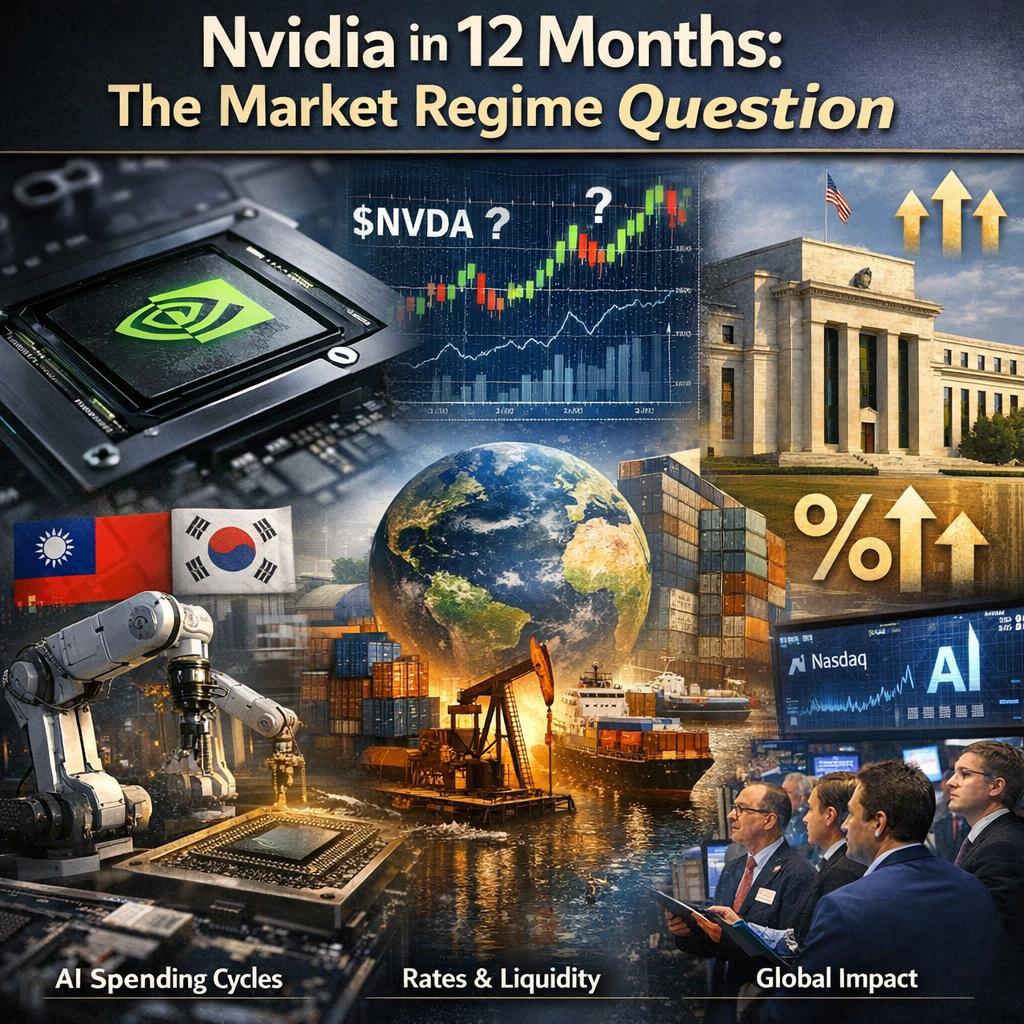
Nvidia in 12 Months: The Real Question Isn’t the Price Target — It’s the Market Regime
Every time a headline asks, “What will Nvidia be worth in a year?”, it’s tempting to treat it like a straight-line forecasting exercise: plug in revenue growth, slap on a multiple, and call it a day. But Nvidia has become so central to the AI trade that the more useful exercise is stepping back and asking what kind of market we’re actually in — and what shifts could change the rules on investors globally.
Because Nvidia isn’t just a company anymore. It’s a benchmark for risk appetite, a proxy for AI capex, and (in many portfolios) the single biggest driver of whether “growth is back” or “we’re rotating again.”
Why Nvidia is different from a normal “one-year target” stock
In a typical large-cap, a one-year view is mostly about execution: margins, guidance, buybacks, competitive pressure. With Nvidia, execution still matters — but the stock’s gravitational pull is tied to three bigger forces:
1) AI spending cycles are lumpy, not linear
The AI buildout isn’t evenly distributed through time. It comes in waves: hyperscalers and sovereign buyers place massive orders, supply chains stretch, then digestion periods follow. A one-year price prediction can look “wrong” simply because the market is repricing the timing of demand rather than the existence of it.
For global investors, this matters because the AI wave isn’t only a US equity story. It runs through Taiwan and Korea (advanced manufacturing and memory), Europe (industrial automation), and emerging markets that supply commodities and energy inputs. When Nvidia sentiment flips, it often pulls an entire web of markets with it.
2) The valuation is a referendum on rates and liquidity
Even the best business in the world can look “expensive” if the discount rate is moving against it. When inflation prints surprise, when bond yields rise, when central banks stay restrictive longer than expected — high-duration equities feel it first. Nvidia is a high-duration asset in the eyes of many allocators, meaning the story is “future-heavy.”
So the one-year Nvidia debate is also a one-year debate about the global cost of capital. That’s not just Wall Street trivia. It affects whether pensions de-risk, whether emerging market flows strengthen or weaken, and how aggressively institutions can stay overweight US tech.
3) Concentration risk has become a macro factor
The biggest indexes increasingly reflect the performance of a relatively small set of mega-cap names. That’s great when leadership is strong — and uncomfortable when it narrows too far.
This is where Nvidia has an outsized impact on investors worldwide: global portfolios that “just buy the index” can end up with more single-stock exposure than they realize. And when a single narrative dominates (AI infrastructure), correlated positioning builds quietly. If the narrative wobbles, the unwind can be faster than fundamentals would suggest.
What actually moves Nvidia over the next year
If you’re trying to think like an investor rather than a forecaster, the most important variables aren’t “Will AI be big?” (it will). They’re:
– Evidence that AI demand is broadening beyond a handful of buyers and use-cases
The more diversified the end-market, the more durable the multiple.
– Any sign of capex fatigue at hyperscalers
Even a modest shift in tone can reprice the entire complex.
– Supply chain and competitive dynamics (including custom silicon)
Markets can handle competition. What they struggle with is uncertainty around pricing power.
– Regulation and geopolitics
Export restrictions and cross-border tech policy can change the addressable market quickly, and global investors feel that instantly through risk premiums.
– The “index effect”
Passive flows can amplify both upside and downside. When Nvidia is a top weight, it can behave like a liquidity instrument as much as an operating company.
How I’m thinking about positioning (without pretending to have a crystal ball)
Rather than obsessing over a single price number 12 months from now, I think the better approach is to treat Nvidia as a “regime indicator” and build around it:
– If you’re bullish, consider whether your portfolio is accidentally a one-theme bet. Balance matters.
– If you’re cautious, remember that underexposure can be just as risky in a momentum-driven tape — especially if you benchmark against broad indices.
– If you hold it directly, risk-manage it like a core macro exposure, not just a stock: position sizing, rebalancing rules, and drawdown tolerance matter more than most people admit.
The bigger takeaway for global investors
The Nvidia conversation is really a conversation about how markets price innovation when capital is still expensive and positioning is crowded. The stock can do well and still be volatile. It can also go sideways while the business grows, simply because the multiple compresses.
That’s why the “one-year price” question is less useful than the “what needs to be true?” question. The investors who navigate this best won’t be the ones with the boldest target. They’ll be the ones who understand the regime they’re in — and size their risk accordingly.
If you’re watching Nvidia closely, I’d love to hear how you’re thinking about it: as a long-term compounder, a tactical trade, or a proxy for the entire AI cycle. Comment with your framework.