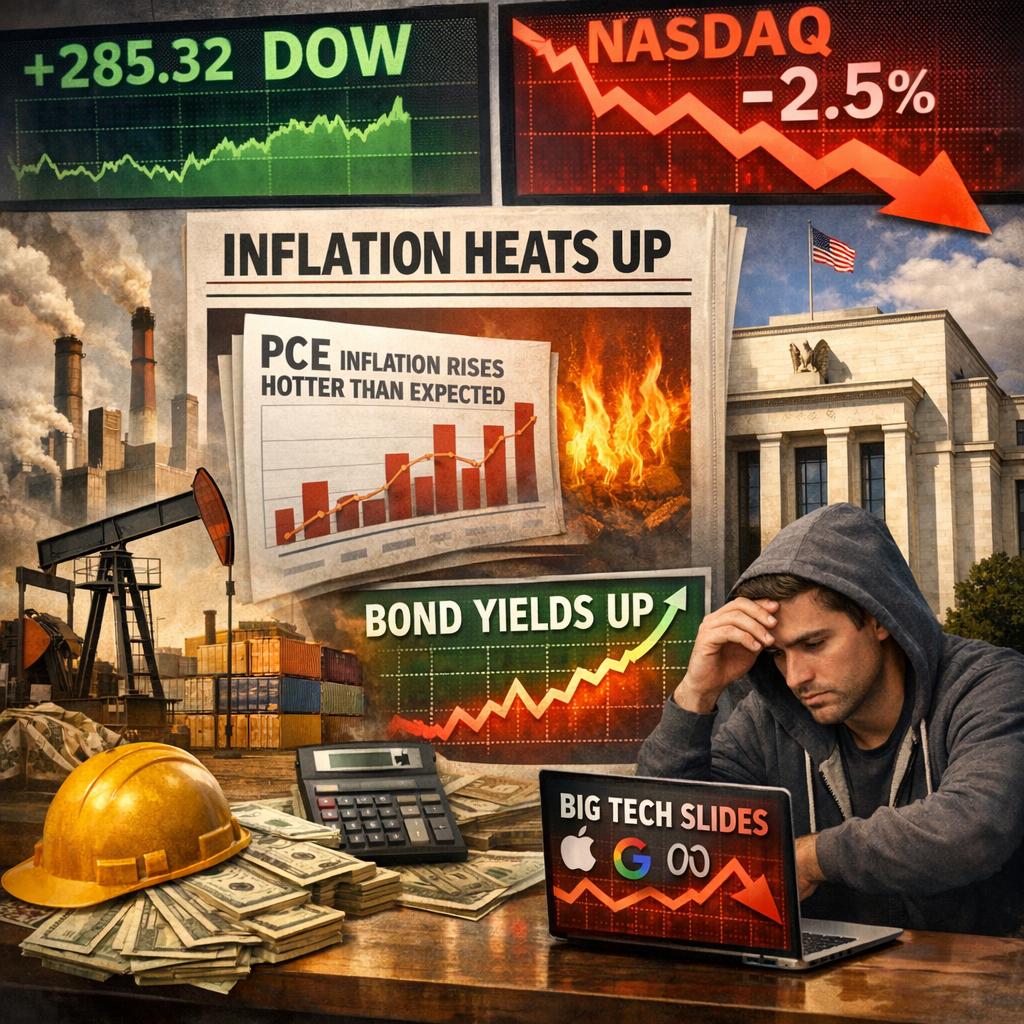
The Market’s New Divide: “Hot” Inflation, Old-Economy Strength, and Big Tech Fatigue
One of the most telling market stories this week wasn’t a dramatic crash or a euphoric rally. It was something subtler: the Dow and S&P 500 pushing higher while the Nasdaq slipped, all happening as a hotter-than-expected PCE inflation print reminded investors that the inflation fight isn’t a neat, linear path.
That kind of split tape matters, because it reveals what investors are really paying for right now: cash flows they can touch today, balance sheets that can handle higher-for-longer rates, and businesses that don’t need a perfect macro backdrop to justify their valuation.
Why “hot” PCE changes the rules (even when stocks rise)
PCE is the Federal Reserve’s preferred inflation gauge, and when it comes in hotter than expected, it does two things immediately:
1) It hardens the floor under interest rate expectations.
Even if the market still hopes for cuts later, “hot” inflation makes it harder to price in an easy, aggressive easing cycle. That lifts bond yields or, at minimum, keeps them elevated.
2) It forces investors to re-check multiples.
High-growth equities, especially the mega-cap tech names that dominate the Nasdaq, are more sensitive to discount rates. When yields rise or stubbornly refuse to fall, future earnings are worth less in today’s dollars. That doesn’t mean the businesses are broken. It means the market is less willing to overpay for tomorrow.
So when you see the Nasdaq lag on an inflation surprise, it’s not always “risk-off.” Often it’s “re-pricing.”
The rotation signal: broad index strength with tech weakness
A rising S&P 500 alongside a falling Nasdaq is a reminder that “the market” is not one trade. It’s a portfolio of narratives competing for capital.
When inflation runs hot, investors tend to favor:
– Value and cyclical names that can pass through prices, defend margins, or benefit from nominal growth
– Financials that can earn more on interest spreads (depending on the curve and credit conditions)
– Industrials and defensives with visible demand and less reliance on long-duration expectations
– Energy/materials exposure when inflation pressures show up in real-economy inputs
Meanwhile, parts of Big Tech can stumble for reasons that have nothing to do with product demand:
– Valuations are still doing the heavy lifting
– Expectations are high, and “beating” isn’t the same as “beating enough”
– Investors become less forgiving of spending, capex, and long payback AI bets when money isn’t getting cheaper
That’s why a market can look healthy on the surface while leadership quietly changes underneath.
What this means for global investors (not just US portfolios)
Even if you don’t own US equities directly, the implications travel fast.
Currency and capital flows
Higher-for-longer US rates tend to support the dollar. That affects emerging market funding conditions, the cost of dollar-denominated debt, and the translation of overseas earnings for multinational companies.
Global equity leadership
When US mega-cap tech cools, passive flows can shift. Global indices that are heavily correlated with US growth leadership may feel it, while markets with more banks, commodities, or industrial exposure sometimes hold up better in relative terms.
Cross-asset positioning
A hot inflation print doesn’t just hit stocks. It can reshape the entire risk stack: bonds, credit spreads, and even commodities. Global portfolios built on the assumption that inflation is “done” can suddenly look a bit too optimistic.
Practical takeaways (without overreacting)
1) Don’t treat index performance as the full story.
If the S&P is up but breadth is changing, leadership is changing. Track what’s actually driving returns.
2) Respect duration risk in equities.
You don’t need to abandon growth, but you do need to be honest about what you’re paying for and how sensitive that price is to yields.
3) Diversification is doing real work again.
This is the kind of market where owning different drivers (quality defensives, value, selective cyclicals, and yes, some growth) can be more effective than betting everything on one theme.
4) Inflation surprises are now “positioning events.”
In a market built on narratives, data prints like PCE are catalysts that can force fast reallocations—especially when everyone is leaning the same way.
If you’re watching this shift in leadership too, share what you’re seeing in your own portfolio or watchlist. Are you rotating, holding steady, or leaning into the volatility?