The AI Trade Just Met Its First Real Patience Test
For the last couple of years, “AI” hasn’t just been a theme in markets—it’s been a shortcut. A simple narrative investors could use to justify premium multiples, aggressive capex, and a lot of faith that today’s spending will become tomorrow’s cash flow.
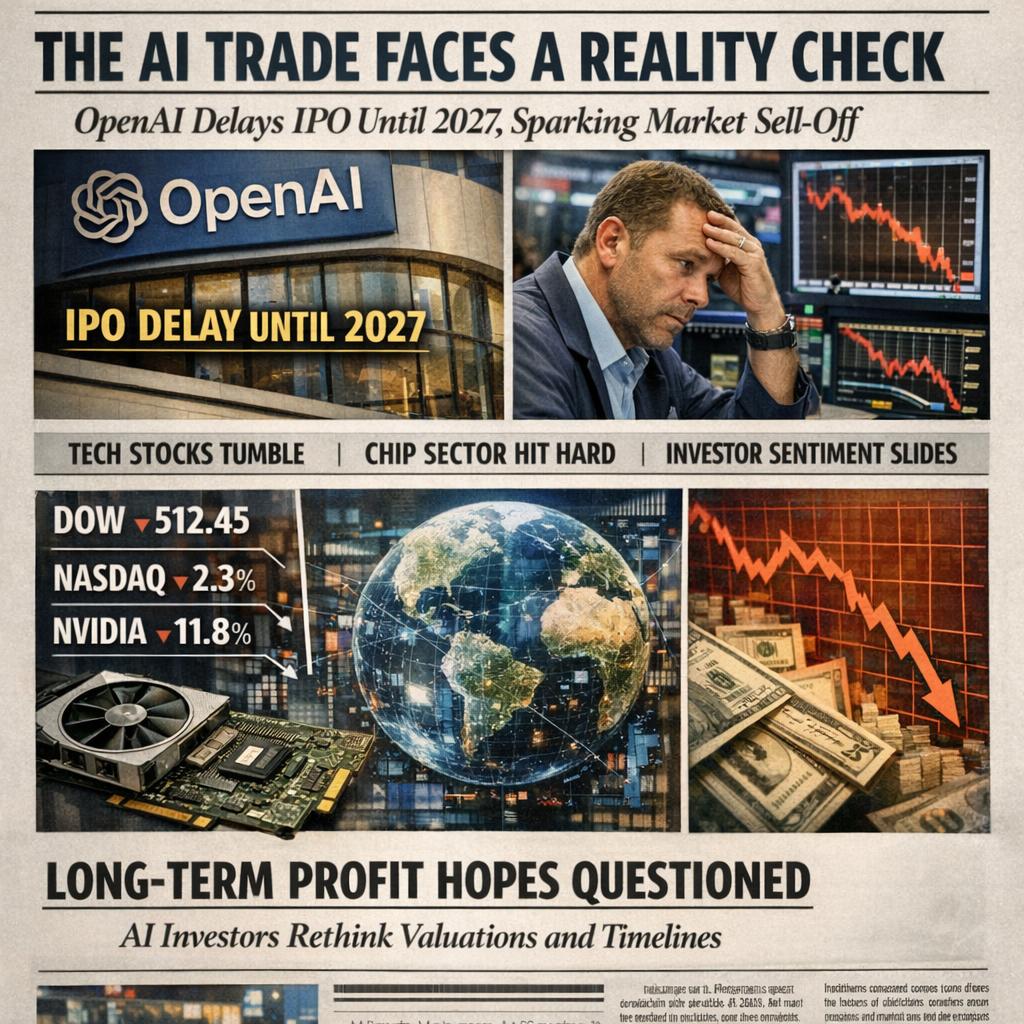
This week’s wobble, sparked by reports that OpenAI may delay an IPO until 2027, is a useful reminder that markets don’t only price innovation. They price timelines.
And when timelines get pushed out, even by a year or two, the math changes fast.
Why a Delayed IPO Matters More Than It Sounds
On the surface, an IPO delay is just one company’s decision. But OpenAI sits at the centre of the AI ecosystem in a way that makes it feel like “the bellwether you can’t actually buy.” So when news suggests the listing window is moving further away, it hits investors in three places at once:
1) Sentiment
A lot of the AI rally has been momentum plus narrative. If one of the biggest narrative anchors signals “not yet,” that tends to drain a bit of speculative energy from the whole complex.
2) Comparable valuation logic
Even if OpenAI isn’t public, it functions like a reference point for how investors think about the value of frontier models, compute demand, and the “platform layer.” If that reference point becomes more distant, the market can become less willing to pay up today for profits that might arrive later.
3) The supply chain trade
The immediate market reaction has been felt most sharply in the parts of the AI chain that are most crowded: chips, infrastructure, and the mega-cap names that became default AI proxies. When the market starts to question the pace of AI monetisation, it doesn’t politely re-rate one stock. It reprices the whole bundle.
This is why you can get a broad tech sell-off off the back of what looks like a single-company headline.
The Bigger Issue: The Market Is Re-Learning Duration Risk
When investors talk about “duration” they usually mean bonds. But equities have duration too.
A company whose profits are expected far in the future behaves like a long-duration asset. It’s more sensitive to changes in discount rates, and more sensitive to shifts in confidence around “when” revenue shows up.
That’s exactly what we’re seeing. Even without a dramatic move in yields, the market is showing you it’s less tolerant of stories where the payoff horizon keeps sliding to the right.
That matters globally because the AI trade is global:
– US megacaps set the tone for index-level risk appetite worldwide.
– Semiconductor supply chains run through Asia.
– European markets often take their cue from US tech multiples because capital flows are connected, not siloed.
– Retail investors everywhere have piled into the same names via ETFs, which can amplify moves when the tape turns.
So a “US tech headline” quickly becomes a global risk-on/risk-off temperature check.
What Investors Should Watch Next (Beyond the Headlines)
If you’re trying to separate a healthy reset from something more structural, I’d focus less on the IPO chatter and more on these signals:
1) Capex discipline vs. capex escalation
Are the biggest AI spenders still increasing investment at the same pace, or do you start hearing more language about efficiency, payback periods, and ROI? The moment the narrative shifts from “build at all costs” to “prove it works,” multiples usually compress.
2) Breadth inside tech
If weakness stays concentrated in the most crowded AI beneficiaries while other areas hold up, it’s likely a rotation. If the selling broadens into software, cloud, and broader growth, it’s the market de-risking more generally.
3) Earnings quality
AI optimism is cheap. Cash flow is not. Watch for companies converting AI excitement into measurable revenue, margin stability, and guidance that doesn’t rely on vague multi-year promises.
4) Positioning
When everyone is in the same trade, the first disappointment hurts more. The second disappointment is where the real drawdowns happen.
A Practical Take: This Doesn’t “Kill AI,” It Changes the Rules
A delayed IPO doesn’t invalidate AI adoption. It simply reminds markets that adoption curves don’t always match investor timelines.
The trade may be shifting from “own anything adjacent to AI” to “own the firms that can monetise AI without permanently sacrificing margins,” and “own the picks-and-shovels, but only at prices that assume competition and cycles.”
In other words: the theme remains, but the easy version of the trade might be behind us for a while.
If you’re investing globally, this is the sort of moment to check whether your portfolio is truly diversified—or just diversified across different tickers that all move with the same AI sentiment.
If you’ve been watching the tech sell-off closely, share in the comments what you think this is: a normal reset, or the start of a longer re-pricing of AI expectations.