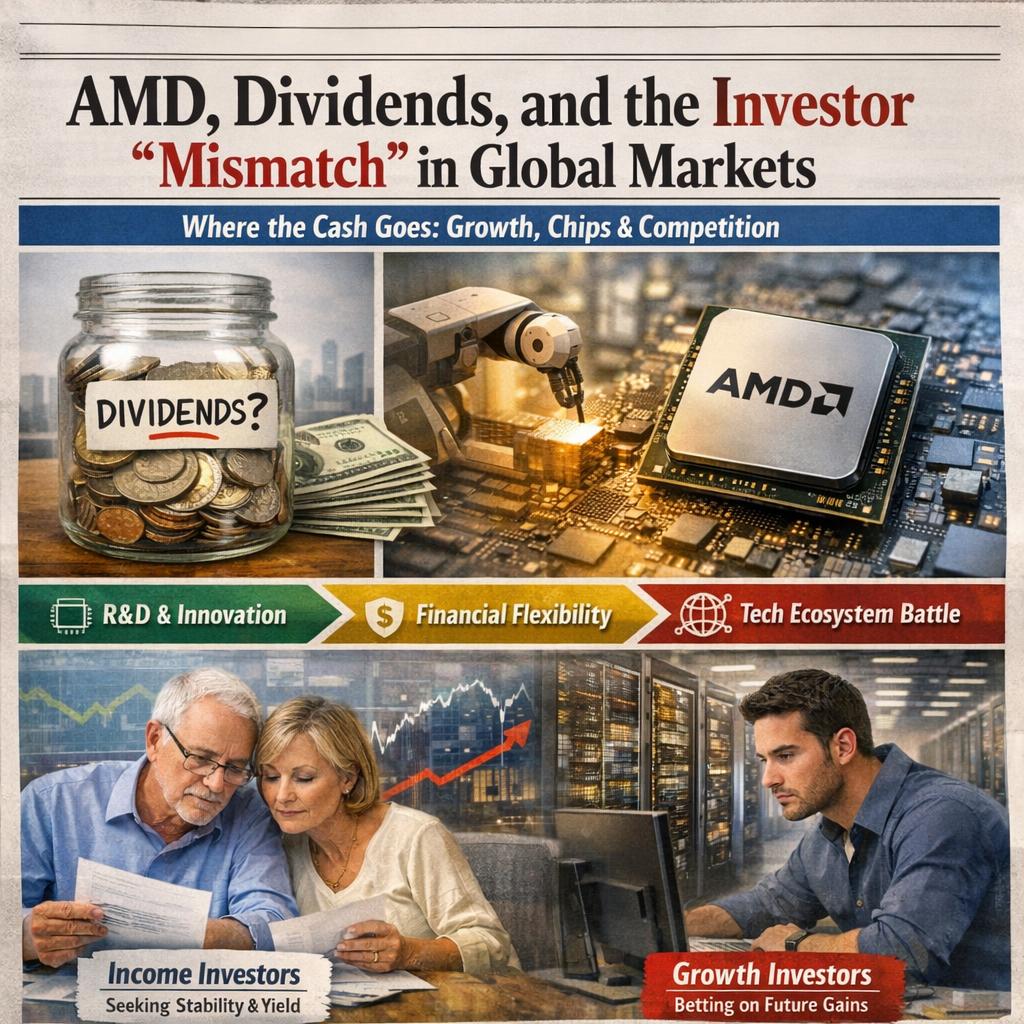
AMD, Dividends, and the Investor “Mismatch” That Keeps Showing Up in Global Markets
One of the quieter but more revealing stories doing the rounds is the simple question: does AMD pay dividends, and what does it do with its cash instead?
On the surface, it’s a basic retail-investor query. Underneath, it’s a neat snapshot of a bigger global market dynamic right now: a growing mismatch between what some investors want (income and predictability) and what many of the market’s most strategically important companies are built to deliver (reinvestment, optionality, and long-duration growth).
Why AMD’s “no dividend” answer matters more than it seems
AMD sits in the middle of several expensive, competitive and geopolitically sensitive supply chains: advanced computing, data centres, AI infrastructure, and the broader chip ecosystem that touches everything from consumer devices to national security. In sectors like this, cash is less a “reward shareholders now” tool and more a “stay in the race” tool.
When a company doesn’t pay a dividend, it usually signals one (or several) of these priorities:
1) Reinvesting to compete
In semiconductors, standing still is falling behind. Product cycles are relentless, R&D is costly, and winning designs can translate into multi-year revenue streams. If leadership believes internal returns on capital are attractive, paying a dividend can look like the wrong use of funds.
2) Preserving flexibility
Chips is cyclical. Demand can surge, then fade. Having cash and balance-sheet capacity gives management room to navigate pricing pressure, inventory swings, and sudden capex needs without resorting to punitive financing.
3) Funding the “ecosystem war,” not just the product war
The competition isn’t only about who has the fastest chip. It’s software stacks, developer adoption, partnerships, and supply-chain resilience. These aren’t always line items that scream “shareholder yield,” but they can decide winners.
The global investor impact: not everyone is investing for the same outcome
Here’s the part I think matters for investors globally. Dividend policy has quietly become a proxy for “what kind of risk am I actually taking?”
Income-oriented investors (including many pensions, insurers, and private investors in higher-rate environments) often want visible cash returns. A dividend signals maturity, stable cash generation, and a willingness to share it.
Growth-oriented investors accept (or prefer) reinvestment because they’re effectively buying future earnings power, not current income.
But the market doesn’t always price those preferences cleanly—especially when rates are not near zero. When cash yields something again, the opportunity cost of holding a non-dividend growth stock becomes more obvious. That doesn’t mean “avoid” companies like AMD. It means you need to be honest about what you’re being paid to wait.
Dividends vs buybacks vs reinvestment: the capital allocation lens investors should use
A lot of people reduce this debate to “dividends good, no dividends bad.” That’s too simplistic.
What matters is whether management is allocating capital in a way that improves per-share value over time:
– Dividends: great for discipline and investor clarity, but can reduce flexibility.
– Buybacks: powerful when shares are undervalued and the balance sheet is healthy; destructive when done at peaks to “manage optics.”
– Reinvestment: best when returns are high and durable; risky if it becomes spending for the sake of a narrative.
For AMD specifically, the investment case typically lives and dies on execution: product competitiveness, margins, data-centre momentum, and the ability to translate demand into profitable scale. In that context, dividend policy is less a “shareholder friendliness” signal and more a “we have better uses for cash” signal.
What this signals about the market right now
Zooming out, this story connects to a broader market reality:
– Investors are increasingly separating “cash now” stocks from “cash later” stocks.
– Higher rates make that separation sharper.
– The tech and semiconductor space is still viewed as strategically essential, but investors are less willing to pay any price for future potential without clearer evidence of monetisation and operating leverage.
So when someone asks whether AMD pays a dividend, what they’re really asking is: am I buying an income asset or an execution bet?
Neither is inherently better. But mixing them up is how portfolios end up feeling “mysteriously” out of balance.
If you’re investing globally, the practical takeaway is to align your chip exposure with your objective:
– If you need cashflow from equities, build that intentionally (and don’t assume every big tech name will provide it).
– If you’re investing for long-term compounding, accept that the “payment” might come through reinvestment-driven growth and eventual valuation changes—not quarterly cheques.
If you’ve got a view on dividends in big tech—whether they’re a sign of strength or a sign of slowing—feel free to comment.