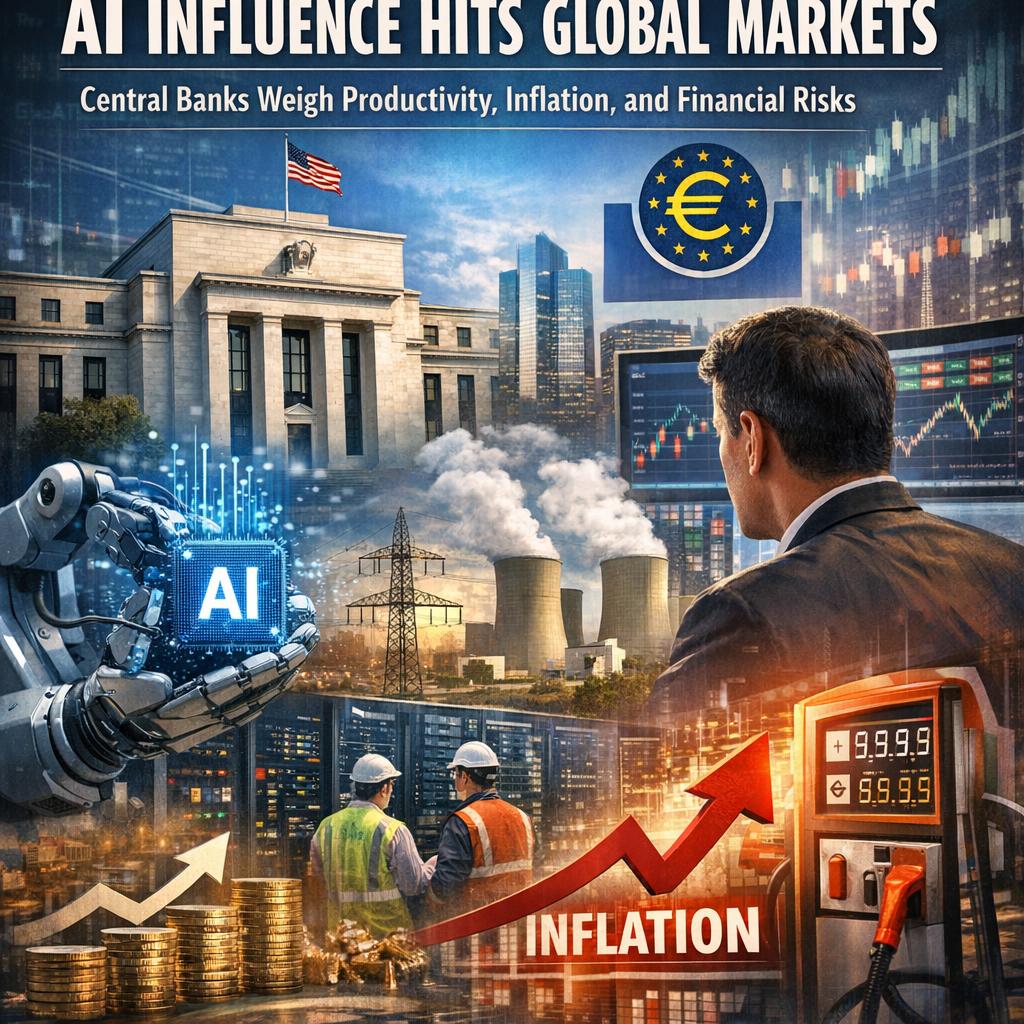
AI Is Now a Central-Bank Variable — and Markets Are Starting to Price It In
One of the more revealing signals in global markets right now isn’t a single rate decision or inflation print. It’s the fact that AI is increasingly showing up in the same conversations as monetary policy, productivity, financial stability, and labor-market resilience.
That matters for investors because central banks don’t just react to today’s inflation. They try to anticipate the economy’s next regime. If policymakers begin to believe AI meaningfully lifts productivity, changes wage dynamics, or reshapes competitive pressure across sectors, it can influence the entire path of rates, liquidity, and risk appetite—even if the next meeting ends with “no change.”
Here’s how I’m thinking about it.
1) AI could shift the “neutral rate” debate — and that’s a big deal for long-duration assets
Investors spend a lot of time obsessing over the next cut or hike. But the deeper driver of valuations is where rates settle over the long run.
If AI is seen as a genuine productivity accelerator, central banks may become more open to the idea that the economy can run “hotter” without generating the same inflationary pressure. In theory, that could be supportive for growth, earnings, and risk assets.
But there’s a twist: stronger trend growth can also imply a higher neutral rate than markets previously assumed, especially if investment demand rises (data centers, chips, energy infrastructure, network upgrades) and the real economy absorbs more capital. A higher neutral rate is not friendly to the “set-and-forget” valuation multiples that powered the last decade.
For investors, the key point is this: AI optimism can be bullish for earnings and simultaneously messy for multiples. That’s why we’re seeing sharper rotations and more sensitivity to rate expectations, even when the macro data looks only moderately changed.
2) The inflation story becomes less straightforward, not more
The popular narrative is “AI is deflationary.” Sometimes, yes—software-driven efficiency can compress costs, automate tasks, and reduce friction.
But central banks also have to watch second-order effects:
– Heavy AI buildout increases demand for electricity, specialized hardware, cooling, and construction labor.
– Market power can concentrate in AI “gatekeepers,” changing pricing behavior.
– Wage dynamics may split: some roles face wage pressure, while scarce technical roles command premiums.
– Productivity gains take time to diffuse across the economy; costs can rise before efficiencies show up in data.
For global investors, this means inflation risk isn’t simply going away because the word “AI” is in the room. It may become more uneven, more sector-specific, and more dependent on supply constraints—energy and infrastructure in particular.
3) Financial stability risk is an underappreciated channel
Central bankers don’t just target inflation and employment. They also care about what breaks when a theme becomes crowded.
AI investment is increasingly large, global, and interconnected: public equities, private markets, venture funding, credit, and large-scale capex plans. When a theme becomes a backbone of the market narrative, two things happen:
– Expectations embed into prices quickly.
– Disappointment becomes a systemic risk, not just a stock-specific risk.
If policymakers believe markets are over-levered to AI optimism, that can subtly change their communication and their tolerance for froth. It doesn’t mean they’ll “target” AI stocks—but it does mean risk conditions can tighten faster than investors expect if financial stability flags start rising.
4) Global spillovers: policy divergence and currency effects matter more
Not every region will experience AI the same way. Countries with:
– cheap and stable energy,
– strong semiconductor or compute supply chains,
– deep capital markets,
– and high-skill labor pipelines
may capture disproportionate gains. Others could face higher import bills (compute, chips, energy) without the same productivity payoff.
That divergence can show up in currencies, capital flows, and equity leadership. For investors with global exposure, this is a reminder that “AI” isn’t a single trade—it’s a map of winners and losers across regions, not just companies.
What I’m watching as an investor (and what I think markets may be underpricing)
– Whether central banks start referencing productivity more explicitly in forward guidance, not as a side note but as a pillar.
– Signs that AI-linked capex is pushing up demand faster than supply can respond (energy and grid constraints are the obvious pressure point).
– Whether labor-market cooling is being interpreted as cyclical… or structural (automation/augmentation).
– Any hint that policymakers see asset-price exuberance tied to AI as a risk to financial conditions.
Bottom line: AI isn’t just a tech story anymore; it’s a macro story. And once it becomes macro, it starts influencing the discount rate, not just the growth narrative. That’s when market leadership gets more volatile, correlations shift, and “set it and forget it” investing becomes harder.
If you’re positioning globally right now, I’d love to hear how you’re thinking about the AI-macro link: is it primarily a productivity windfall, an inflation wild card, or a valuation trap? Comment with your take.