Fed Minutes Show a House Divided — and Markets Globally Should Treat That as a Real Risk Factor
The latest Federal Reserve minutes landed with an unusually clear message: policymakers aren’t simply debating timing anymore—they’re split on the direction of the next big move. That might sound like inside-baseball for US macro watchers, but for global investors it matters in a very practical way, because a divided Fed doesn’t just “add noise.” It changes how risk is priced across currencies, equities, credit, and commodities.
Why the divide matters more than the headline rate
When the Fed is aligned, markets can build a clean base case: cuts start around X, inflation trends toward Y, and the terminal rate lives somewhere around Z. Even if you disagree, you can position around a central narrative.
When the Fed is divided, that narrative breaks. And when it breaks, volatility tends to rise not because data is suddenly worse, but because the range of plausible policy outcomes widens. In that environment, investors start paying more for protection, demanding higher compensation for duration risk, and rotating away from crowded “one-way” trades.
The two scenarios the market has to price at once
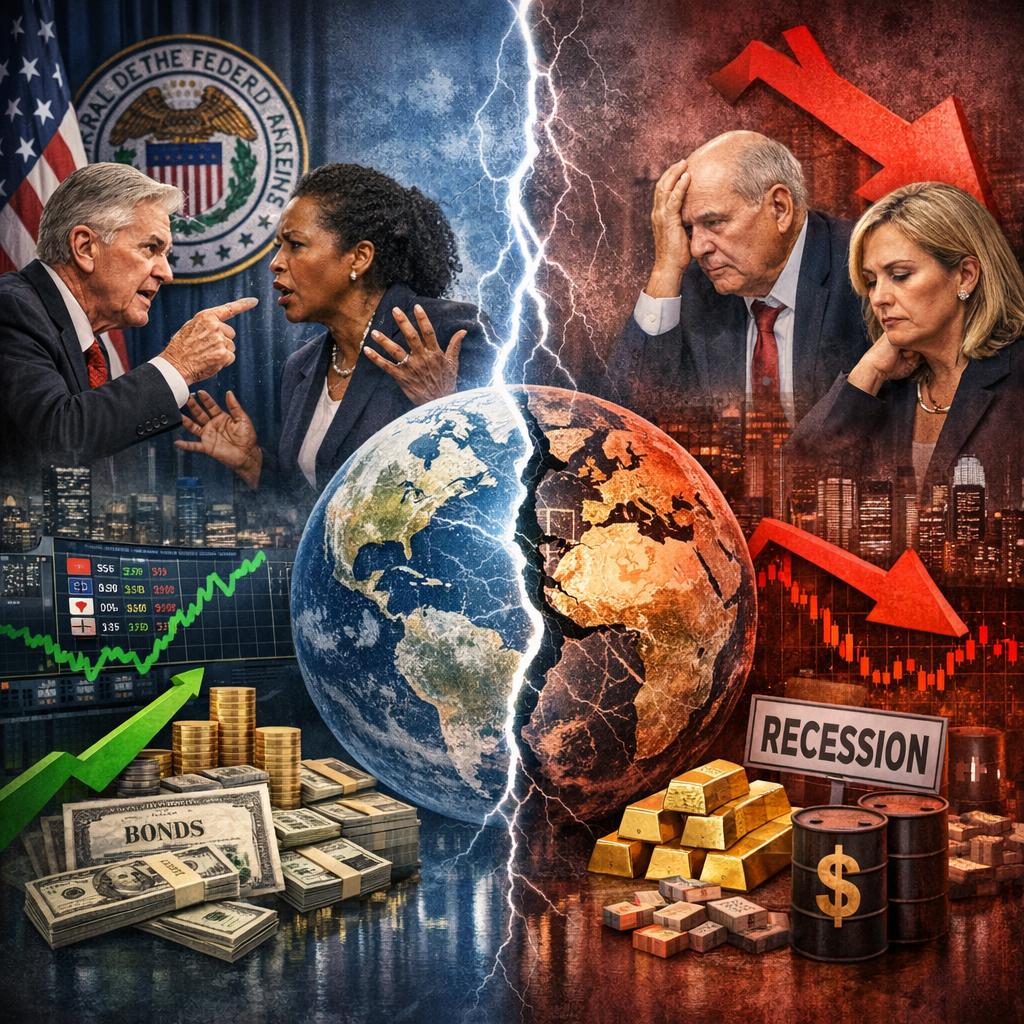
A split Fed typically means investors are forced to price two competing regimes simultaneously:
1) The “higher for longer” regime
This is the path where sticky inflation, resilient growth, or renewed cost pressures keep policy tight. The impact shows up quickly:
– Bond yields stay elevated (or re-steepen), which pressures long-duration assets
– Cash remains a real competitor to risk assets
– Credit spreads can look deceptively calm until refinancing risk bites
2) The “cuts are coming” regime
This path is driven by cooling growth, easing inflation, or rising financial stress. The market implications are very different:
– Duration rallies (especially the long end if recession risk rises)
– High beta equity can sprint, but leadership becomes fragile if earnings roll over
– The dollar can weaken, boosting some EM assets—unless risk-off overwhelms everything
The problem is that a divided Fed makes both regimes feel plausible at the same time. That “policy ambiguity” itself becomes the macro variable.
Global transmission: this isn’t just a US rates story
Even investors with zero US exposure end up dealing with the Fed because the dollar is the world’s funding currency and Treasuries are the reference price for global capital.
Here’s where the spillovers tend to hit:
FX: a stronger dollar isn’t only a currency move—it’s a tightening mechanism
If the Fed stays restrictive while other central banks lean dovish, the interest-rate differential can push the dollar higher. That tightens financial conditions globally, particularly for:
– Emerging markets with USD liabilities
– Import-dependent economies where a weaker local currency feeds inflation
– Global companies with USD-denominated input costs
Equities: valuation is a rates story in disguise
When policy uncertainty rises, investors tend to compress multiples. That doesn’t require bad earnings—it’s simply the market applying a higher discount rate and demanding a larger risk premium. That’s why you can see “good news” rally attempts fade quickly in a split-Fed environment: the hurdle rate keeps moving.
Credit: the quiet risk that wakes up late
Credit markets often lag the policy debate until refinancing calendars get closer. If “higher for longer” wins, the stress usually shows up in:
– leveraged loans and lower-quality high yield
– commercial real estate pockets
– highly levered “growth infrastructure” projects that assumed cheaper capital
Commodities: caught between growth and the dollar
A divided Fed can create a tug-of-war: tighter policy supports the dollar (a headwind for commodities), but resilient growth can support demand. That push-pull often translates into choppier, range-bound commodity pricing rather than clean trends.
How I’d think about positioning (without pretending there’s one perfect trade)
In a world where policy outcomes are wider, the edge often comes from structure and humility rather than bold predictions.
A few practical lenses investors are leaning on right now:
– Balance-sheet quality over storytelling: companies that can fund themselves internally matter more when capital is expensive
– Pricing power and margin resilience: not as a buzzword, but as protection against policy-driven cost volatility
– Duration awareness in equities: you don’t need to abandon growth, but you do need to know what you own and why it’s sensitive to rates
– Currency risk discipline: global investors can be “right” on an asset and still lose via FX translation
The bigger point: policy uncertainty is now part of the risk premium
The most important takeaway from these minutes isn’t “cuts soon” or “no cuts.” It’s that the Fed’s internal disagreement is now visible enough to become a market input. When central banks speak with one voice, markets can trend. When they don’t, markets tend to chop—and chopping markets punish lazy positioning.
If you’re watching this closely, I’d be interested in how you’re adjusting: are you treating this as a signal to stay defensive, or as an opportunity to lean into volatility? Comments welcome.