Elon Musk’s SEC Settlement Gets a Fresh Side-Eye — and Investors Should Treat It as a Governance Signal, Not Celebrity Noise
One of the more telling market stories this week isn’t about a rate decision or an earnings blowout. It’s about something investors often say they care about, but don’t always price in properly until it hits the headlines: governance risk.
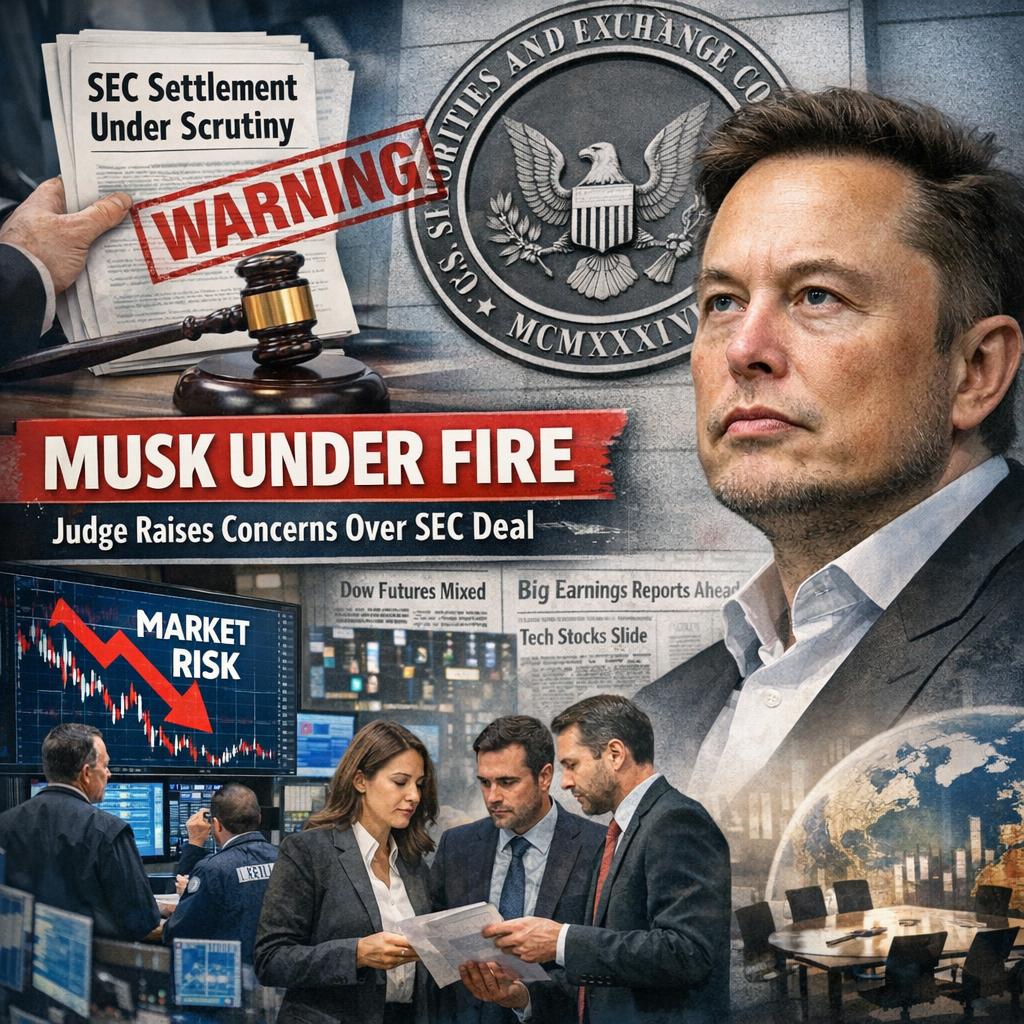
A judge has reportedly raised “red flags” around Elon Musk’s SEC settlement — a reminder that for mega-profile CEOs (especially those who are both influential and highly online), regulatory oversight doesn’t fade just because markets move on. And while this story has a familiar “Musk vs. institutions” flavour, the investor takeaway is broader and more global than one person or one company.
This is about how markets price trust.
Why governance risk matters more than people admit
Most investors are comfortable modelling revenue growth, margins, TAM narratives, even competitive moats. Governance is harder. It lives in the grey zone between personality, process, and accountability.
But governance risk can become financial risk very quickly when it triggers:
1) Regulatory constraints (limits on communications, tighter supervision, or future enforcement)
2) Board-level pressure and management distraction (time, legal costs, internal focus)
3) Volatility premiums (the market quietly demands a bigger discount rate)
4) Counterparty hesitation (partners, lenders, insurers, even talent pipelines become more cautious)
If you’re a global investor, this matters because US capital markets still set the tone for risk pricing worldwide. When the world’s most followed executives face heightened legal scrutiny, it reinforces a simple message: regulatory regimes are not optional “background noise.” They are part of the investment landscape.
The “key-person” premium cuts both ways
In the modern market, certain companies trade with an embedded “key-person premium.” Investors assume the founder-CEO is a strategic advantage: vision, dealmaking, recruitment, product velocity, narrative power.
But the same structure creates a “key-person risk discount” when the person becomes the source of uncertainty.
This is where the Musk story becomes a case study. When an individual’s communication style, public posture, or legal exposure repeatedly intersects with regulators, shareholders are forced to confront an uncomfortable question: how much of the company’s valuation is attached to execution… and how much is attached to the continued freedom (and judgment) of one person?
That’s not a moral question. It’s a portfolio construction question.
Global ripple effects: it’s not just about one ticker
Even if you don’t own Musk-linked companies, stories like this influence markets through three channels:
1) Risk appetite and “story-stock” positioning
When governance headlines hit, the market tends to reprice the most narrative-driven trades first. This can spill into adjacent sectors: high-growth tech, AI infrastructure, EV supply chains, speculative innovation baskets. The common thread is not industry, it’s valuation sensitivity to sentiment.
2) Regulatory signalling
Investors outside the US sometimes underestimate how much American regulatory posture shapes global behaviour. When US regulators and courts appear more assertive (or simply more visible), it can embolden other jurisdictions to tighten standards or enforcement tone.
3) Boardroom behaviour and capital access
Boards watch these cases closely. So do insurers and lenders. If governance concerns rise, the cost of doing business can rise too — even without a direct fine. Higher D&O insurance costs, more restrictive covenants, extra oversight requirements: these are subtle drags that compound over time.
What investors should watch next (practically)
This isn’t a “buy/sell” signal in isolation. It’s a prompt to monitor a few measurable things:
– Legal and regulatory timeline risk: is the situation escalating toward new constraints, or stabilising?
– Disclosure discipline: do communications become more controlled, or does the pattern continue?
– Board independence and response: do you see stronger governance architecture, or reactive PR?
– Volatility and valuation: does the market start charging a higher uncertainty premium?
– Management focus: do operational milestones keep landing on time, or does distraction creep into execution?
In my view, the smartest investors treat governance like credit risk: not exciting, but essential. You don’t need drama for it to matter. You just need enough uncertainty for the market to demand a bigger margin of safety.
If you’re tracking this story too, I’d be interested to hear how you price “CEO/regulatory risk” in your own investing framework. Comment with what signals you watch (or what you think most investors miss).