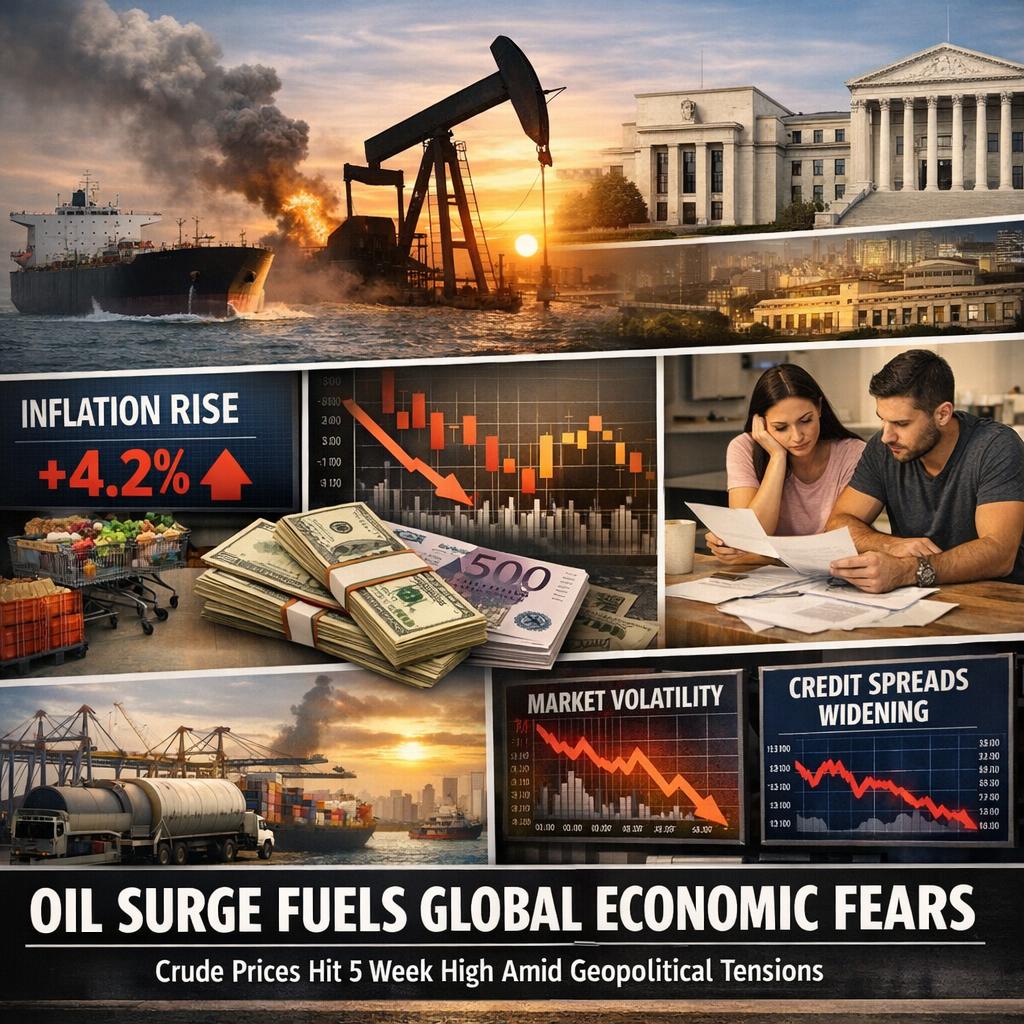
Oil at a five-week high isn’t just an “energy headline” — it’s a global macro event in disguise
The latest move higher in oil, driven by reports of US-Iran attacks and the renewed risk of disruption around key shipping routes, is one of those market stories that can look contained to the energy complex at first glance. But oil is never just oil. It’s a price that quietly touches almost everything: inflation expectations, central bank confidence, corporate margins, consumer spending, and the risk appetite that underpins equity and credit markets.
When crude pushes to a multi-week high on geopolitics, investors should treat it less like a commodity chart and more like a live stress indicator for the global economy.
Why this kind of oil rally matters more than a normal supply/demand move
There are “fundamental” oil moves and there are “risk premium” oil moves.
A fundamentals-driven move is usually about inventories, OPEC decisions, refinery issues, seasonal demand, or slower/faster growth. You can model it, debate it, and, to a degree, hedge it.
A risk-premium move is different. It’s the market repricing uncertainty. It’s traders paying up for the possibility that supply routes become less reliable, that shipping insurance gets more expensive, that tankers reroute, and that governments respond with policy decisions that ripple outward.
And the uncomfortable part for investors is that risk premium tends to be jumpy. It can fade quickly on diplomacy headlines, and then reappear just as quickly on escalation. That makes it uniquely good at destabilising sentiment in other asset classes, especially when positioning is complacent.
The first transmission channel: inflation doesn’t need to “return” — it just needs to stop falling
A lot of the global investment narrative in recent years has been anchored to the belief that inflation is normalising and that rate pressure will eventually ease. Oil complicates that story because energy prices flow into inflation prints directly (fuel, utilities) and indirectly (transport, logistics, plastics, packaging, food inputs).
Even if oil doesn’t stay elevated for months, a sharp move higher can change behaviour:
1) It can lift short-term inflation expectations.
2) It can make central banks less willing to sound dovish.
3) It can raise the bar for rate cuts, or at least slow the pace.
That may not show up immediately in the policy rate, but it often shows up quickly in bond yields and in the “tone” of markets. Equity multiples don’t love that, especially in areas that depend heavily on lower discount rates.
The second transmission channel: consumer pressure arrives quietly, then all at once
Energy shocks are often described as regressive, and the reason is simple: fuel and heating are not optional for many households. When energy costs rise, discretionary spending tends to be the release valve.
Globally, that matters for investors because consumer-facing sectors can start to feel margin pressure and volume pressure at the same time. Companies can try to pass through costs, but demand elasticity eventually bites.
It also matters because the consumer is not just a “US story.” Europe, parts of Asia, and emerging markets can be even more sensitive to imported energy costs and currency moves. When oil rises while the dollar is firm, some countries effectively experience a double tightening: higher commodity costs and a tougher FX translation.
The third transmission channel: corporate margins and the “hidden tax” on growth
Even outside airlines and transportation, oil seeps into cost structures. Logistics costs rise. Input costs rise. Suppliers raise prices. The cumulative effect can look like a slow leak in corporate profitability.
For equity investors, this is where the market’s reaction can become more complicated than “energy stocks up, everything else down.” Some companies have pricing power; others don’t. Some regions subsidise energy; others pass it straight through. Some sectors hedge; others get hit in spot pricing.
A useful way to think about it is that higher oil can behave like a tax on growth. It doesn’t always trigger a recession, but it can shave the edges off earnings expectations and make forward guidance more cautious. That’s often enough to change leadership in the market.
What this means for investors globally (without turning it into a trading call)
1) Be careful about assuming inflation is a one-way street.
If oil stays elevated, markets may have to reprice the “smooth disinflation” story. That doesn’t automatically mean rates surge, but it can mean volatility returns to bonds — and bond volatility tends to infect everything.
2) Watch the second-order effects, not just the crude chart.
Shipping risk, insurance costs, and rerouting can keep pressure on energy-linked prices even if headline crude calms down. The market sometimes underestimates how sticky those knock-on costs can be.
3) Equity leadership can shift fast in an oil-driven tape.
When energy becomes a macro driver, leadership often tilts toward sectors with pricing power, strong cash flows, and more resilient demand. Highly levered balance sheets and long-duration growth narratives can become more fragile if yields rise alongside oil.
4) Emerging markets can diverge sharply.
Oil exporters and oil importers can behave like two different asset classes during an energy shock. Country risk, FX stability, and current account dynamics matter more when energy prices jump.
5) Don’t ignore credit.
Equities get the headlines, but credit markets often give the cleaner signal. If oil is rising because geopolitical risk is rising, keep an eye on spreads and funding conditions. If credit stays calm, the market is saying “manageable.” If it tightens quickly, the market is saying “this could spread.”
The bottom line
Oil at a five-week high on escalating geopolitical risk is not a niche story for commodity traders. It’s a reminder that the global pricing system still has pressure points — and energy remains one of the fastest ways for uncertainty to enter the real economy and the portfolio.
If you’re watching markets right now, it’s worth treating this as a cross-asset event: inflation expectations, central bank reaction functions, consumer resilience, margins, and risk appetite all sit downstream from the oil price when the driver is geopolitics rather than fundamentals.
If you’ve adjusted anything in your portfolio approach when energy risk rises — sector exposure, regional exposure, duration, hedges, or just your risk tolerance — feel free to comment with what you look at first.