Federal Debt Interest Is Quietly Becoming a Market Variable Investors Can’t Ignore
One of the more underappreciated stories in markets right now isn’t about a single company blow-up, a meme stock surge, or even the latest twist in AI. It’s the steady, compounding cost of government debt.
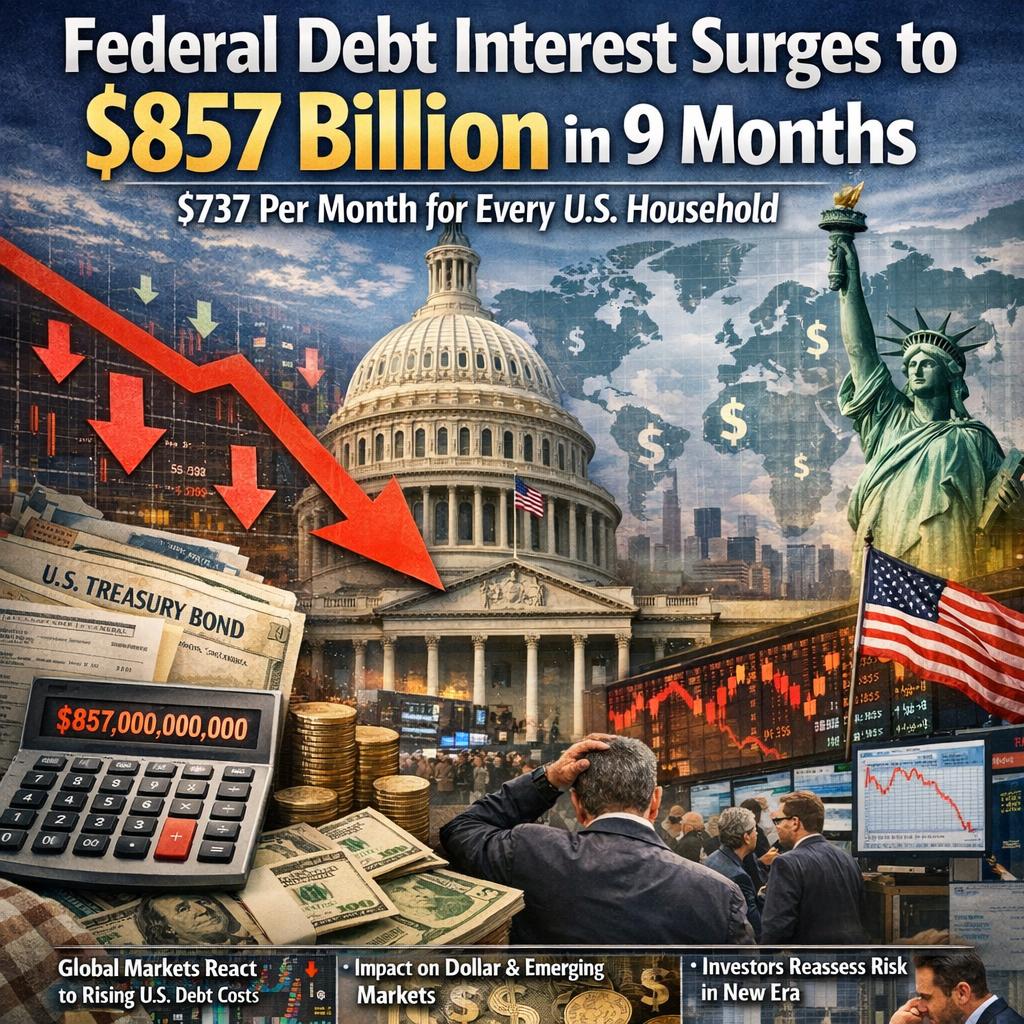
The headline number that caught my eye: US federal debt interest has reached $857B in nine months. Framed another way, that’s roughly $737 per month for every US household. Those are the kinds of figures that can feel abstract until you connect them to the plumbing of global investing—because sovereign debt dynamics don’t stay neatly inside one country’s borders. They leak into currency markets, equity risk premiums, credit conditions, and ultimately, portfolio construction everywhere.
This isn’t “doom” content. It’s a regime reality: higher-for-longer interest rates plus elevated debt levels create a different investment backdrop than the post-2009 era many investors grew up in.
1) Interest expense is becoming a policy constraint, not just a line item
When interest payments were low, deficits were politically noisy but financially manageable. Now the math is tougher.
As debt rolls over and gets refinanced at higher yields, interest expense rises even if spending doesn’t. That matters because it narrows the range of comfortable policy choices. Governments can do some combination of:
– Spend less (fiscal tightening)
– Raise revenues (tax increases or improved collection)
– Borrow even more (risking higher yields if investors demand compensation)
– Or hope for growth/inflation to do the heavy lifting (which comes with second-order effects)
From an investor’s perspective, the key point is that interest expense starts competing with everything else governments want to fund. And once that competition becomes visible, markets begin to price policy trade-offs more aggressively.
2) Treasury yields don’t just affect bonds; they reprice the entire risk stack
If you take one mechanism away from this post, let it be this: the “risk-free rate” is the foundation under nearly every valuation model.
When government yields rise and stay elevated, the discount rate on future cash flows rises too. That can compress equity multiples, particularly for long-duration assets (companies where much of the value is expected far in the future). It can also reset hurdle rates for private equity, real estate, and venture capital.
In plain terms: in a world where cash yields something meaningful and government bonds pay a decent coupon, investors become more selective about which risks they’re willing to take—and what price they’ll pay to take them.
This doesn’t mean equities can’t perform. It means the market becomes less forgiving:
– More sensitivity to earnings quality
– More scrutiny on leverage
– Less tolerance for “story stocks” with weak cash generation
3) Global spillovers: the dollar, capital flows, and emerging markets
Because the US Treasury market is the world’s benchmark, rising US yields can pull capital toward dollar assets, strengthening the dollar and tightening financial conditions globally.
That matters for:
– Emerging markets with dollar-denominated debt (their debt service can become more expensive)
– Countries importing inflation via currency weakness
– Global companies that report in dollars but earn abroad (FX translation effects)
– Commodity pricing, which is often dollar-linked
So even if you never buy a Treasury bond, Treasury yields can still move the ground beneath your portfolio.
4) The “fiscal risk premium” conversation is back
For years, many investors treated developed-market government debt—especially US debt—as the closest thing to a universal collateral asset: deep, liquid, and unquestioned.
What changes in a high-interest-expense environment is that markets start asking more pointed questions:
– Will issuance keep rising?
– Who is the marginal buyer?
– How sensitive are auctions to shifts in risk appetite?
– What happens if inflation re-accelerates while deficits remain wide?
This is where the concept of a fiscal risk premium appears. Not because default is around the corner, but because investors might demand extra yield to compensate for supply, inflation uncertainty, and policy volatility.
Even a small shift here matters. When trillions are refinanced, a modest increase in average borrowing cost can cascade through budgets and, in turn, influence growth expectations and market sentiment.
5) What this means for investors (without pretending there’s one perfect play)
I’m wary of posts that turn macro complexity into a single trade. Instead, here are the practical portfolio implications I think are worth considering:
A) Diversification has to be real again
In the low-rate era, investors could get away with “diversified” portfolios that were effectively one bet: long growth duration. With rates and fiscal dynamics in play, broader diversification across styles, geographies, and risk factors matters more.
B) Balance sheet strength deserves a premium
Companies with heavy refinancing needs, floating-rate exposure, or weak interest coverage are structurally more sensitive to this environment. Strong free cash flow and prudent leverage become more than nice-to-haves.
C) Be intentional about duration
Duration isn’t just a bond concept. Many equities behave like long-duration assets too. Investors should know where their portfolio sits on that spectrum and whether that matches their conviction about rates.
D) Inflation resilience is not an outdated theme
Higher interest expense can create incentives for financial repression or policies that tolerate higher inflation. That doesn’t guarantee inflation returns—but it keeps inflation risk on the table. Assets with pricing power and inflation-linked cash flows become strategically valuable.
E) Don’t ignore currency
For global investors, the currency layer can dominate returns over shorter horizons. A stronger dollar can be a headwind for some international allocations, while currency-hedged exposures may behave very differently than unhedged ones.
The bigger picture: this is a “cost of capital” world again
The most important shift is psychological as much as financial. In a near-zero-rate world, capital felt abundant and time felt cheap. In a world where interest expense is exploding and yields are real again, capital has a price, and time carries a higher opportunity cost.
That tends to reward discipline:
– Profitability over promises
– Margins over narratives
– Risk management over bravado
It also tends to increase dispersion. Instead of a rising tide lifting most boats, you get sharper winners and losers—across sectors, across countries, and even within the same industry.
If you’re watching this theme closely, I’d be interested to hear how you’re thinking about it: is rising government interest expense a slow-burn macro backdrop, or a catalyst that eventually forces a more visible shift in market pricing? Comment with your view.