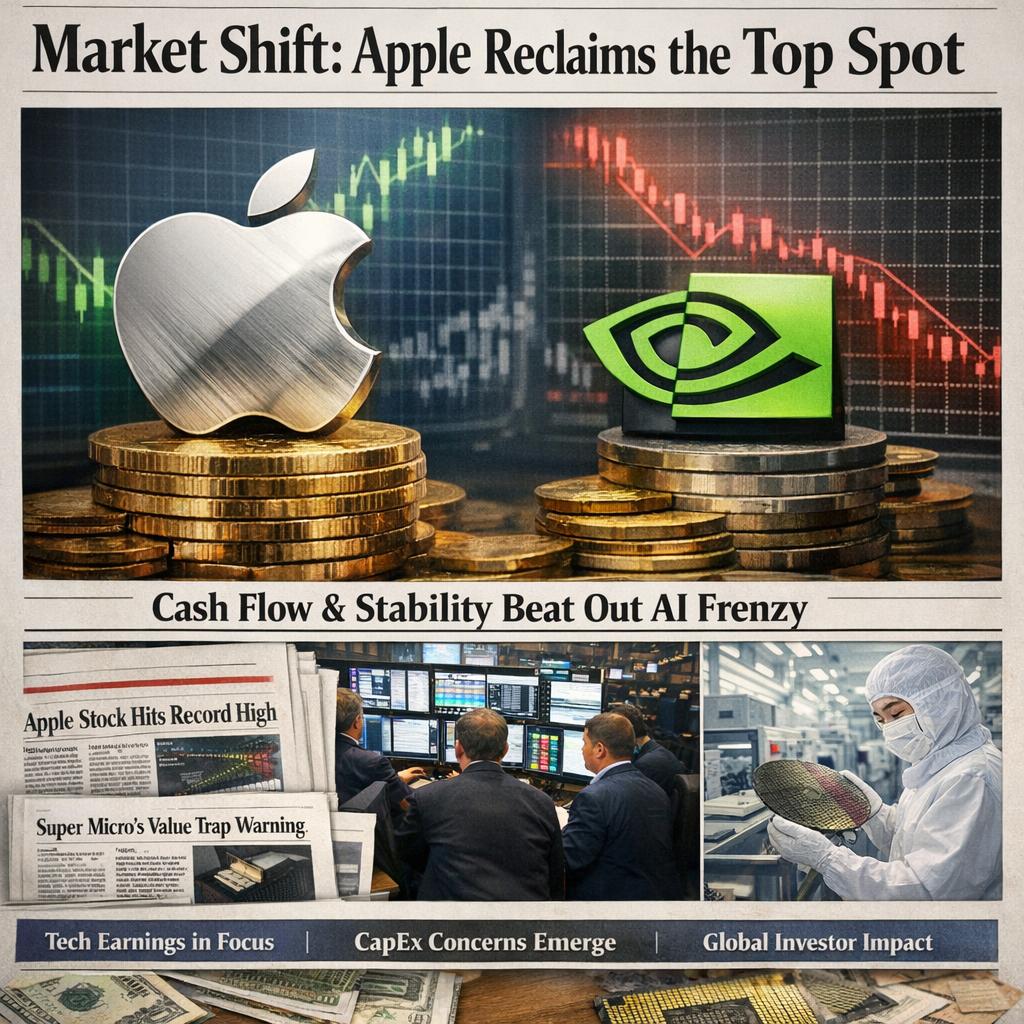
Apple overtaking Nvidia to reclaim the “most valuable company” title might look like a simple leaderboard swap, the kind of thing that gives financial media a clean headline and traders a quick narrative. But I think it’s more interesting than that, because it hints at a broader shift in what the market is rewarding right now: not just AI exposure, but disciplined capital allocation and durable cash-flow machines.
In other words, it’s not only about who has the most exciting story. It’s about who can turn scale into returns without falling into the “capex trap.”
Why this moment matters beyond Apple vs Nvidia
Over the last couple of years, global equity markets have been dominated by a single gravitational force: AI. It hasn’t just lifted a group of companies; it has reshaped how investors think about growth, moats, and even what “defensive” means in a world where technology is embedded in everything.
Nvidia became the emblem of that era because it sits near the choke point of the AI buildout. If you believe AI demand keeps compounding, you can make a clean case that Nvidia’s earnings power is still underappreciated even after huge gains.
So when Apple steps back into the top spot, it can read like the market is quietly rebalancing its own enthusiasm. Not abandoning AI—far from it—but broadening the definition of “quality” again. Apple’s appeal in this context isn’t that it’s the most direct AI infrastructure play. It’s that it tends to be the kind of business that can absorb uncertainty while continuing to generate massive free cash flow.
And that distinction matters for investors globally, because it speaks to where we may be in the cycle: not a full-on risk-off regime, but perhaps a more selective, valuation-sensitive phase where “show me the returns” starts to beat “tell me the story.”
The capex pitfall: the market’s quiet anxiety inside the AI boom
One of the under-discussed tensions in the AI trade is that the winners and the “almost winners” can look identical in the early innings.
When a technology wave hits, companies rush to invest: data centers, chips, networking, talent, acquisitions, long-term supply contracts. Those investments can be rational, even necessary. But they also create a risk that the market often prices late: what if the spending grows faster than the profitability?
This is the capex pitfall. It happens when:
1) The competitive landscape forces everyone to spend.
2) Demand is real, but pricing power erodes as supply catches up.
3) Customers become more sophisticated and start negotiating harder.
4) The “growth at any cost” phase outlasts investor patience.
Apple, by contrast, is often seen as a company that can expand capabilities without having to constantly bet the balance sheet. It doesn’t mean Apple doesn’t invest—it does—but investors tend to believe those investments will be managed with a tight focus on margins, ecosystem leverage, and return on capital.
That’s likely part of why markets are comfortable awarding it a premium “stability halo” even while still participating in the AI narrative.
The bigger signal: quality is being redefined, not replaced
For a while, “quality” in markets became almost synonymous with “owns the AI rails.” But the longer a theme dominates, the more investors start separating:
– Companies that benefit from the theme
from
– Companies that can convert that benefit into sustained shareholder returns
This is a subtle but important shift. It’s the difference between “excitement pricing” and “compounder pricing.”
Apple sits firmly in the second camp in investors’ minds: a global brand, sticky customer base, a services engine, and a history of returning capital. Nvidia sits in a hybrid zone: it’s a phenomenal beneficiary of AI, but its valuation and cyclicality (chips always have cycles) mean investors will periodically pressure-test the assumptions.
So Apple reclaiming the crown can be read as a market telling you something like: we still want growth, but we also want reliability. We want winners that don’t have to keep raising the stakes just to stay in the game.
Why global investors should care (even if you don’t own either stock)
This kind of “leadership rotation” at the very top of the market matters because it influences flows, positioning, and risk appetite across portfolios worldwide.
1) Index gravity and passive flows
Apple and Nvidia aren’t just big companies; they’re structural pillars in global indices. When the mega-caps move, they pull index performance with them, which then influences everything from pension allocations to retail sentiment. If the market’s leadership leans toward cash-flow durability, you often see knock-on effects: other high-quality, profitable businesses get bid up while more speculative names face tougher scrutiny.
2) FX and cross-border portfolio decisions
When investors globally decide the US is offering the “best quality growth,” capital tends to concentrate. That can influence currency dynamics, hedging costs, and relative valuations between US equities and other regions. You don’t need to be a macro trader to feel that—international investors see it in local-market underperformance and the cost of currency hedges.
3) The AI supply chain isn’t a straight line
Even if Apple isn’t the pure AI infrastructure play, it sits on top of an enormous global supply chain. Shifts in Apple sentiment can ripple through semiconductors, components, logistics, and consumer electronics exposure across Asia, Europe, and emerging markets. Leadership changes at the top often become “sentiment weather” for entire sectors.
4) Valuation discipline is returning in pockets
When a market is in full momentum mode, valuation can feel like a relic. When the market starts to reward capex discipline and consistent cash generation, it becomes harder for companies to justify big multiples without clear profitability. That matters for global investors because it affects which regions and sectors attract marginal capital.
How I’d frame this as an investor (without turning it into a “buy/sell” call)
I’m not treating “Apple back on top” as a verdict that the AI trade is over. I see it more as a reminder that markets are always running two pricing engines at once:
– A narrative engine (what could be huge)
– A cash-flow engine (what is durable and repeatable)
When those two engines align, you get powerful trends. When they diverge, you get volatility, rotation, and sudden re-ratings—especially in crowded trades.
So the practical takeaway for me is less about picking the single winner and more about portfolio construction:
– If you’re heavily concentrated in theme-driven winners, ask whether you’re also concentrated in capex intensity and cyclical risk.
– If you’re underweight “boring” cash-flow machines because they felt slow during the momentum phase, it may be worth reassessing what “defensive” actually means when rates, geopolitics, and growth expectations can change quickly.
– If you’re global, think about the second-order effects: sector exposure through indices, currency impacts, and whether your diversification is real or just “different tickers in the same factor trade.”
There’s a reason the biggest companies become the biggest stories: they’re not just stocks, they’re signals. And this one looks like a signal that markets still love the AI future—but they’re getting pickier about how that future is financed.
If you’re watching this shift too, I’d be interested to hear what you think: is this a temporary reshuffle driven by positioning into earnings, or the start of a broader move back toward cash-flow certainty at the top of the market?