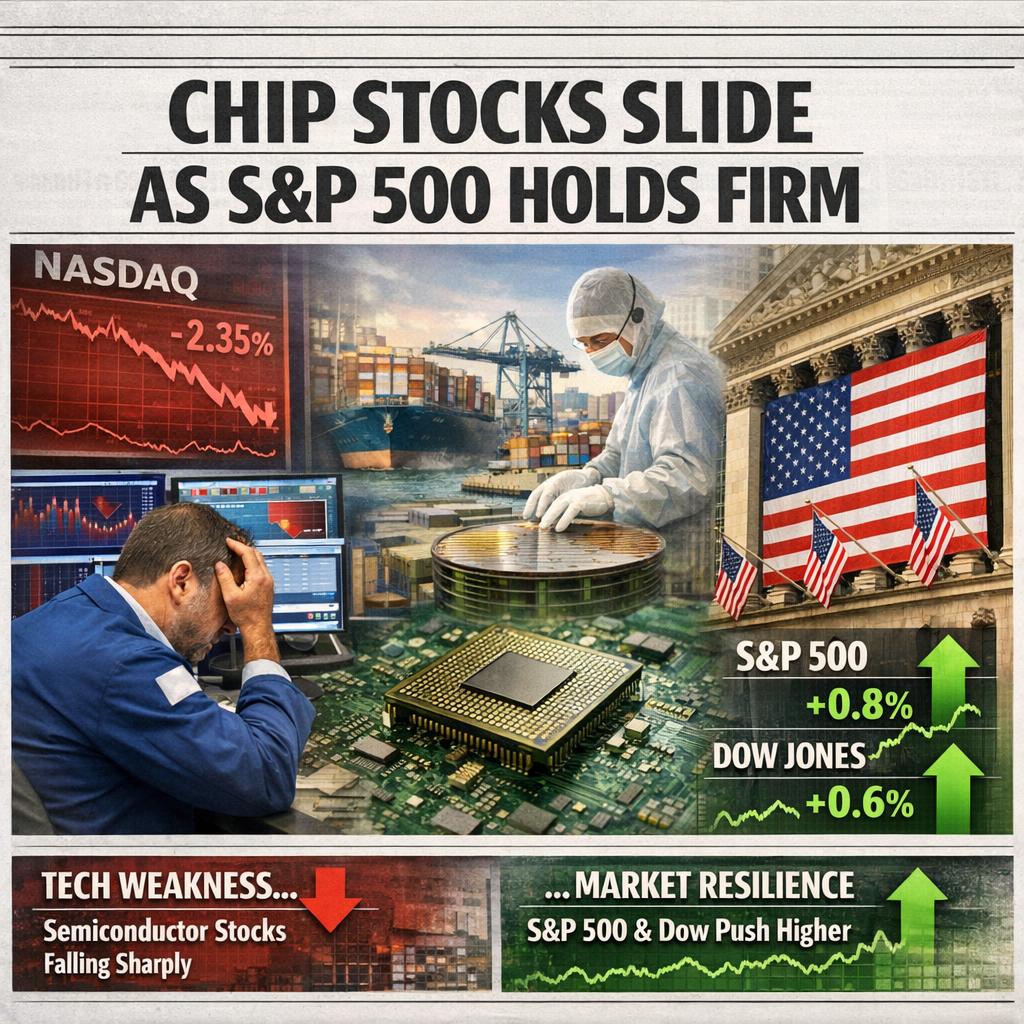
Chip Stocks Slipping While the S&P Holds Up: A Small Market Move With Big Global Implications
One of the more interesting market stories right now isn’t an all-out selloff or a euphoric melt-up. It’s something subtler: the Nasdaq trimming losses while chip stocks slide, even as the S&P 500 and Dow manage to grind higher.
On the surface, that sounds like an ordinary day of sector rotation. Under the hood, it’s a reminder of how concentrated global equity returns have become, how quickly leadership can wobble, and why investors outside the US should care just as much as investors inside it.
Because when semiconductors sneeze, a lot of the world catches a cold.
Why chips matter more than “tech”
Semiconductors sit at a strange intersection: they’re technology, yes, but they’re also industrial capacity, national security, supply chain resilience, and (increasingly) the limiting factor for AI ambitions. They touch nearly every part of the modern economy: smartphones, cloud infrastructure, vehicles, defense systems, manufacturing automation, medical devices, energy grids, and consumer electronics.
So when you see chip names sell off while the broader market stays relatively steady, it’s not just a “risk-on/risk-off” toggle. It can be the market quietly repricing the pace of future growth expectations.
And because semis are so central to the AI narrative, moves in chip stocks also act like a real-time referendum on how much optimism is already priced into markets.
A healthy rotation or an early warning?
There are two ways to interpret a day where semis are weak but the Dow and S&P are resilient.
The constructive interpretation is rotation. Investors take profits in the hottest part of the market and reallocate toward “steady compounders,” defensive earners, and businesses with clearer near-term cash flows. In that world, the market broadens out, becomes less dependent on a narrow cohort of stocks, and looks more stable.
The less comfortable interpretation is that the market is starting to question the most expensive growth assumptions first. When leadership cracks at the margin, it doesn’t automatically mean a bear market is coming. But it does mean the easy part of the trade might be behind us.
In concentrated markets, leadership matters. If the same group of stocks has been doing an outsized amount of the lifting, the index can look fine right up until it doesn’t. A wobble in the highest-expectation segment is often where sentiment shifts first.
What this means for investors globally
Even if you don’t own US semiconductors directly, you may have more exposure than you think.
1) Index-linked exposure is bigger than people realize
Pensions, ISA-style accounts, robo-portfolios, and “global equity” funds often lean heavily toward US large caps, and US large caps have had meaningful exposure to AI-linked themes. If chips weaken materially, it can show up in performance even for investors who feel diversified.
2) Currency effects can amplify or cushion the move
For non-US investors, market returns are a blend of asset performance and FX. A tech-driven risk-off moment can strengthen or weaken the dollar depending on the broader macro backdrop (rates, growth expectations, flight-to-safety dynamics). That can turn a mild equity dip into a more meaningful drawdown in local-currency terms—or soften the blow.
3) The ripple hits manufacturing regions quickly
Semis are deeply tied to East Asian manufacturing ecosystems, European industrial demand, and global capex. If chip stocks are selling off because the market expects slower demand or margin pressure, that narrative can spill over into suppliers, equipment makers, logistics, and even commodity inputs.
4) It’s a signal for global growth sensitivity
Semiconductors are a “high beta” expression of global growth and investment cycles. When the market gets cautious, it often shows up first in the areas with the most optimistic earnings trajectories and the most cyclicality underneath the story.
What to watch next (the practical checklist)
If this is just a one- or two-day tremor, it will fade. If it’s a change in leadership, it will leave footprints. Here are a few things worth tracking without getting lost in the daily noise:
1) Market breadth
Are more stocks participating in gains, or are fewer names doing all the work? A market that’s rising with improving breadth is generally healthier than one rising on narrowing leadership.
2) Relative strength: semis vs. the broader index
Watch how semiconductor indices perform versus the S&P 500 over a few weeks, not a few hours. Persistent underperformance can indicate a rotation away from the AI growth premium, even if the overall market holds up.
3) Rates and the “duration trade”
High-growth stocks are more sensitive to discount rates. If yields are rising (or expected to stay higher for longer), the market often compresses the valuation multiples on long-duration growth stories first. Even small shifts in rate expectations can have outsized effects on the most expensive corners of the market.
4) Earnings quality, not just earnings beats
Chip stocks can “beat” and still sell off if guidance, margins, or forward demand signals disappoint. The market is less forgiving when expectations are elevated.
5) Capex signals from the hyperscalers
AI enthusiasm is partly a capex story. If large cloud and platform companies signal any slowdown or tightening, the market tends to translate that quickly into chip demand assumptions.
Portfolio implications (without overreacting)
This is not a call to abandon technology or semiconductors. It’s a reminder to be intentional about concentration and narrative exposure.
A few disciplined takeaways that apply to most long-term investors:
Rebalance when a theme becomes a portfolio’s backbone by accident.
If a handful of winners have quietly become a very large percentage of your equity exposure, a small trim can reduce risk without changing your core view.
Separate “AI is real” from “AI stocks are priced perfectly.”
Both can be true: the technology can be transformative and the market can still overpay at points in the cycle. The price you pay determines a lot of your outcome.
Diversify by earnings drivers, not just by ticker count.
Owning 30 stocks isn’t diversification if they’re all dependent on the same macro factor (rates), the same customer base (enterprise capex), or the same narrative (AI acceleration).
Keep an eye on defensives that are actually defensive.
Some stocks get labeled “defensive” because they’re familiar, but the real defense is pricing power, stable demand, and resilient margins through cycles.
The bigger point: markets are negotiating the future in real time
Days like this are the market negotiating what the next 12–24 months should look like: growth, rates, margins, capex, and competitive dynamics. Semiconductor weakness alongside index resilience can be nothing more than profit-taking. Or it can be the early stage of a broader shift in leadership.
For global investors, the key is not to get hypnotized by index-level calm. Look through the surface. Watch where the stress is appearing, where money is rotating, and whether the “new winners” are durable businesses or just temporary parking spots.
If you’ve been watching the chip space closely, I’d be interested to hear how you’re interpreting this move: healthy rotation, or the start of something bigger? Comment with what you’re tracking.