The cacophony of daily market news can often feel like a blur—earnings beats, analyst upgrades, geopolitical tremors, and economic data points all competing for attention. Yet, every so often, a single headline cuts through the noise not just for its immediate impact, but for the stark, almost philosophical conflict it lays bare about how we value power, authority, and economic management. This week, one such story did exactly that.
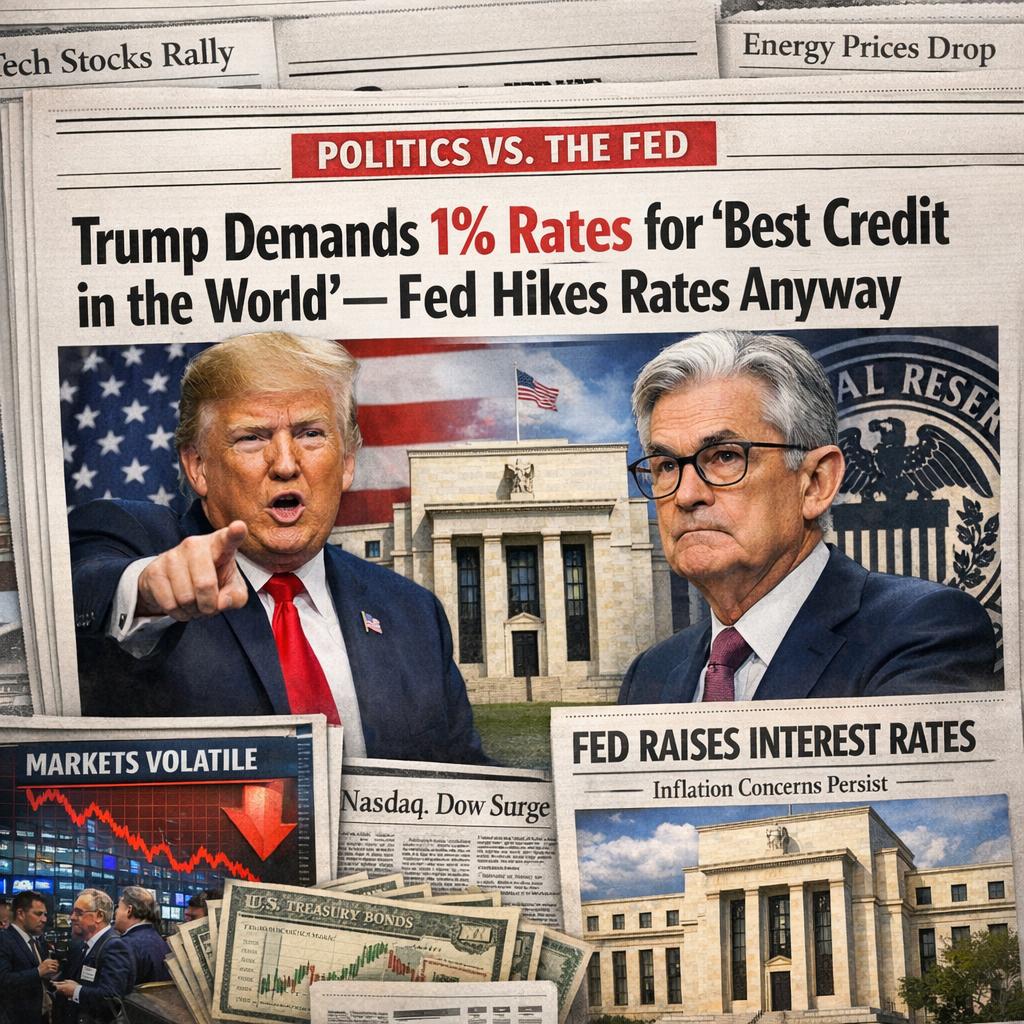
The headline was direct: “Trump demands 1% rates because the US has the ‘Best Credit in the World’ — the Fed hiked rates anyway.” On the surface, it’s a simple report on monetary policy divergence. But beneath that surface lies a profound tug-of-war that every global investor must understand: the clash between political narrative and institutional independence.
The argument for a 1% federal funds rate, as presented, is seductively simple. It frames national creditworthiness as a singular, paramount metric. The logic follows that if the United States borrows in its own currency and has never defaulted, it should enjoy the lowest possible cost of capital, a benefit theoretically passed to businesses and consumers. This view is inherently political and populist, appealing to a sense of national exceptionalism and the immediate relief lower rates would provide to debtors. It’s a perspective that prioritizes stimulating economic activity and managing the cost of servicing the national debt above all else.
The Federal Reserve’s decision to hike rates, in direct contradiction to this demand, is the institutional counter-argument. The Fed’s mandate is not to affirm national prestige but to ensure price stability and maximum employment. Its decision-making is (ideally) insulated from political cycles, driven by data on inflation, employment figures, wage growth, and long-term financial stability. A 1% rate in the current economic climate, as the Fed evidently sees it, would be wildly inappropriate—a recipe for re-igniting inflationary pressures, distorting asset prices further, and undermining the dollar’s value. Their move signals a focus on the conditions of the economy, not its reputation.
For the global investor, this isn’t just a Washington spat. It’s a live case study in risk assessment. When political pressure mounts on independent central banks, it introduces a new variable into the market calculus: the risk of institutional erosion. The credibility of a central bank is its most valuable asset. If markets begin to doubt that the Fed is free to act on purely economic grounds, the entire pricing structure of dollar-denominated assets comes into question. Bond yields could become more volatile, reacting to political rhetoric as much as to inflation data. The dollar’s status as the world’s reserve currency, deeply tied to trust in U.S. institutions, could face incremental, long-term strain.
Conversely, the Fed’s decision to hike in the face of such public pressure is a powerful, if tense, reaffirmation of that institutional credibility. It tells global capital that, for now, the technocrats are still at the wheel, prioritizing long-term stability over short-term political expediency. This action likely provided a bedrock of certainty amidst other market movements—perhaps partly explaining the resilience in tech and broader indexes noted in other reports, as investors appreciated a known, if painful, variable over an unpredictable one.
The takeaway here is nuanced. Investors aren’t simply choosing a side between a politician and a central bank. They are constantly gauging the balance of power between them. A world where central banks are perceived as truly independent creates a different set of risks (primarily data-dependent policy shifts) than a world where they are seen as bending to political will (which introduces unpredictable, narrative-driven volatility).
This particular episode underscores that one of the most critical assets in any market isn’t listed on any exchange: institutional integrity. Its preservation, or its erosion, will dictate capital flows, currency valuations, and risk premiums far more than any single rate decision. As we navigate this landscape, watching this tension play out remains one of the most crucial exercises for anyone with capital in the global game.
I’m keen to hear your perspective on how this dynamic influences your own approach to asset allocation. Feel free to share your thoughts in the comments.