Today’s market narrative feels pulled in two powerful, opposing directions. On one hand, we have the grand, almost philosophical declarations about the future of value itself. On the other, a steady drumbeat of granular, fundamental business updates that demand a forensic level of scrutiny. The tension between these two modes of analysis—the macro prophecy and the micro reality—is where thoughtful investors often find their edge.
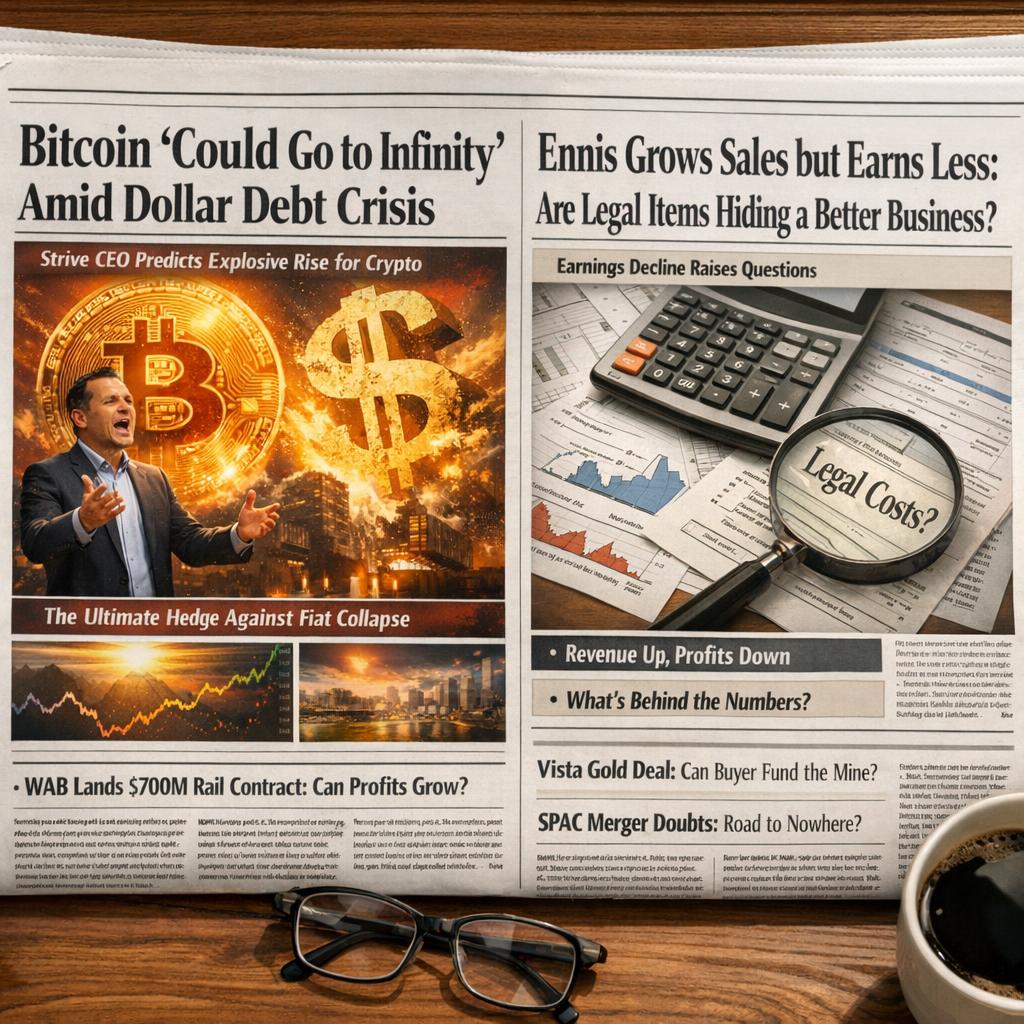
Consider the stark contrast in this morning’s financial headlines. One story features a CEO proclaiming that Bitcoin could mathematically “go to infinity,” framed as the ultimate hedge against a breaking dollar debt crisis. It’s a compelling, universe-scale narrative that taps into deep-seated fears about fiat currency and the search for a digital lifeboat. The language is maximalist, designed to capture attention and stir conviction.
Yet, just a scroll away, we encounter a more muted but equally critical story: Ennis, a business forms and apparel company, reported growing sales but declining earnings. The headline poses a precise, accountant’s question: “Are Legal Items Hiding a Better Business?” This isn’t about infinity; it’s about the finite details of a balance sheet, about one-time legal settlements or restructuring costs that may be obscuring the underlying operational health. It’s a puzzle for those willing to dig into the footnotes.
This dichotomy is the essence of modern market participation. The “infinity” narrative drives sentiment, liquidity flows, and can dictate the broad risk-on or risk-off environment that all assets swim in. A widespread belief in a looming dollar crisis can pull capital out of traditional sectors and into alternative stores of value, affecting everything from treasury yields to emerging market currencies. It sets the stage.
But on that stage, individual companies continue to perform their own, distinct plays. Ennis’s report is a masterclass in looking beyond the top line. Sales growth is typically a green light, a sign of market share gains or strong demand. But when earnings move in the opposite direction, it’s a flashing amber. It forces an investigation. Are margins being squeezed by input costs? Is the company investing heavily for future growth, depressing current profits? Or, as the article suggests, is it a one-time legal or regulatory charge creating a temporary distortion? The answer determines whether this is a weakening business or a temporarily disguised one—a crucial distinction for a value-oriented investor.
This pattern of digging beneath the headline repeats across other dispatches. Westinghouse Air Brake signs a substantial $700 million-plus rail services deal, which speaks to backlog and visibility. But the immediate follow-up question is, “Can Profits Grow?” A large contract doesn’t automatically mean high-margin business; execution and cost management will determine its true value. Similarly, Vista Gold agrees to a sale, but the pivotal query is about the buyer’s capacity to fund a major gold mine development. The transaction headline is just the first step; the capital allocation follow-through is what ultimately creates value.
Meanwhile, in the red-hot AI ecosystem, we see the market itself performing this analytical triage in real time. A little-known chip stock doubles on news of its technology doubling optical speeds—a pure play on a specific, high-growth bottleneck. Elsewhere, Lumentum jumps 10% while Corning barely moves, prompting analysts to ask if the “AI optics trade” is splitting into winners and losers rather than lifting all boats. This is sectoral rotation driven by microscopic differentiation in technology and execution, a world away from broad “infinity” bets.
For a global investor, the lesson is about maintaining a dual lens. The macro narratives—like the dollar debt crisis or the AI revolution—provide the context, the wind direction. They help you understand why capital is moving between asset classes, why certain sectors are in or out of favor. Ignoring them is akin to sailing without checking the weather.
However, the micro realities—the Ennis earnings reports, the WAB contract details, the specifics of an AI chip’s performance—determine the seaworthiness of your individual vessels. In a market swept up by grand prophecies, it is often in these detailed, unsexy financial disclosures where true risks are hidden and genuine opportunities are overlooked. While the crowd gazes at the promise of infinity, the diligent investor is often better served by reading the fine print. I’m keen to hear which side of this divide you find more compelling in your own analysis. Feel free to share your thoughts below.