In the daily churn of market headlines—where billion-dollar deals, AI breakthroughs, and speculative crypto prophecies compete for attention—it’s easy for the foundational mechanics of business to get lost in the noise. A story that caught my eye this morning serves as a potent reminder that the most critical analysis often lies not in the grand announcement, but in the quiet, contradictory details that follow.
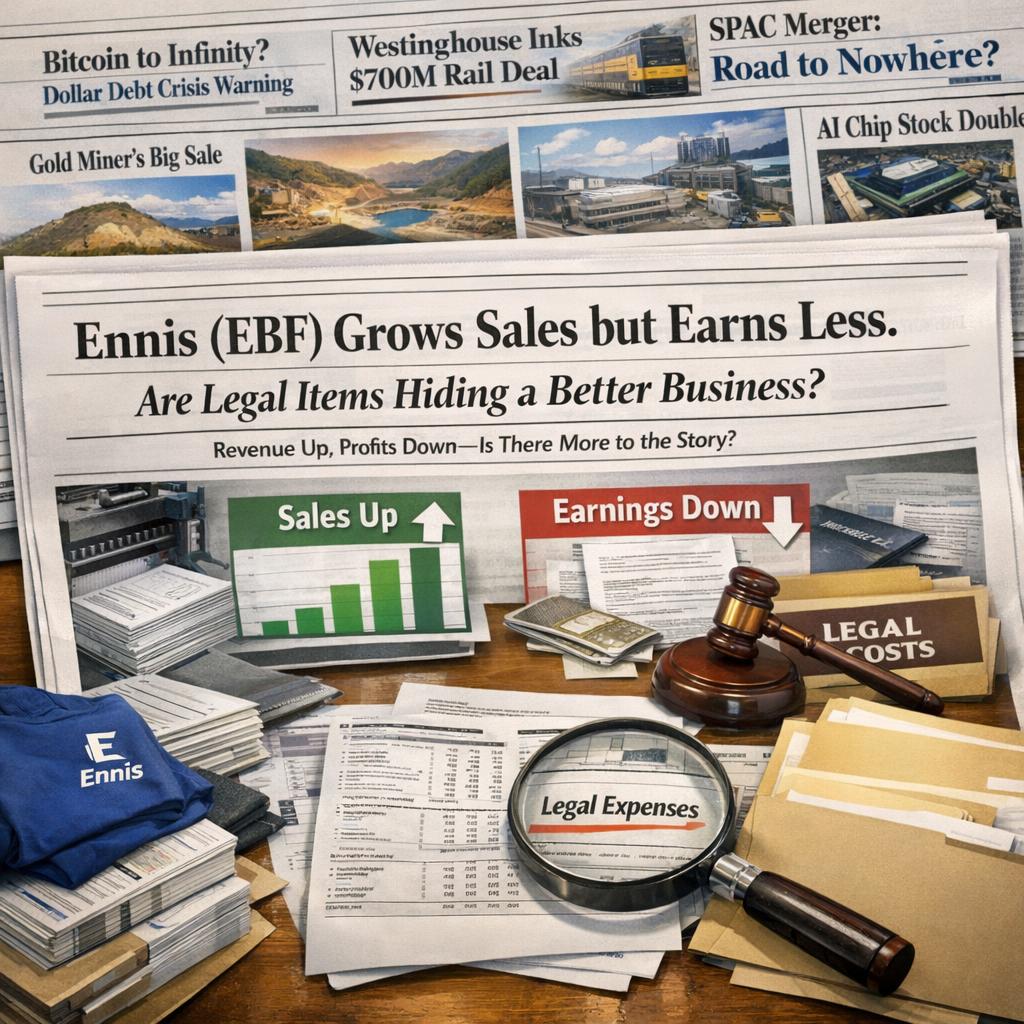
The headline was straightforward: “Ennis (EBF) Grows Sales but Earns Less.” On the surface, it’s a simple, almost disappointing data point. A company that manufactures business forms, apparel, and printing services reported higher revenue yet saw its earnings decline. In a market obsessed with top-line growth, particularly in flashy sectors, this might prompt a swift, negative judgment. But the article’s subtext, hinted at in its own title, is where the real lesson for global investors begins: “Are Legal Items Hiding a Better Business?”
This single sentence frames a universal investment dilemma. We are presented with two competing narratives. The first is the raw, reported outcome: profits are down. The second is the suggestion of a non-recurring, legal or one-time cost obscuring the underlying operational health. The market’s immediate reaction and our long-term assessment hinge entirely on which narrative we choose to believe and, more importantly, how deeply we dig to verify it.
For a company like Ennis, which operates in the essential but unglamorous world of printed products and wearables, this earnings report is a microcosm of a much broader market theme. In an era dominated by discussions of AI margins and cryptocurrency valuations, traditional industrial and service businesses are still the bedrock of the real economy. Their stories are told not in hype cycles, but in balance sheets and cash flow statements. The “legal items” in question could be anything from the settlement of a long-running lawsuit to costs associated with a regulatory change or a plant closure. These are not operational failures; they are financial events that cleanse the slate. If an investor dismisses the stock based on the headline earnings drop without investigating these items, they may be overlooking a company that is actually growing its core customer base and improving its market position—a company now available at a discounted price because of a temporary accounting reality.
This connects directly to the pulse of global markets right now. We’re in a climate where capital is selective and volatility is often driven by sentiment. The flood of news on any given day—from Westinghouse Air Brake’s substantial $700 million rail deal, to the cautious skepticism around May Mobility’s SPAC merger, to the stratospheric predictions for Bitcoin as a hedge against “dollar debt crisis”—creates a cacophony. Each piece invites a reaction: buy, sell, fear, or greed.
The Ennis report is a call for a different response: pause and scrutinize. It underscores that global investing isn’t just about chasing the next big thing; it’s about discerning durable value from fleeting noise. A legal settlement depressing earnings today has no bearing on whether a company will fulfill print orders or sell workwear tomorrow. Similarly, a massive deal for rail services signals long-term industrial confidence, while a speculative SPAC merger carries a different, riskier set of assumptions. The AI chip stock that doubled on a new product unveiling exists in a different universe of expectations than a gold miner arranging financing for a mine.
For investors watching from London, New York, Singapore, or anywhere else, the implication is clear. The information age provides an abundance of data, but it also creates a mirage of understanding. Headlines are designed to capture attention, not to convey nuance. The real work begins after the click. It’s in the management discussion, the footnotes to the financial statements, and the context of industry trends. Is the sales growth at Ennis coming from price increases or volume? Is the market for their products shrinking or stable? What is the nature and size of the “legal item,” and is management providing clear guidance going forward?
These are the questions that separate thematic betting from fundamental investing. They are applicable whether you’re analyzing a legacy printer, a cutting-edge optics company like Lumentum, or a semiconductor giant like Intel facing new competitive pressures. In every case, the reported figure is just the starting point. The truth—and the opportunity—lies in the layers beneath.
As we navigate a landscape filled with both transformative promise and old-fashioned operational challenges, let the case of a company growing sales but earning less serve as a useful checkpoint. It’s a reminder that in global finance, clarity is rarely given; it is excavated. I’m always interested in other examples where the headline story diverged sharply from the underlying business reality—feel free to share your observations in the comments.