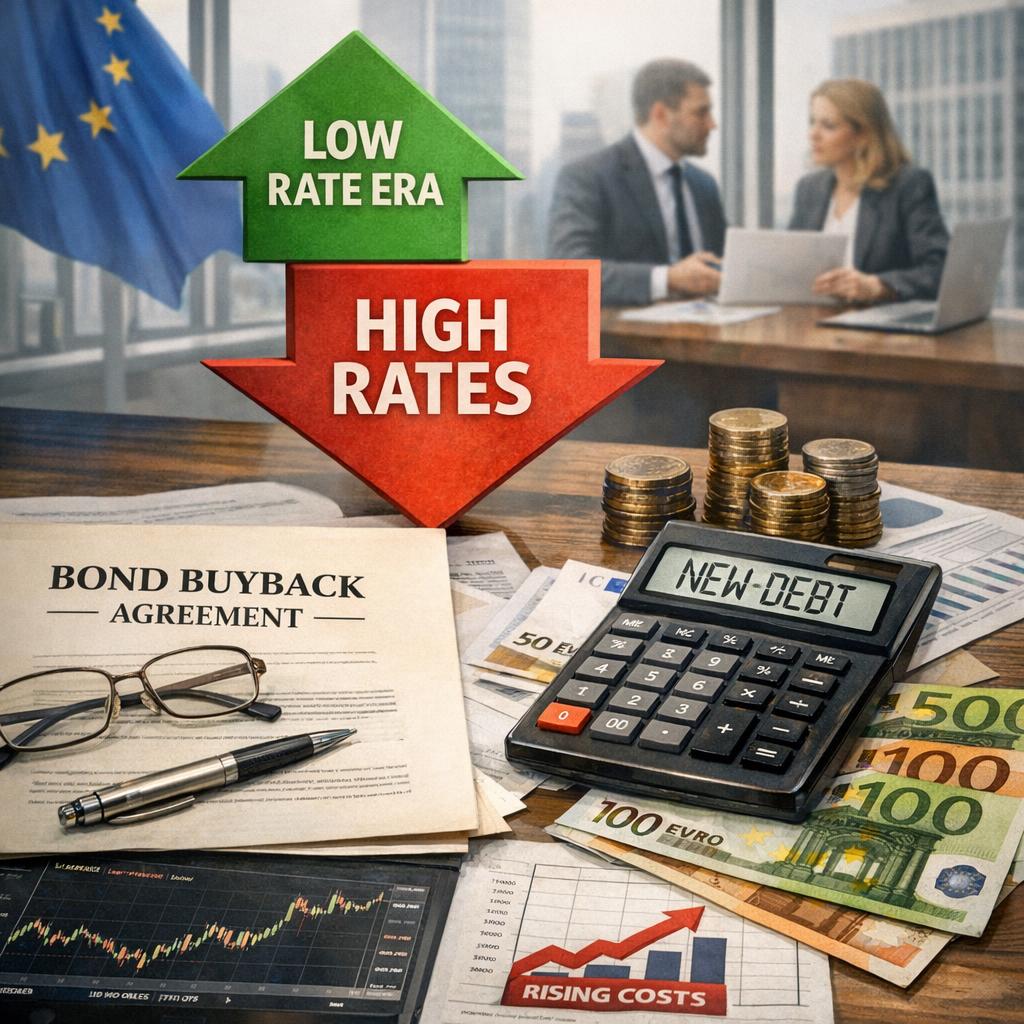
This week, a piece of news from the corporate debt markets cut through the usual noise with a quiet but definitive thud. It wasn’t about a flagship company defaulting or a dramatic bankruptcy filing. Instead, it was about a significant, investment-grade European firm successfully completing a bond buyback tender. The operation itself was textbook, but the context and the outcome were anything but routine. For global investors, it served as a potent, real-time indicator of a profound and uncomfortable shift: the era of cheap capital is not just over; its reversal is now actively rewriting corporate playbooks in real-time.
The mechanics are simple. A company offers to repurchase its own outstanding bonds from investors before maturity, usually at a small premium to the current market price. Historically, this move was often a sign of strength—a company with ample cash seeking to optimize its balance sheet, reduce interest expenses, or simply remove debt from its books. The narrative was one of proactive financial management. What made this latest event so telling was the stark financial logic behind it. The company was not repurchasing this debt with excess operational cash flow. It was funding the buyback by issuing new debt.
On the surface, that seems illogical. Why borrow more money to pay off existing debt? The answer lies in the cold arithmetic of interest rates. The bonds being bought back were issued several years ago, in the twilight of the low-rate era. They carried a coupon reflective of that time. The new debt being issued, however, is priced in today’s market, characterized by persistently higher benchmark rates. The company’s calculus revealed that even with today’s higher rates, the overall cost savings—when factoring in the premium paid to repurchase the old bonds—were still materially positive. They are literally refinancing upwards to save money.
This is a watershed moment. It confirms that the interest rate reset is so severe that it has inverted traditional refinancing logic. The “higher-for-longer” regime is not a forecast; it is a current operating condition. For investors globally, this singular transaction radiates implications across multiple portfolios.
Firstly, for fixed-income investors, the playbook for credit analysis needs an urgent update. The quality of a balance sheet can no longer be assessed statically by looking at current debt levels. The new critical question is: At what cost will this debt roll over? A company with manageable debt today could see its interest coverage ratio deteriorate sharply if a large portion of that debt was issued in the 2020-2021 period and matures in the next 24-36 months. This bond buyback is a canary in the coal mine, suggesting sophisticated corporate treasurers are looking at their maturity walls and deciding that acting now, even at higher rates, is preferable to the uncertainty of what rates might be in 2025 or 2026. The hunt for yield must now be accompanied by a deep dive into refinancing risk.
Secondly, for equity investors, this directly impacts valuations. Equity markets have, at times, seemed to discount the rate environment, focusing on AI narratives or soft-landing hopes. This move is a concrete reminder that the cost of capital is the fundamental denominator in every valuation model. When a company’s weighted average cost of capital (WACC) rises, the present value of its future cash flows falls. This bond swap is a microcosm of that entire system recalculating itself. Sectors that are capital-intensive or carry heavy debt loads—utilities, telecoms, real estate, some industrials—may see continued pressure not from operational failure, but from this relentless financial gravity. The multiple compression we’ve witnessed may have further to go as these refinancing realities hit earnings reports.
Finally, this signals a broader macroeconomic truth. Corporate behavior is a leading indicator. This company’ decision to lock in today’s higher rates is a vote of no confidence in a swift return to the zero-bound world. It is a defensive financial maneuver, prioritizing certainty over hope. If this practice becomes a trend, it could have a paradoxical effect: increased new debt issuance to retire old debt could keep pressure on credit spreads, subtly reinforcing the very rate environment companies are seeking to manage. It’s a self-reinforcing loop that central banks will be watching closely.
The lesson here is to look beyond the headlines of central bank meetings and inflation prints. The real story of this financial cycle is being written in the quiet, technical decisions of corporate treasurers. A successful bond buyback, funded by new debt, is not just a balance sheet transaction. It is a flag planted on the new shoreline of global finance, telling every investor that the landscape has permanently changed. The assumptions of the past decade are not just outdated; they are now being actively arbitraged away.