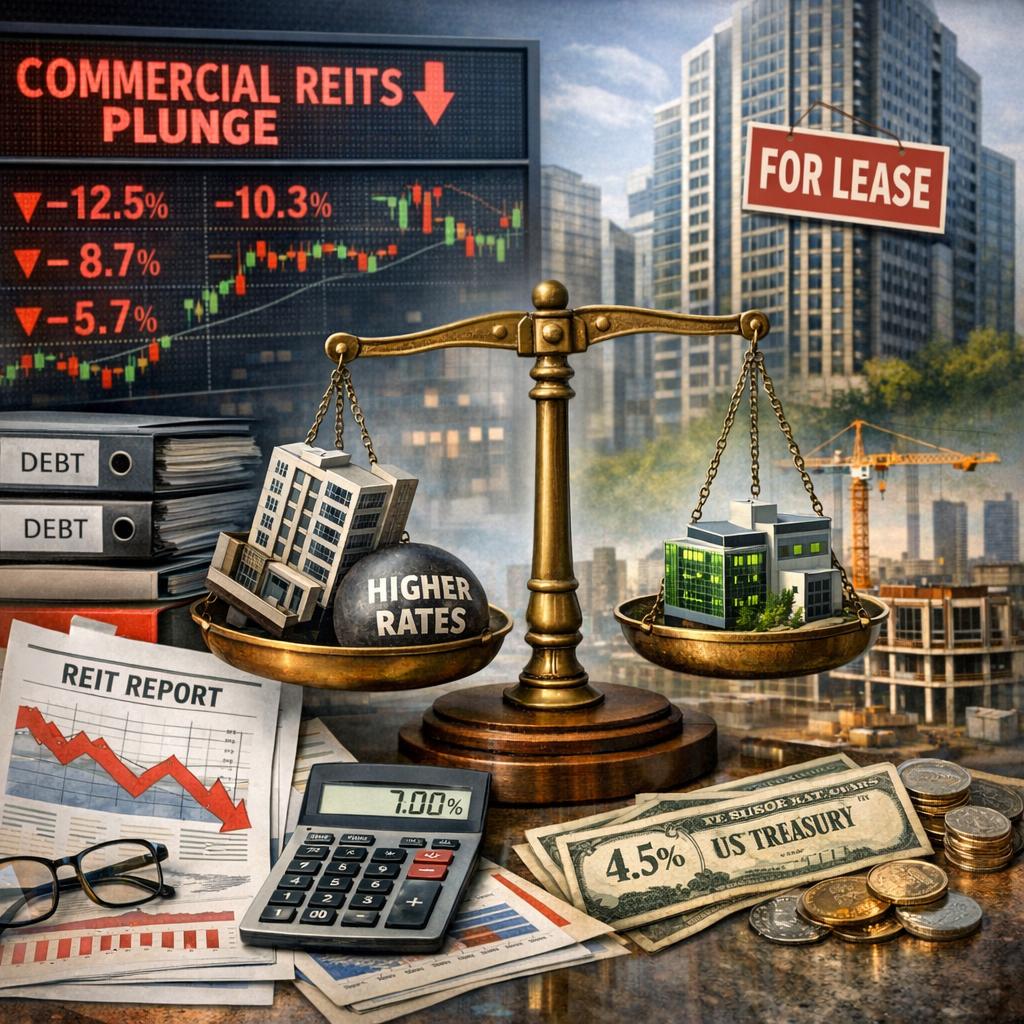
This week, a development in the real estate investment trust (REIT) sector provided a masterclass in how changing capital costs can quietly dismantle long-standing market assumptions. The story was the unexpected, severe underperformance of several major, traditionally stable commercial REITs against the broader equity market, even in the absence of dramatic news about occupancy or rents.
For years, certain classes of commercial real estate—think prime office spaces in major cities or high-end logistics warehouses—were considered bedrock assets. Their valuations were underpinned by long-term leases with creditworthy tenants and the perceived enduring value of the physical asset. Investors flocked to the REITs that owned these properties for their reliable, bond-like income streams and potential for modest appreciation.
That model is now facing a profound stress test, and the culprit is not merely a cyclical downturn, but a fundamental shift in the financial landscape. The era of persistently low interest rates that followed the 2008 financial crisis acted as a powerful tailwind for these assets. Cheap debt inflated property valuations and made the yield from REIT dividends exceptionally attractive. It created a virtuous cycle: low rates supported higher asset prices, which supported stronger balance sheets, which supported further investment.
That cycle has decisively reversed. The current environment of “higher for longer” interest rates is not just a headwind; it’s a structural repricing mechanism. The impact is twofold, and it’s squeezing these REITs from both sides.
First, and most directly, is the cost of capital. REITs are inherently capital-intensive businesses. They constantly acquire, develop, and maintain properties. This requires frequent trips to the debt and equity markets. As borrowing costs have surged, the hurdle rate for any new investment has risen dramatically. Projects that were marginally profitable with debt at 3% become clear money-losers with debt at 7%. This forces a retreat from growth, stagnating a REIT’s earnings potential. Furthermore, as older, cheaper debt matures, it must be refinanced at these new, higher rates, directly eroding profitability.
Second, and more subtly, is the denominator effect. As risk-free rates offered by government bonds have risen, the premium investors demand for taking on the additional risk of a commercial REIT has necessarily compressed. Why accept the risks of tenant bankruptcy, property devaluation, and market volatility for a 4% dividend yield when you can get a near-guaranteed 4.5% from a 10-year Treasury? This forces a downward re-rating of the entire sector’s valuation multiples. The asset that was once prized for its yield is now being judged against a much more competitive alternative.
The market is now discriminating with brutal clarity. It is punishing REITs with weaker balance sheets, near-term debt maturities, or exposure to vulnerable property sectors (like traditional office space in a hybrid-work world). It is rewarding those with fortress-like balance sheets, long-dated fixed-rate debt, and exposure to resilient niches like data centers or essential healthcare facilities.
For the global investor, this is a critical lesson in sectoral rotation and the long-lasting effects of monetary policy shifts. It moves beyond the simple “rates up, REITs down” narrative. We are witnessing a great sorting within the sector, a separation between the truly resilient and the structurally challenged. It underscores that in a new cost-of-capital regime, business models built on the assumptions of the previous era will be found out. Due diligence now requires a forensic examination of debt maturity schedules, interest rate hedging, and the fundamental demand driver for the underlying property type—not just the headline dividend yield.
This repricing in a cornerstone sector like real estate is a signal. It suggests that the transition to a higher-rate environment is still working its way through the system, with more valuation adjustments likely ahead in other interest-rate-sensitive corners of the market. It asks investors to look beyond income and appreciate the paramount importance of financial durability. The easy yield is gone; what remains is the price of stability.
As always, I’m keen to hear your perspective. Are you seeing this capital cost pressure manifest in other sectors? Comment below.