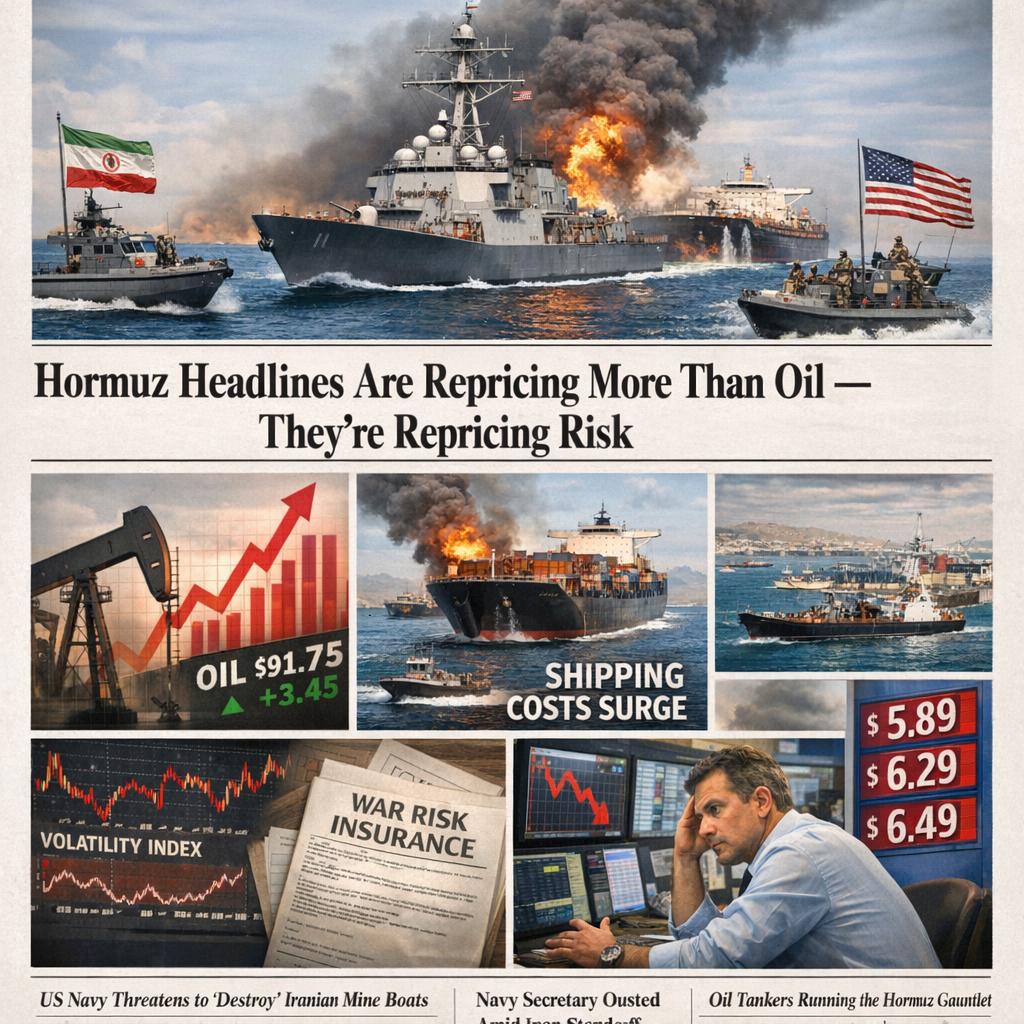
Hormuz Headlines Are Repricing More Than Oil — They’re Repricing Risk
One of the most market-moving stories right now isn’t tucked away in an earnings report or a central bank speech. It’s sitting in a narrow stretch of water that global trade can’t easily route around: the Strait of Hormuz.
With Washington and Tehran trading threats and signalling a willingness to escalate, the immediate market reaction has been straightforward: oil up. But the deeper investor takeaway is more important than the first-order price spike.
This is a risk re-rating moment.
1) The “oil move” is the headline, but the real story is volatility
When the market thinks supply could be disrupted, crude doesn’t just rise — it starts to gap, whip around, and drag cross-asset volatility with it.
That matters because volatility is a tax on positioning. It forces:
– Tighter risk limits at funds and banks
– Higher margin requirements
– Faster deleveraging when trades go wrong
– Wider bid-ask spreads in everything from energy to FX to credit
Even investors who don’t touch commodities feel this. When volatility rises, correlations tend to rise too. Diversification works less well at the exact moment you want it most.
2) Energy is the fastest channel into inflation expectations
Oil is not just another input. It’s an inflation accelerant that hits consumers, logistics, manufacturing, and services. When crude jumps on geopolitical risk, investors quickly start revisiting:
– The path of inflation over the next 3–12 months
– How long central banks may need to stay restrictive
– Whether rate cuts get delayed or repriced entirely
That feedback loop is why energy shocks often punch above their weight. It’s not only about oil equities or airline stocks — it’s about the discount rate used to value everything.
3) The second-order impact is on shipping, insurance, and real-world flow
Even when barrels still move, the cost of moving them can surge.
If insurers demand a higher war-risk premium, if routes change, if crews hesitate, if ports slow down — the “supply” doesn’t have to collapse to produce a meaningful price response. Markets react to marginal disruption, not perfect shutdowns.
And there’s another detail investors sometimes miss: physical markets don’t need to be broken for paper markets to panic. If participants fear a squeeze, they hedge harder and sooner. That alone can push prices and volatility higher.
4) Winners and losers aren’t as simple as “energy up, airlines down”
Yes, higher oil can lift upstream energy cashflows and pressure fuel-sensitive sectors. But the real sorting mechanism is balance sheet strength and pricing power.
In a high-vol, high-input-cost environment:
– Companies with strong margins and the ability to pass through costs hold up better
– Highly levered businesses get punished faster
– Emerging markets with weaker external balances can face currency stress
– Import-dependent economies feel the shock more sharply than producers
So this kind of geopolitical risk can quietly reshape leadership across regions and sectors, even if the original headline is “just oil”.
5) What I’m watching as an investor (without trying to predict the politics)
Rather than pretending we can forecast the next headline, I look for market-based signals that tell us whether this is turning into something systemic:
– The shape of the oil curve (backwardation vs contango) for signs of real near-term tightness
– Credit spreads, especially in transport, industrials, and high yield energy
– Inflation breakevens and real yields (what the bond market is pricing)
– The dollar and EM FX for stress signals
– Volatility indices for whether risk is spilling beyond commodities
Those indicators often move before the “mainstream narrative” catches up.
The big picture
This Hormuz story is a reminder that geopolitics isn’t a side-show. It is a pricing engine. When control of critical arteries of trade comes into question, investors don’t just update oil assumptions — they update assumptions about inflation, rates, growth, liquidity, and risk tolerance.
If you’re building a portfolio for the real world, not just the spreadsheet, these are the moments that test whether your diversification, sizing, and time horizon are actually fit for purpose.
If you’re tracking this closely too, feel free to comment with what signals you’re watching most (oil curve, credit, FX, rates, equities) and why.