The Powell Cloud Lifts — And Markets Immediately Start Pricing the Next Fed
One of the most underappreciated market risks isn’t a recession print or a CPI surprise. It’s governance risk at the very top of monetary policy.
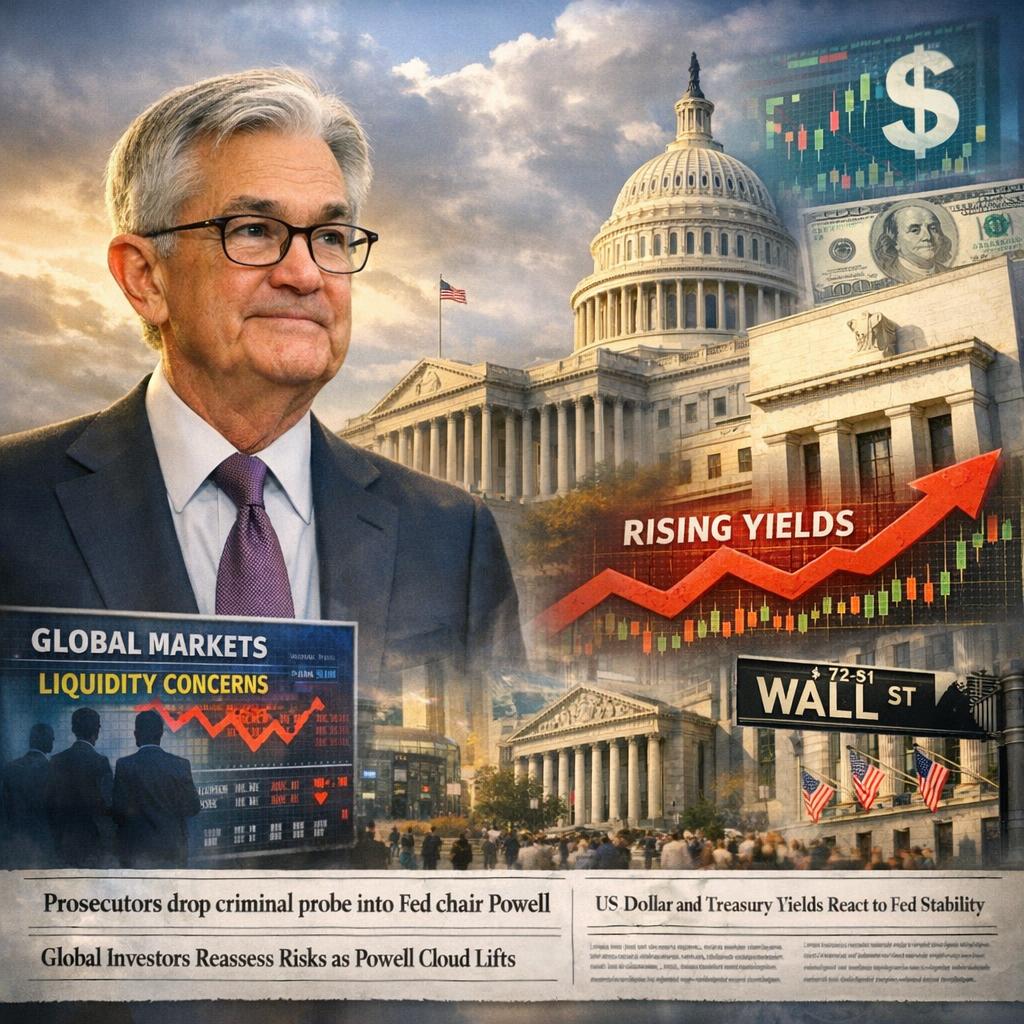
That’s why the news that US prosecutors have dropped a criminal probe into Federal Reserve chair Jay Powell matters more than it seems at first glance. Even if the probe wasn’t the base-case driver of prices day to day, its existence created a lingering tail risk: a sudden leadership shock, a messy confirmation fight, or an accelerated transition that markets would be forced to handicap in real time.
Now that cloud has lifted, investors can do what they prefer: turn an open-ended “what if” into a more measurable set of probabilities around Fed leadership and the future path of policy.
Why this is globally relevant (even if you never touch US stocks)
The Fed isn’t just America’s central bank. It’s the anchor point for global funding markets.
When the market senses instability at the Fed, you tend to see it show up quickly in three places:
1) The US dollar
If traders start to believe the Fed could become more politically constrained, or simply less predictable, the dollar can react in either direction depending on the narrative. Sometimes it strengthens on risk-off fear. Other times it weakens if credibility is questioned. Either way, currency volatility spills into everything from emerging market debt servicing costs to multinational earnings translations.
2) Treasury term premium
A credible, steady central bank generally keeps long-term inflation expectations and risk premia better contained. Any whiff of leadership turmoil can nudge investors to demand extra compensation for holding duration. That’s not just a bond-market nuance. Higher long-end yields tighten financial conditions globally, whether you’re pricing mortgages, infrastructure, or growth equity valuations.
3) Cross-border liquidity
So much global capital is intermediated in dollars that “Fed uncertainty” can become “funding uncertainty” abroad. That shows up as wider credit spreads, weaker risk appetite, and less forgiving refinancing conditions.
The “next Fed” trade is already a market input
What’s interesting about this development is not just the legal headline; it’s the second-order effect: it potentially removes a political hurdle for an alternative Fed leadership path.
Markets don’t wait for official announcements. They anticipate.
So once a transition becomes more plausible, investors start stress-testing scenarios:
– A chair perceived as more hawkish could lift expected real rates, steepen parts of the curve, and pressure long-duration assets.
– A chair perceived as more dovish could do the opposite initially, but might also raise questions about inflation discipline—pushing term premium higher even as front-end rate expectations fall.
– A chair perceived as less independent could increase volatility across rates, FX, and risk assets, even if the average “rate path” doesn’t change much.
In other words, it’s not just about where rates go. It’s about how confident markets are in the reaction function that gets us there.
What investors should watch next (the practical checklist)
If you’re trying to translate this into actionable market awareness, I’d keep an eye on:
– Fed independence narratives in major US political messaging (language matters; it becomes a volatility catalyst)
– The shape of the yield curve (especially whether long-end yields rise even when growth data softens)
– Inflation breakevens versus real yields (is the move about inflation expectations, or confidence and risk premium?)
– Dollar strength versus global risk appetite (are we in a “tightening via USD” regime?)
– Bank funding and credit spreads (quiet stress often appears there before equities notice)
Bigger picture: credibility is an asset class
Central bank credibility doesn’t sit on a balance sheet, but markets treat it like one of the most valuable assets in the system. When that credibility looks stable, risk premia compress and capital flows more freely. When it looks contested, everyone starts charging a little more for uncertainty—across borders, across asset classes, and across time horizons.
This isn’t a story that only matters to macro traders. It affects pension returns, mortgage rates, venture funding conditions, and EM debt sustainability.
If you’ve been watching this from the sidelines: what do you think markets are most likely to price next—policy direction, Fed independence risk, or just higher volatility across the board? Comment with your take.