Wall Street Shrugging Off an Energy Shock Isn’t Bravery — It’s a Very Specific Bet
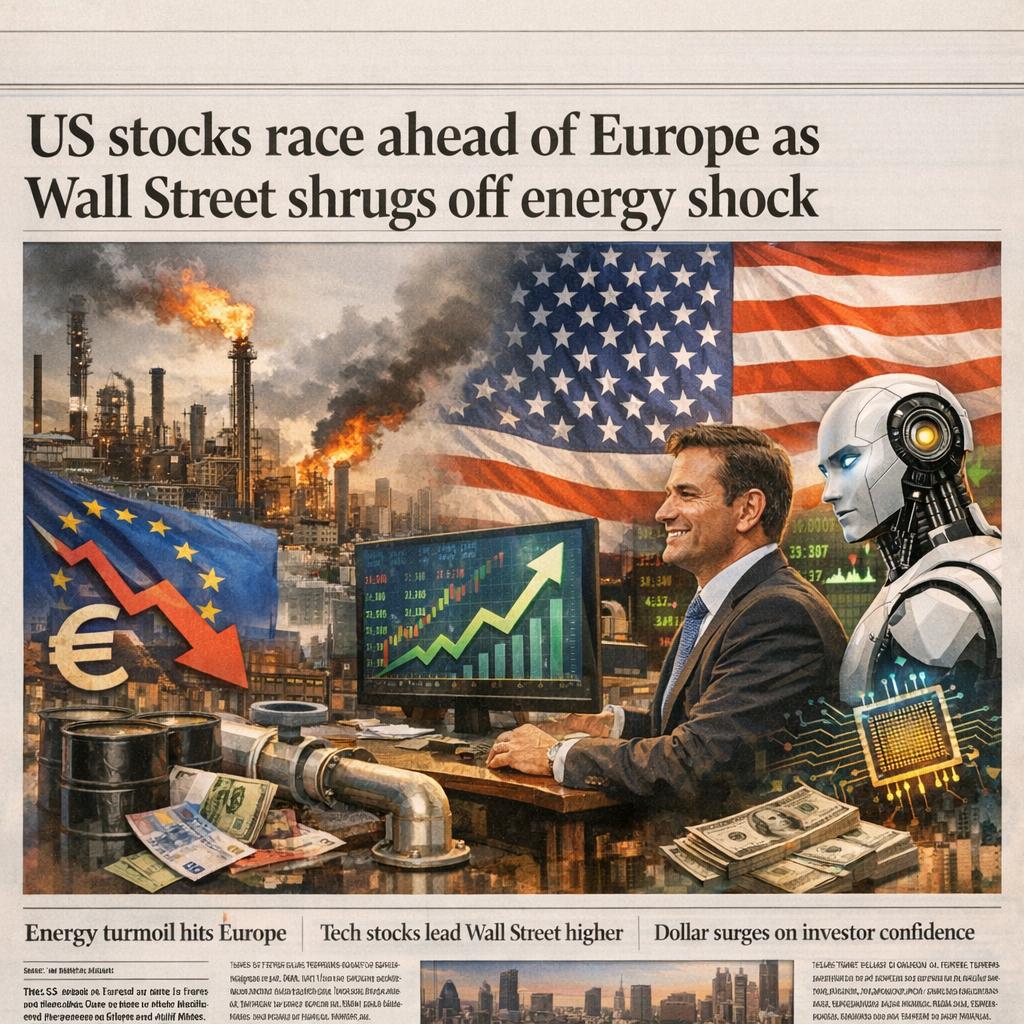
One of the more revealing market stories this week is how US stocks have continued to race ahead of Europe even as the energy backdrop has become more unstable. The headline reaction is easy to summarise: “equities don’t care.” But that reading misses what investors are actually doing.
This isn’t indifference. It’s positioning.
The US market is implicitly making a few tightly linked assumptions at once:
1) the energy shock is either temporary or containable,
2) US growth and earnings are resilient enough to absorb higher input costs,
3) the winners inside the index (large, profitable tech and AI-linked names) are structurally less exposed to energy volatility than the rest of the world.
Europe, by contrast, doesn’t get to make those assumptions as comfortably. Even when Europe isn’t the epicentre of a geopolitical flare-up, it can be the place where the second-order effects land hardest: imported energy exposure, thinner growth buffers, and a market composition that tilts more toward sectors where margins are more sensitive to costs and demand swings.
The hidden driver: market structure is doing the talking
A big part of the divergence comes down to what each market “is.”
In the US, a handful of mega-cap companies can drag the entire index higher even if large parts of the economy are merely fine, or even struggling. Investors don’t have to be bullish on everything; they just have to be bullish on the narrow set of firms with strong balance sheets, durable demand, and pricing power.
In Europe, the index mix is less forgiving. When energy uncertainty rises, it tends to show up more quickly in the parts of the market that dominate European benchmarks: industrials, financials, consumer names, and globally exposed manufacturers. Those businesses can do well, but they don’t offer the same clean “duration + dominance” story that investors buy when they want growth without cyclical mess.
So when US equities “shrug off” the shock, what you’re often seeing is not broad confidence — it’s concentration risk wearing a confident face.
Why this matters globally (even if you don’t own US stocks)
If you’re an investor outside the US, this gap creates three practical consequences:
1) Global portfolios can become unintentionally more American
If the US keeps outperforming, many diversified portfolios drift toward higher US weights over time. That can feel good in the moment, but it increases dependency on a single market’s narrative: AI-led earnings strength, stable funding markets, and a contained geopolitical risk premium.
2) Currency effects start doing more of the work
When relative growth and risk sentiment favour the US, the dollar often becomes part of the story. That can tighten financial conditions elsewhere and change the realised returns of international holdings, sometimes more than the equities themselves.
3) “Energy shock” stops being a commodity story and becomes a rates story
If energy prices stay elevated long enough to threaten inflation expectations, central bank paths can diverge further. Markets then reprice not just oil and transport, but the discount rates applied to everything from property to high-growth equities. The irony is that the same US market that looks most relaxed today can become the most violent if rate expectations move abruptly.
A note of caution: the calm can flip quickly
When markets absorb bad news and keep climbing, it’s tempting to call it strength. Sometimes it is. But sometimes it’s just a crowded trade expressing itself: “own the dominant US winners, ignore the noise, assume policy will handle the rest.”
That trade works until it doesn’t — and when it breaks, it tends to break through correlations. The assets people thought were diversifiers start moving together, liquidity gets patchy at the edges, and the sell-off spreads from “obvious losers” to “whatever can be sold.”
How I’d think about positioning (without pretending anyone can time it perfectly)
This kind of tape rewards a few disciplines:
– Know whether your “global” exposure is actually concentrated in US mega-caps through index weights.
– Stress-test your portfolio for a higher-for-longer energy scenario, not just a one-week spike.
– Re-check what you own in Europe and Asia through the lens of energy sensitivity and margin vulnerability, not just valuation.
– Be honest about whether your biggest risk is fundamentals — or crowding.
If you’re watching this divergence too: do you think the US is correctly pricing resilience, or is this another episode of concentrated leadership masking wider fragility? Comments welcome.