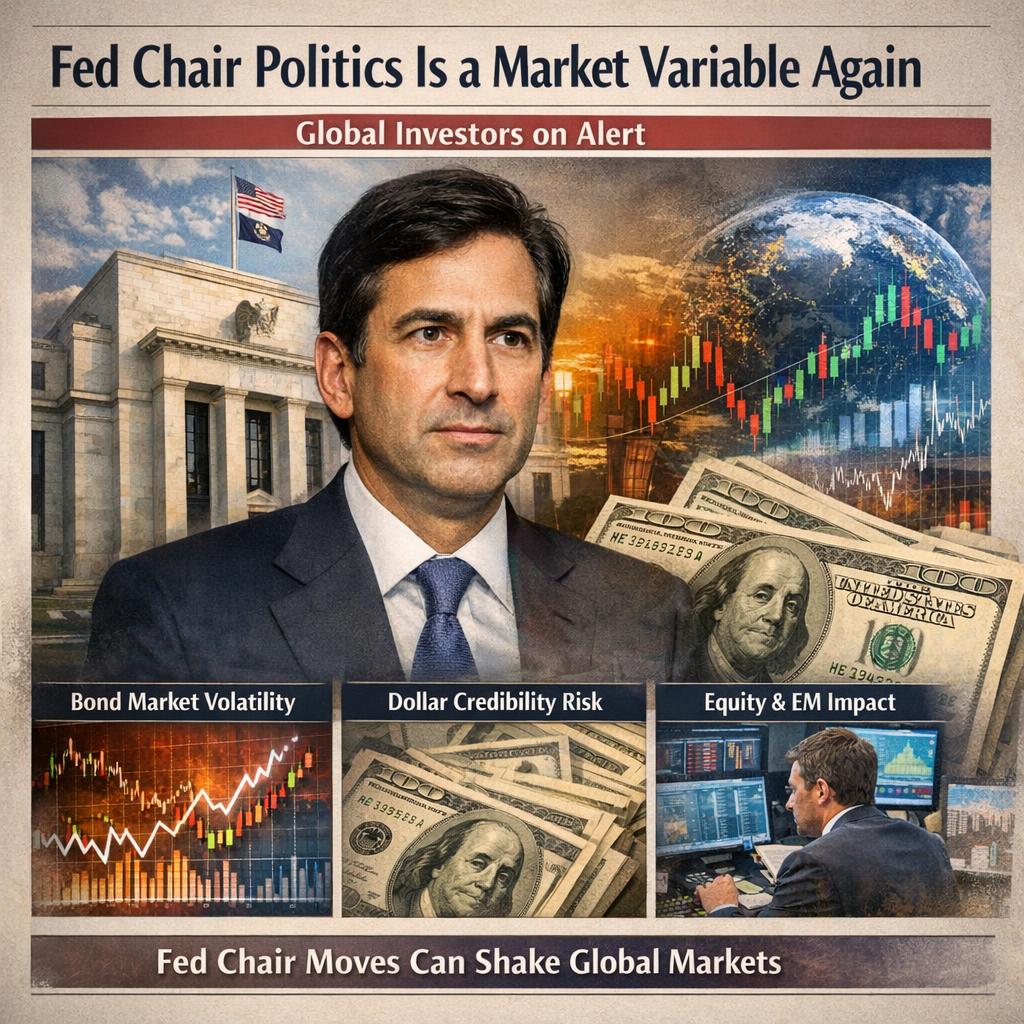
Fed Chair Politics Is a Market Variable Again — And Global Investors Should Treat It Like One
One of the easiest mistakes to make in markets is to treat central banks as “background institutions” rather than live risk factors. This weekend’s news that a senior Republican has cleared the path for Kevin Warsh’s confirmation as Fed chair is a reminder that the identity, credibility, and perceived independence of the Federal Reserve aren’t just Washington drama. They can become inputs into asset pricing across the world — sometimes faster than earnings, inflation prints, or even geopolitics.
Why the chair matters more than a single rate decision
Investors don’t just price the current policy rate. They price the reaction function: how the Fed is likely to respond to growth slowdowns, inflation surprises, financial stress, and political pressure.
A new chair can shift expectations in three subtle but powerful ways:
1) The “pain tolerance” of policy
Markets care about how long the Fed will hold tight policy if inflation is sticky, or how quickly it will cut if unemployment rises. Even if the dot plot looks similar on paper, a chair’s communication style and bias can move the front end of the curve and reprice risk assets.
2) The credibility premium in the dollar
The US benefits from a kind of institutional credibility that supports the dollar’s role as the world’s primary reserve currency. If investors begin to perceive that credibility as weakening — whether fairly or not — the risk doesn’t stay inside US borders. It flows into FX, commodity pricing, and global funding conditions.
3) The “policy uncertainty tax”
Uncertainty itself has a cost. It tends to widen credit spreads, raise equity risk premia, and increase demand for hedges. That cost can be invisible when markets are calm — until it isn’t.
The immediate market channels: rates, dollar, and risk appetite
When Fed leadership becomes politicised (or is perceived to be), three market moves become more likely:
Treasuries become more volatile.
Not necessarily higher yields in a straight line — but more two-way risk as investors debate whether the Fed will be more inflation-tolerant, more growth-sensitive, or more reactive to political narratives. That volatility can spill into mortgage rates, investment-grade issuance windows, and the valuation math for equities.
The dollar can strengthen or weaken — for different reasons.
A more hawkish policy expectation can lift the dollar. But a perceived hit to institutional independence can do the opposite, especially at the margins in periods of stress. For global investors, the “why” matters as much as the move: dollar strength driven by higher real yields is very different from dollar weakness driven by a credibility question.
Equities can rally and still be fragile.
Stocks sometimes like the idea of easier policy. But if the path to “easier” is messy — higher inflation risk, less predictable communication, or a market that starts second-guessing the Fed — you can get a sugar-rush rally with a fatter left tail. That’s when hedging costs rise and leadership narrows.
Why this is global, not just American
The Fed is the de facto central bank of global liquidity. Many corporates and sovereigns borrow in dollars, many commodities are priced in dollars, and many emerging markets effectively manage their monetary policy with one eye on the Fed.
So changes in Fed leadership expectations can transmit globally through:
Emerging market funding conditions
If US yields rise or the dollar tightens financial conditions, EM central banks often have less flexibility. That can mean higher local rates, slower growth, or renewed pressure on external balances.
European and UK rate expectations
Even when domestic inflation dynamics differ, global bond markets are linked. A repricing in Treasuries can drag global term premia around with it, complicating the path for other central banks.
Global tech and growth stock valuation
A meaningful chunk of global equity valuation still rests on discount rates. If the market starts to price a different “long-run” Fed posture, it can ripple through US megacaps and into global indices that are heavily exposed to them.
How I’d think about positioning (without pretending anyone has a crystal ball)
This isn’t a call to panic, and it’s not a call to trade headlines. It’s a call to respect governance risk as a real input.
A few practical ways investors can frame it:
Treat policy credibility as part of your risk budget.
If your portfolio is built on the assumption that inflation will be neatly contained and that the Fed will communicate predictably, you’re implicitly long “institutional stability.” Make sure that’s intentional.
Watch the bond market for the real signal.
Equities can ignore a lot. Rates markets usually don’t. Pay attention to real yields, the shape of the curve, and inflation compensation — not just the Fed funds path.
Know your dollar exposure.
Many investors discover their true FX risk only when volatility spikes. If your returns depend on a stable or strengthening dollar, say so plainly and decide whether you’re comfortable with that bet.
Expect more headline-to-volatility sensitivity.
When politics and policy intersect, markets can move on narrative as much as data. That tends to reward diversification and discipline more than heroic forecasting.
The bigger point: markets price institutions
We spend a lot of time debating “soft landings” and “hard landings,” but sometimes the more important question is whether the market trusts the pilot. Central banks are part of the architecture that keeps modern financial systems functioning. When leadership changes become politically charged, global investors should assume that the architecture itself will be stress-tested — at least in price action.
If you’re watching this story closely, I’d love to hear how you’re thinking about it: is this mainly a rates story, a dollar story, or a broader confidence story? Comment with your take.