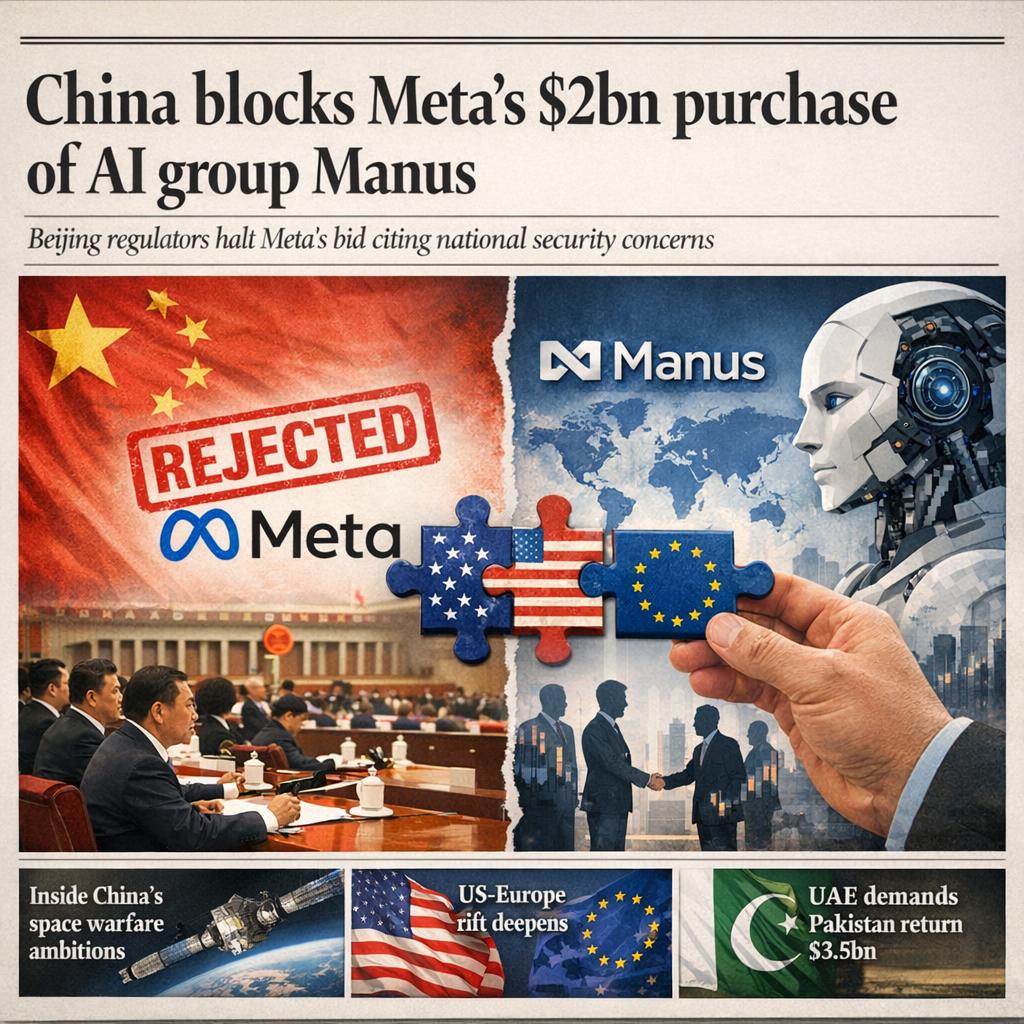
China blocking Meta’s reported $2bn purchase of the AI group Manus is one of those stories that looks, on the surface, like a simple M&A deal that didn’t make it over the line. In reality, it’s another reminder that the AI trade is no longer just about talent, models, and compute. It’s about jurisdiction, approval risk, and the growing separation of “who can own what” across the world’s biggest blocs.
For global investors, that shift matters more than the single transaction.
The new premium: regulatory clearance
For years, big tech M&A was largely a question of price, strategic fit, and antitrust optics in the US and Europe. What’s increasingly clear is that cross-border tech deals—especially anything AI-adjacent—can now die for reasons that sit outside traditional competition policy.
This is a different kind of risk. It’s binary, it can be hard to hedge, and it can arrive late in the process after months of deal momentum.
That has knock-on effects:
1) Deal probability becomes a valuation input
Investors will need to think more explicitly about “closing odds” when markets price companies that are likely acquisition targets. If the most obvious buyers can’t get approvals, the takeover floor under certain assets is lower than it looks.
2) The buyer universe narrows
When regulators block or chill foreign acquisitions, the pool of credible bidders shrinks. Fewer bidders usually means weaker pricing power for sellers and more leverage for domestic champions.
3) More value shifts to partnerships and licensing
If ownership is politically sensitive, firms will route around it. Expect more joint ventures, strategic minority stakes, distribution partnerships, and licensing structures designed to keep sensitive IP and control within borders.
AI is getting treated like strategic infrastructure
A big reason this matters is that AI is increasingly being framed as strategic capacity—closer to semiconductors, energy, or telecoms than to consumer apps.
Once a sector is viewed through that lens, investor assumptions need to change:
– The “best product wins globally” narrative weakens.
– The “most capital wins” narrative gets complicated by politics.
– And the “exit via acquisition” pathway becomes less reliable for startups and their backers.
That doesn’t mean innovation stops. It means the market structure changes. Instead of one unified global AI marketplace, we move toward parallel ecosystems with controlled gateways between them.
What it means for public market investors
If you’re holding global tech or AI exposure, this kind of decision pushes you to think in scenarios rather than straight-line forecasts.
A few implications that stand out:
1) Geographic concentration risk increases
Companies with revenue, supply chains, or key talent across multiple jurisdictions may face higher friction. That can show up as slower expansion, duplicated costs (two stacks instead of one), or forced localisation.
2) Moats may strengthen domestically, weaken internationally
National champions can benefit from protection, procurement preference, and regulatory support at home. But their international TAM can shrink if other countries respond in kind. The result can be strong local profitability but capped global upside.
3) Compute and data strategy becomes an investor diligence item
Where models are trained, where data sits, and which cloud stack is used aren’t just engineering details anymore. They’re part of the geopolitical footprint of the business.
4) M&A multiples may diverge by “clearability”
In the same way markets price litigation risk or funding risk, they’ll increasingly price “regulatory clearability.” Two similar AI companies can trade at meaningfully different multiples if one is seen as acquirable and the other is effectively fenced off.
What it means for private markets and venture
This is also a subtle warning to venture investors and founders: the list of plausible acquirers might not be the same list it was even 18 months ago.
If cross-border exits become harder, then:
– IPO readiness matters more (even if IPO windows are cyclical).
– Secondary markets and structured liquidity become more important.
– And business models that can scale within a single regulatory zone may get valued more highly than “global from day one” stories that assume frictionless expansion.
The bigger picture: fragmentation as an investable theme
It’s tempting to file this under “one blocked deal.” I think it’s better understood as part of a broader investable theme: fragmentation.
Fragmentation creates winners and losers:
– Winners: firms selling compliance, data governance, cyber security, sovereign cloud, localisation tooling, and anything that helps companies operate in multiple regimes without breaking.
– Mixed outcomes: global platforms that thrive on standardisation and seamless cross-border scaling.
– Potential winners: domestic players that benefit from protected demand and state-backed strategic priorities.
None of this is a call to abandon global tech. It’s a call to be more precise about what kind of global tech you own, and what assumptions your valuation model quietly makes about cross-border flows of capital, IP, and control.
If you’re building or investing in AI right now, I’d be interested to hear how you’re adjusting for deal risk and regulatory risk in your valuations—comment with what you’re seeing in your corner of the market.