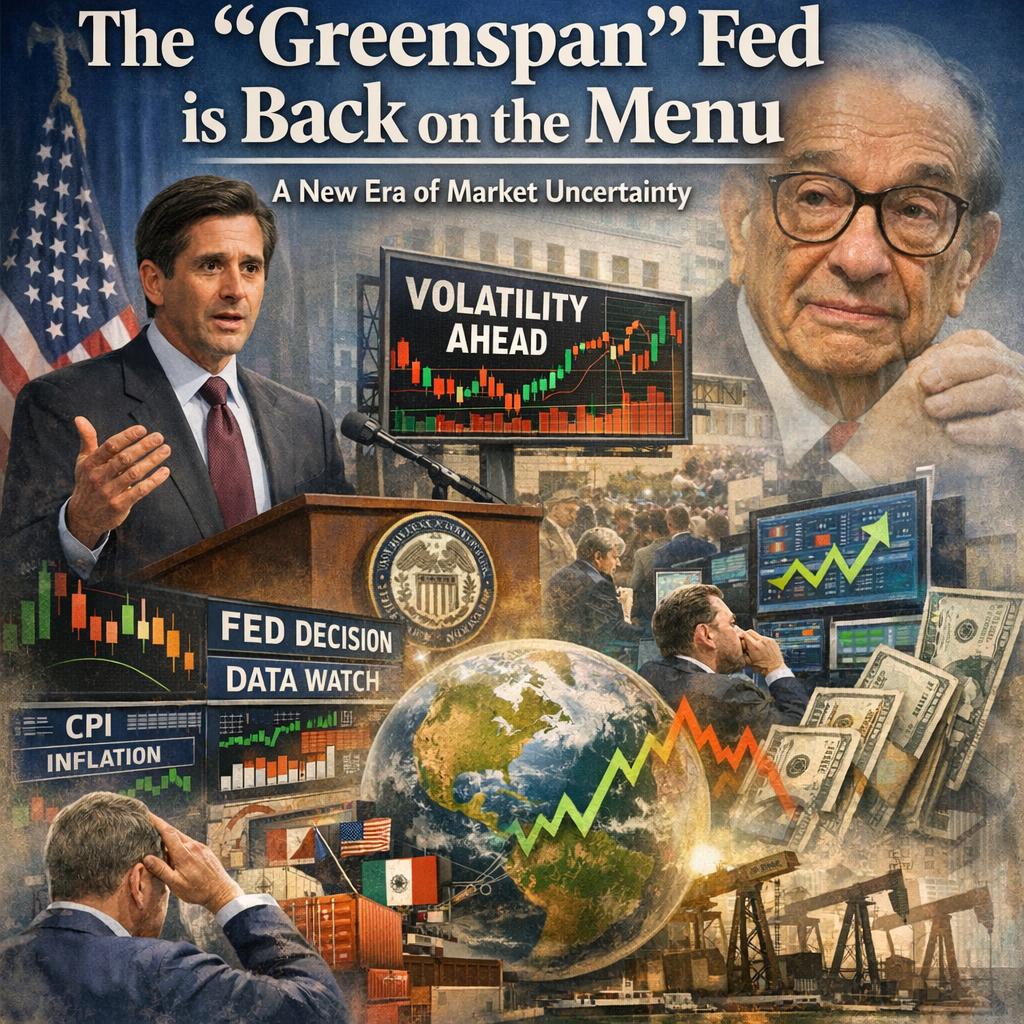
The “Greenspan” Fed Is Back on the Menu — and That Changes How Investors Should Think About Risk
One of the most important market stories this week isn’t an earnings beat, a mega-cap rally, or another viral stock chart. It’s the messaging coming out of the central bank.
With a new Fed Chair, Kevin Warsh, signaling a potential “Alan Greenspan-style” approach, markets are being asked to recalibrate to a very specific kind of regime: one where the Fed is less eager to pre-commit, more comfortable with ambiguity, and more inclined to “manage expectations” with tone and timing rather than explicit guidance.
That might sound like inside-baseball. For global investors, it’s not. It’s a direct input into how you price everything from US tech to emerging market debt.
What a “Greenspan-style” Fed really implies
Greenspan’s era is often remembered for three traits that matter to markets today:
1) Strategic ambiguity
Instead of spelling out the path of rates in clean, forward-guidance language, the Fed communicates in a way that keeps optionality high. Investors get fewer “promises,” more nuance, and more dependence on incoming data.
2) A higher premium on reading the Fed correctly
When guidance is less explicit, markets can swing harder on speeches, press conferences, and even the framing of risks. The “reaction function” becomes something investors infer rather than something the Fed hands you.
3) A different kind of volatility
Not necessarily more volatility every day—but more event-driven volatility. CPI days, labor prints, and Fed meetings matter more because the path is less “anchored.”
If that’s the direction of travel, investors shouldn’t just ask “where do rates go?” They should ask “how confident can markets be about where rates go?” That difference is where repricing happens.
Why this matters far beyond US borders
The Fed is still the global reference rate setter, even for investors who never buy a US Treasury.
A more ambiguous Fed can do a few things internationally:
A stronger or more erratic dollar cycle
If markets are constantly updating expectations, the dollar can become more sensitive to surprise. That flows straight into commodity pricing, EM inflation dynamics, and global liquidity conditions.
Pressure points for emerging markets
When US policy feels less predictable, risk premia widen where external financing is more fragile. It’s not always dramatic, but it shows up in spreads, currency hedging costs, and capital flow reversals.
A different backdrop for global equities
Global stock multiples aren’t just about earnings; they’re about discount rates and confidence in the macro path. Less clarity from the Fed can cap valuations even when earnings are fine—particularly for long-duration equities that rely on low and stable discount rates.
The investor takeaway: treat “certainty” as an asset class
In a world where the Fed is less explicit, the edge shifts away from trying to nail the next 25bps move and toward building portfolios that don’t need perfect forecasting.
A few practical implications many investors will lean into:
Diversification across factors, not just regions
If macro uncertainty rises, correlations can jump at the worst time. Balance exposures across value/growth, quality/cyclicals, and defensives—not only US vs ex-US.
Quality balance sheets matter more
When the rate path is murkier, companies with durable cash flows and manageable refinancing needs tend to hold up better than businesses that rely on cheap capital staying cheap.
Liquidity gets re-priced
Markets can look calm until they’re not. Holding some liquidity (or liquid hedges) isn’t about timing crashes—it’s about being able to act when volatility spikes.
Watch the Fed’s “language,” not only the decision
With a Greenspan-style approach, the press conference and statement can matter as much as the dot plot ever did. The market may trade the tone.
None of this guarantees doom, and it doesn’t mean stocks can’t rally. It means the rules of engagement shift: policy uncertainty becomes a bigger driver of how assets are priced, and investors need a sturdier framework than “rate cuts soon” or “soft landing confirmed.”
If you’re positioning for the next 6–12 months, are you treating central bank communication risk as part of your asset allocation—or still treating it as background noise? Comment with how you’re adjusting (or not adjusting) your approach.