Lowe’s Sounds the Alarm: A Retail Read-Through for Global Investors
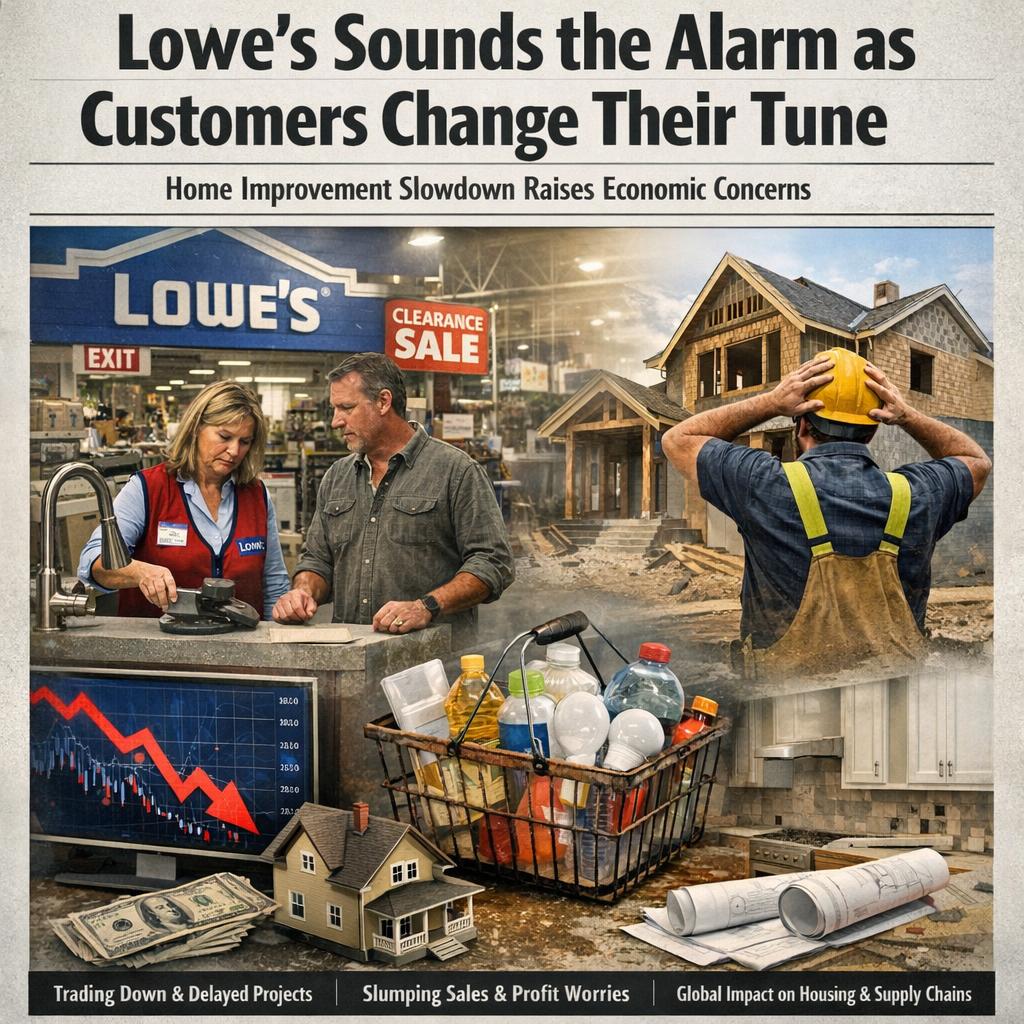
One of the more useful signals in markets doesn’t come from central banks or bond auctions—it comes from retailers when they start describing how customers are behaving in real time. This week, Lowe’s struck that tone: shoppers are “changing their tune,” and the company is flagging warning signs that go beyond a single earnings season.
This matters because home improvement spending sits at a very revealing intersection of consumer confidence, housing dynamics, and credit conditions. When that spending starts to wobble, it can ripple far outside US retail—and global investors should pay attention.
What “changing their tune” typically means in practice
When big-box retailers talk about customers changing behavior, it often boils down to a few consistent patterns:
1) Trading down
Consumers shift from premium brands to value alternatives, lean harder on promotions, and defer higher-margin discretionary items.
2) Project deferral
Home improvement is full of “nice-to-have” purchases. If the consumer is feeling stretched, kitchen upgrades become “next year,” and larger renovation plans get phased or paused.
3) Basket mix deterioration
Even if foot traffic holds up, the composition of what people buy can worsen profitability. More basics, fewer big-ticket items, and heavier discounting can compress margins.
Retailers are uniquely positioned here because they see the consumer at the decision point, not just in lagging macro data. That’s why market participants treat these updates as a kind of high-frequency economic report.
Why this isn’t just a US retail story
Lowe’s is US-focused, but the signal travels. Here’s how global investors can think about the transmission mechanism:
Housing and the “wealth effect”
Home improvement spending tends to move with housing turnover and perceived household wealth. If consumers are less willing to invest in the home, that can reflect a cooler housing backdrop or greater sensitivity to rates and financing costs. That sensitivity isn’t uniquely American—many developed markets are dealing with affordability pressures and rate-aftershocks.
Global supply chains and input demand
Home improvement retail pulls through demand for lumber, fixtures, tools, appliances, and a wide range of manufactured goods. A softer tone can feed into expectations for industrial demand and inventory behavior, which matters for exporters and manufacturers well beyond the US.
FX and rates expectations
If large consumer-facing companies increasingly guide cautious, markets often start to price a different path for growth. That can alter expectations for interest rates, which in turn shifts capital flows, currency moves, and equity risk appetite globally—especially in markets that are sensitive to US financial conditions.
The key investor takeaway: watch margins and guidance, not just sales
In retail, top-line numbers can be misleading. Investors should focus on:
Promotional intensity
More discounting can protect volumes while quietly eroding profitability.
Inventory posture
An inventory build combined with slowing demand can lead to clearance cycles and further margin pressure.
Forward guidance language
When management teams start emphasizing “uncertainty,” “value-seeking behavior,” or “delayed projects,” it often precedes broader estimate cuts across the sector.
What’s especially important is that this kind of commentary can spread. If one major retailer reports caution and peers echo it in subsequent weeks, analysts typically re-rate the whole consumer discretionary complex—sometimes even parts of industrials and materials.
How investors can position without overreacting
This isn’t automatically a “get bearish” signal. It’s a “get precise” signal.
Quality and pricing power matter more late-cycle
Companies that can protect margins—either through pricing power or structurally lower costs—tend to separate themselves when consumers get choosy.
Balance sheet strength becomes a real differentiator
In a softer demand environment, leverage stops being an abstract metric and starts dictating strategic flexibility.
International investors should reassess consumer exposure
Even if you’re not holding US retailers, you may be holding global names tied to discretionary spending, home-related supply chains, or cyclical manufacturing.
If you’ve been watching retail earnings closely, share what you’re seeing: are you noticing more signs of trade-down and project deferral, or do you think this is a company-specific wobble rather than a macro read-through?