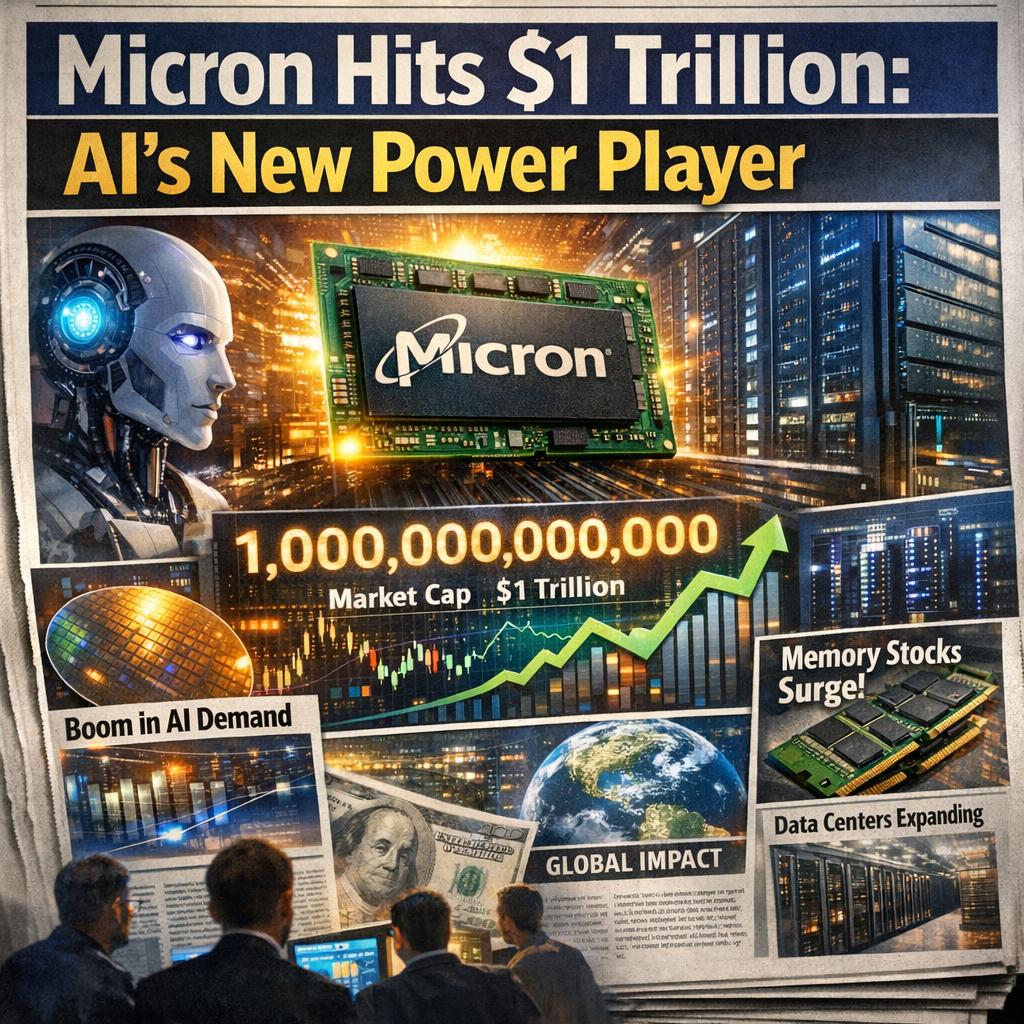
Micron at $1 Trillion: A Market Milestone That Says More About AI Than Memory
Every market cycle has its “this is getting serious” moment. Not necessarily a crash or a rate hike—sometimes it’s a single company crossing a psychological threshold that forces everyone to recalibrate what they thought they knew.
Micron briefly touching a $1 trillion market cap is one of those moments.
On paper, Micron is “just” a memory and storage company—DRAM and NAND, the plumbing of computing. Historically, that’s been a brutally cyclical business: capacity expands, prices fall, inventories build, margins compress, and then the cycle flips again. Investors who have lived through multiple semicon cycles learned to treat memory makers with a particular kind of respect… and caution.
So why does a company with that history suddenly flirt with a valuation typically reserved for platform giants?
Because the market is increasingly pricing Micron less like a traditional commodity-linked chip producer and more like an AI infrastructure enabler.
The AI Trade Is Broadening—And That Matters Globally
For a while, the AI narrative in public markets was narrow: GPUs, accelerators, and the handful of companies building the pickaxes. That trade is still alive, but it’s maturing. As AI workloads scale from experimentation into production, the bottlenecks start to shift.
Compute is only one constraint. Memory bandwidth and capacity become strategic.
Training and serving advanced models is intensely data-hungry. Moving data fast enough, storing it close enough to compute, and doing it with acceptable power consumption becomes a core advantage. That’s where memory stops looking like a commodity line item and starts looking like a performance differentiator.
This is the subtle but important shift: when markets re-rate a company, they’re not just changing its price—they’re changing its category.
And when a category changes, global investors should pay attention, because correlations across portfolios can change with it.
The Rerating Is Not Just a Micron Story
Micron’s milestone is a signal about how investors are mapping the AI supply chain:
1) The market is rewarding “throughput”
AI isn’t just about raw compute. It’s about end-to-end throughput: data in, data moved, data processed, data stored, data served. Companies tied to that throughput can see multiple expansion even if they’re not consumer-facing brands.
2) Capex expectations are being pulled forward
A $1 trillion memory narrative implies sustained, structurally higher demand expectations. If investors believe the AI buildout is durable, they’ll price in longer upcycles, higher average selling prices, and better discipline from suppliers. That reverberates through equipment makers, foundries, advanced packaging, and data center supply chains.
3) Index composition risk is rising
When mega-caps get bigger, passive flows matter more. A larger Micron means more weight in major indices and growth ETFs, which can mechanically increase demand regardless of fundamentals. For global investors—especially those outside the US who access the market via ETFs—this creates a feedback loop: the “AI basket” becomes more concentrated over time.
What Global Investors Should Take From This
If you’re investing from outside the US, or you’re building a diversified portfolio across regions, Micron’s move still lands on your doorstep in a few key ways:
Currency and liquidity channels
Most global equity portfolios have meaningful US tech exposure, directly or indirectly. When US mega-cap tech accelerates, it can strengthen the “US exceptionalism” trade, pulling capital into dollars and US assets. That affects everything from emerging market allocations to commodity-linked currencies.
Semiconductor supply chain spillovers
Semiconductors are one of the most globally distributed industries on earth: design, tooling, fabrication, packaging, and assembly are spread across multiple countries. A valuation shift in one major player changes sentiment across the chain—often lifting suppliers and adjacent players in Asia and Europe as investors search for “the next beneficiary.”
Higher stakes for geopolitics and export controls
When AI-adjacent hardware becomes central to market leadership, policy risk stops being a niche concern and becomes portfolio risk. Export restrictions, licensing rules, and national industrial policy can create sudden winners and losers. The more the market pays for an AI narrative, the more sensitive it becomes to anything that threatens the underlying supply chain.
The Part Investors Should Be Careful With
A trillion-dollar valuation doesn’t automatically mean “bubble,” but it does raise the bar.
Memory is still a business where pricing can move sharply with supply-demand imbalances. If the market is pricing Micron as an AI compounder, then any sign of inventory digestion, slower data center capex, or aggressive capacity additions across the industry can hit expectations fast.
There’s also a broader portfolio construction issue: many investors already have heavy exposure to the AI theme through the obvious names. If Micron is now being priced as part of that same complex, the “diversification” you thought you had inside tech may be lower than you think. Different tickers, similar factor exposure.
A Simple Way to Frame It
Micron touching $1 trillion is less about Micron “joining a club” and more about what investors believe the next decade of computing looks like.
If AI is a genuine platform shift, the market will continue to re-rate the infrastructure layer—sometimes in unexpected places.
If it’s a capex wave that peaks sooner than expected, then the parts of the market priced for perfection will feel it first.
Either way, the signal is clear: the AI trade is moving from a single-lane story into a full supply-chain repricing.
If you’re watching this theme closely, I’d be interested to hear where you think the next bottleneck will show up—compute, memory, networking, power, or something else entirely. Comment your take.