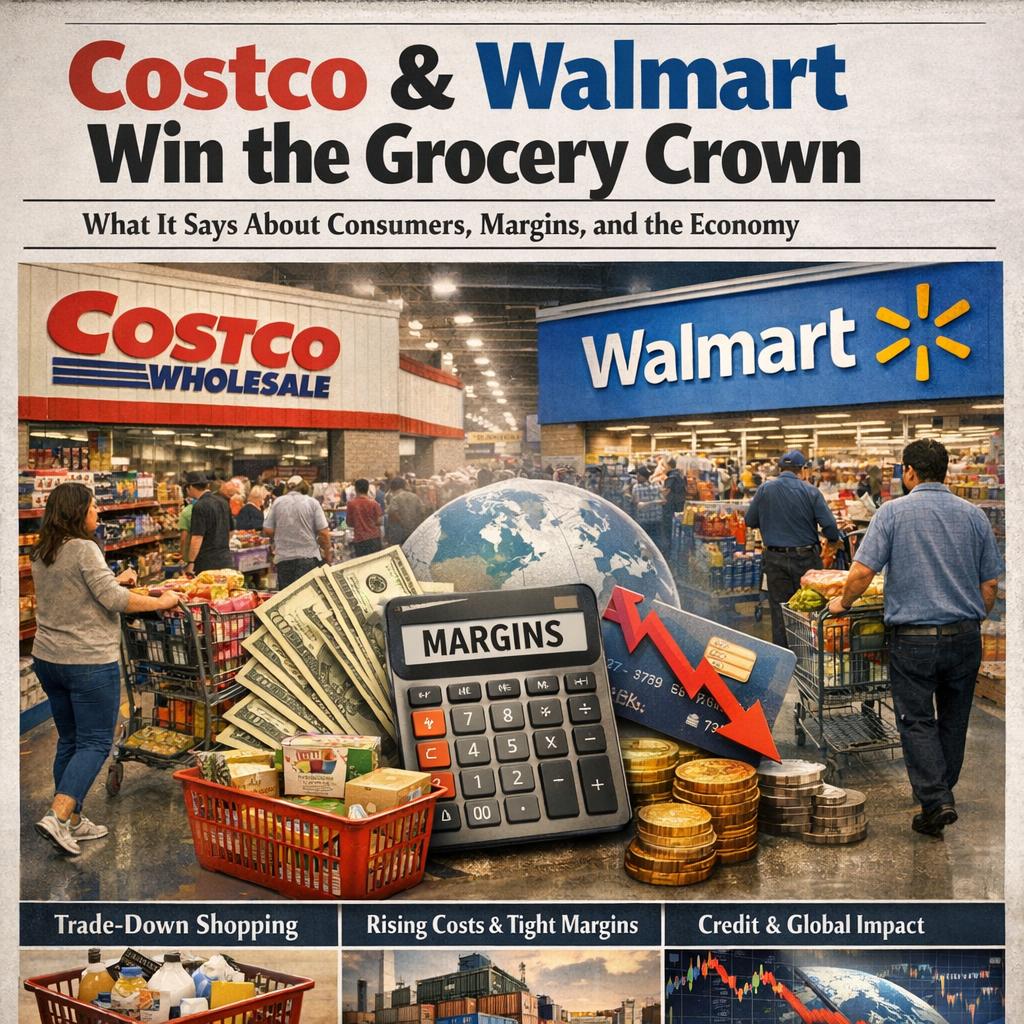
Costco and Walmart Taking the Grocery Crown Isn’t Just a Retail Story — It’s a Margin Story, a Credit Story, and a Global Signal
One of the cleaner reads on the economy right now isn’t coming from a central bank meeting or an earnings call filled with “AI” soundbites. It’s coming from something much simpler: where people are buying their food, and who’s winning the weekly household budget.
The latest data pointing to Costco and Walmart tightening their grip on grocery share matters because groceries are the most frequent “real economy” transaction most households make. You can delay a holiday. You can postpone a car. You can even stretch out a phone upgrade. But you can’t opt out of dinner. So when value-led giants keep capturing the crown, it tells investors something important about consumer behaviour, pricing power, and the competitive temperature across retail.
Here’s what I think investors globally should take from it.
1) This is a “trade-down” signal, even if headline spending looks fine
When Walmart and Costco are gaining grocery share, it often means consumers are becoming more intentional. Not necessarily collapsing, but optimising. That tends to show up as:
– more private label
– fewer premium add-ons
– tighter basket sizes
– a higher sensitivity to promotions and fuel/transport costs
In markets where consumer confidence is wobbly, the “trade-down” doesn’t always look dramatic in the top-line macro numbers. It shows up quietly in who wins share.
For investors, the implication is that “consumer resilience” might be narrower than the aggregates suggest: strong for essentials, weaker for discretionary, and increasingly concentrated in operators that can deliver low prices at scale.
2) Scale is becoming a defensive moat again
In a world of sticky input costs and wage pressure, grocery is a game of logistics, supplier leverage, and operational discipline. Costco and Walmart don’t just sell groceries; they run enormous distribution machines.
That matters because scale changes the rules:
– better terms from suppliers
– more ability to absorb or strategically pass through inflation
– faster inventory turns
– more room to invest in automation and last-mile capabilities
Globally, that’s a reminder to look for “scale winners” in other regions too. The same playbook tends to repeat: when households feel squeezed, the most efficient operators take share, and mid-tier players get stuck between rising costs and customers who refuse higher prices.
3) Watch the second-order effects: suppliers and brand pricing power
When the biggest retailers gain share, they gain negotiating power. That can compress margins upstream.
If you’re investing beyond the retailers themselves, this is where it gets interesting:
– packaged food brands may face tougher shelf placement battles
– smaller suppliers may struggle with volume requirements and payment terms
– marketing spend can rise as brands fight to defend category position
– “premiumisation” strategies get stress-tested in real time
The global angle: many consumer goods companies are international, and a shift in US grocery dynamics can ripple through earnings, guidance, and currency translation effects for multinational suppliers.
4) Membership economics and “sticky” customers are being rewarded
Costco’s model is especially revealing because it’s not only about low prices. It’s about loyalty economics. A membership fee is effectively a separate revenue stream that can stabilise profitability even when product margins are thin.
In volatile environments, investors typically pay up for business models that have:
– recurring revenue characteristics
– high customer retention
– a clear value proposition under pressure
That “membership mindset” is spreading across industries. When you see it working in retail at scale, it reinforces why markets keep rewarding recurring revenue and customer lock-in elsewhere—when it’s genuinely tied to value, not just clever packaging.
5) It’s a quiet warning for everyone else in retail and consumer-facing credit
If value giants are pulling ahead, it can mean the long tail is under strain. That includes:
– regional grocers with weaker supply chains
– convenience and specialty retailers facing margin squeeze
– restaurants and fast-food franchises competing for the same consumer wallet
– consumer credit providers exposed to “essentials inflation” stress
This is where global investors should zoom out. Household budget pressure doesn’t stay neatly inside one sector. It bleeds into delinquencies, into discretionary spending, into labour churn, and into which companies can keep raising prices without losing volume.
How I’d translate this into an investor lens (without overcomplicating it)
– Market share winners in staples can be a “defensive growth” pocket when the cycle is uneven.
– The risk is often in the middle: businesses with neither premium differentiation nor scale economics.
– Don’t just read the retailer story; read what it implies about the consumer, suppliers, and credit conditions.
If you’re tracking the consumer right now, this is one of those stories that looks mundane on the surface but is actually doing a lot of macro signalling.
If you’re watching this space too, I’d love to hear what you think is driving it most: price sensitivity, convenience, membership loyalty, or something else entirely.